Home
Class 10
BIOLOGY
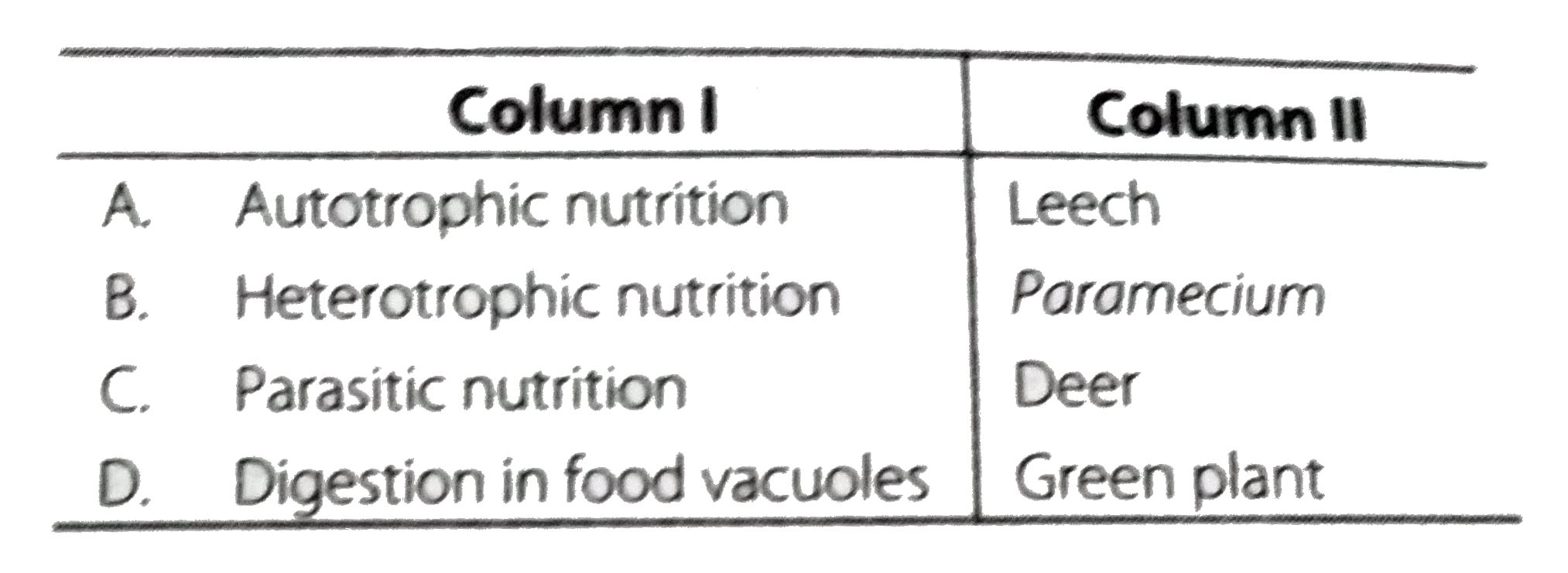
Match the following columns....

Match the following columns.

Text Solution

Verified by Experts
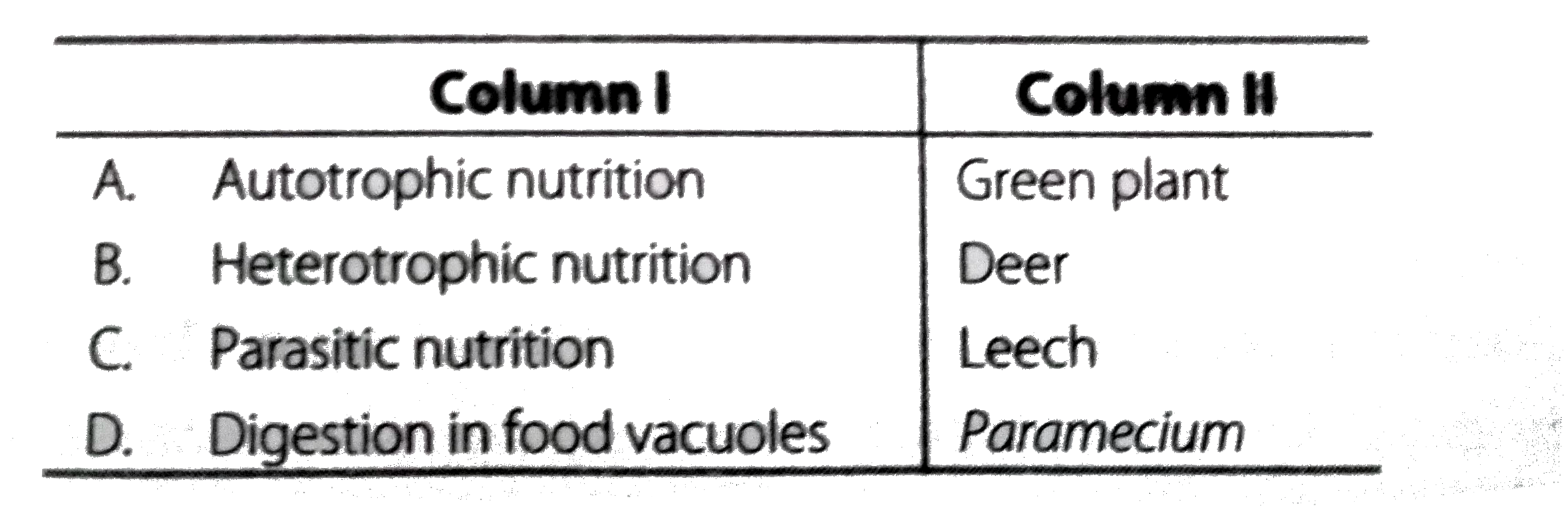
The matching of column I with Columns.

Autotrophic nutrition Plant can synthesise their own food by the process of photosynthesis, thus one called autotrophs and this type of nutrition is called autotrophic nutrition.
Heterotrophic nutrition When organism depends on other plant or animals for theri food they are called heterotrophas and nutrition is heterotrophic nutrition .Deer depends on plants for their food thus heterophic nutrition.
Parasitic nutrition When any organism derives or in dependent on other organism for their food causing less to that organism are called paratites and nutrition made is parositic nutrition . Leech depend as animals for blood as their foods causing blood loss to the animals , thus it is parasite.
Digestion in food vacuoles Paramecium digests food by the help of vacolin. Paramecium are prokaryotic cell which do not show cellular arrangment in them
Promotional Banner

Topper's Solved these Questions

  • LIFE PROCESSES

    NCERT EXEMPLAR ENGLISH|Exercise Long Answer Type Questions|11 Videos
  • LIFE PROCESSES

    NCERT EXEMPLAR ENGLISH|Exercise Long Answer Type Questions|11 Videos
  • HOW DO ORGANISMS REPRODUCE

    NCERT EXEMPLAR ENGLISH|Exercise Long Answer Type Questions|10 Videos
  • OUR ENVIRONMENT

    NCERT EXEMPLAR ENGLISH|Exercise LONG ANSWER TYPE QUESTIONS|8 Videos

Similar Questions

Explore conceptually related problems

Match the following column A with B ?

Match the following column I with column II :

Match the following column I with column-II :

Match the following column I with column II and choose the option with the accurate matches.

Match the following column and select the correct option.

Match of the following columns correctly :-

Match the following column of precipitate/mass listed in Column I with the reagent (s) listed in Column II:

Match the following column I with column II and choose the correct combination. {:(Column I,Column II),((a)"Earthworm",(i)"Gizzard"),((b)"Cockroach",(ii)"Caecum"),((c)"Frog",(iii)"Clitellum"),((d)"Rat",(iv)"Cloaca"):}

Match the following column and select the correct option. Column I " " Column II Hardwood " " Duramen Softwood " " Alburnum Heartwood " " Non-porous wood Sapwood " " Porous wood

Match the following column correctly:

NCERT EXEMPLAR ENGLISH-LIFE PROCESSES-Short Answer Type Questions
  1. What is the significance of emulsification of fats ?

    Text Solution

    |

  2. What causes movement of food inside the alimentary canal ?

    Text Solution

    |

  3. Why does absorption of digested food occur mainly in the small intesti...

    Text Solution

    |

  4. Match the following columns.

    Text Solution

    |

  5. Why is the rate of breathing in aquatic organisms much faster than in ...

    Text Solution

    |

  6. Why is the advantage of having four chambered heart ?

    Text Solution

    |

  7. What is the major events during photosynthesis.

    Text Solution

    |

  8. Mention the major events during photosynthesis.

    Text Solution

    |

  9. In each of the following situations what happens to the rate of photos...

    Text Solution

    |

  10. Name the energy currency in the living organisms .When and where is it...

    Text Solution

    |

  11. What is common for Cuscuta,ticks and leeches ?

    Text Solution

    |

  12. Explain the role of mouth in digestion of food.

    Text Solution

    |

  13. What are the functions of gastric glands present in the wall of the st...

    Text Solution

    |

  14. Match the terms in column I with those in column II . {:("Column I...

    Text Solution

    |

  15. Name the correct substrates for the following enzymes (a) Trypsin ...

    Text Solution

    |

  16. Why do veins have thin walls as compared to arteries ?

    Text Solution

    |

  17. What will happen if platelets were absent in the blood ?

    Text Solution

    |

  18. Why do animals consume more energy as compared to plants

    Text Solution

    |

  19. Why and how does water enter continuously into the root xylem ?

    Text Solution

    |

  20. Why is transpiration important for plants ?

    Text Solution

    |

