Home
Class 12
CHEMISTRY
Consider the graph given in figure . ...

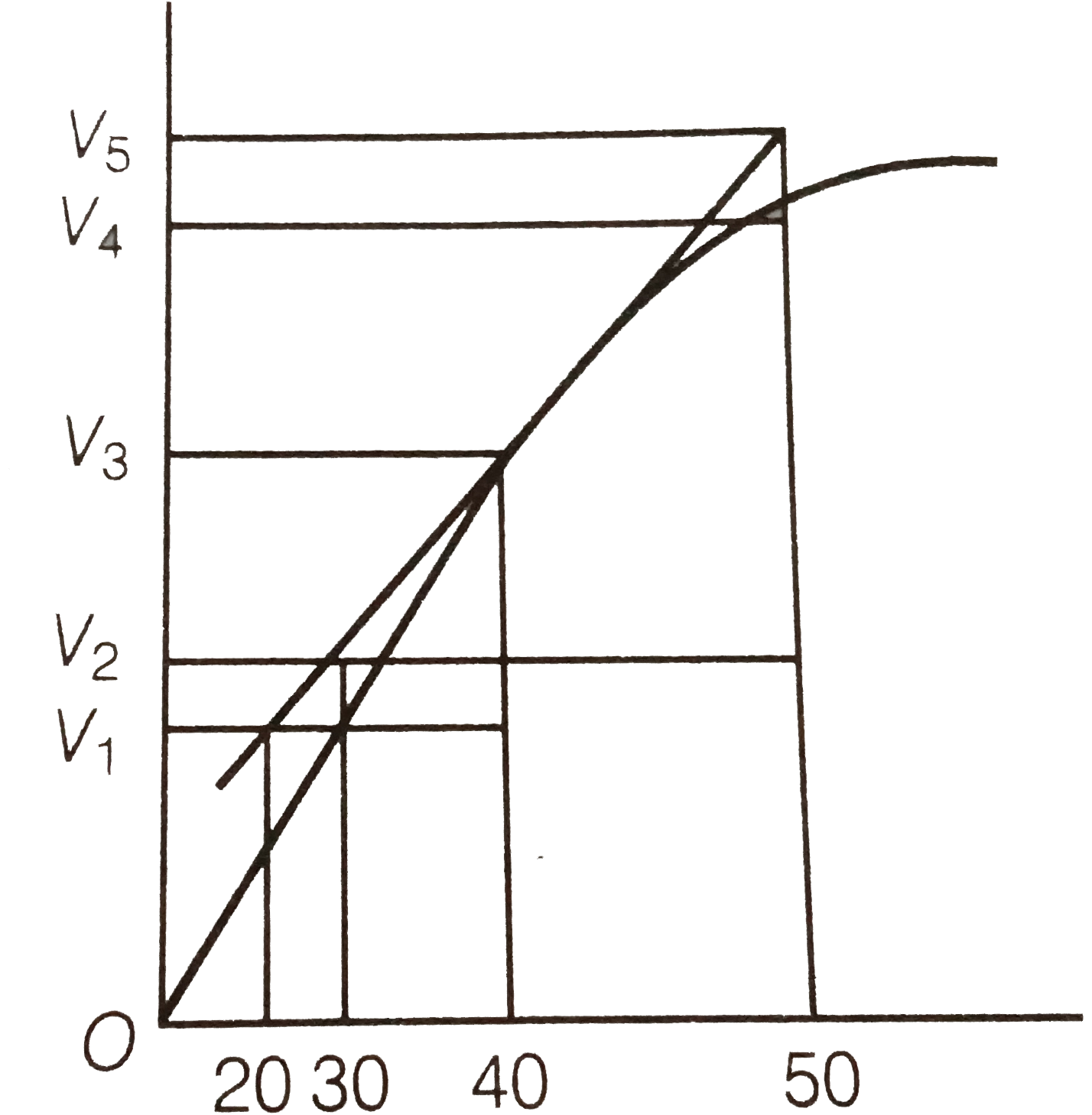
Consider the graph given in figure . Which of the following options does not show instantaneous rate of reaction at 40 ?

(a)`(V_(5)-V_(2))/(50-30)`
(b) `(V_(4)- V_(2))/(50-30)`
(c)`(V_(3)- V_(2))/(40-30)`
(d)`(V_(3)- V_(1))/(40-20)`

A

`(V_(5)-V_(2))/(50-30)`

B

`(V_(4)- V_(2))/(50-30)`

C

`(V_(3)- V_(2))/(40-30)`

D

`(V_(3)- V_(1))/(40-20)`

Text Solution

Verified by Experts

The correct Answer is:

B

Reaction occuring at smallest time interval is known as instantanueous rate of reaction e.g., instantaneous rate of reaction at 40 s is rate of reaction during a small interval of time close to 40 s. Volume change during a small time interval close of 40 s i.e.,
Instanteneous rate of reaction = `("Change in volume")/("Time interval close to 40 s")`
`(a) r_("inst")(20 s )=(V_(5)-V_(2))/(50-30)` correct
`(b) r_("inst")(20s)=(V_(4)-V_(3))/(50-30)"incorrect, correct is "(V_(5)-V_(3))/(50-30)`
(c) `r_("inst")(10s)=(V_(3)-V_(2))/(40-30)"correct"`
(d) `r_("inst")(20s)=(V_(3)-V_(1))/(40-20)"correct"`
Promotional Banner

Topper's Solved these Questions

  • CHEMICAL KINETICS

    NCERT EXEMPLAR ENGLISH|Exercise MULTIPLE CHOICE QUESTIONS|12 Videos
  • CHEMICAL KINETICS

    NCERT EXEMPLAR ENGLISH|Exercise SHORT ANSWER TYPE QUESTION|20 Videos
  • BIOMOLECULES

    NCERT EXEMPLAR ENGLISH|Exercise Long Answer Type Questions|5 Videos
  • CHEMISTRY IN EVERYDAY LIFE

    NCERT EXEMPLAR ENGLISH|Exercise Long Answer Type Qns|4 Videos

Similar Questions

Explore conceptually related problems

In the given figure, the velocity v_(3) will be

Give the magnitude and polarity of the following voltages in the circuit of figure: i. V_1 ii. V_2 iii. V_3 iv. V_(3-2) v. V_(1-2) V_(1-3)

Consider the circuit shown in the figure. Find the current in branch AO and OC . Potential of point A = 10 V of point B = 20 V and of C = 30 V.

Figure shows part of a circuit. If l = 5A and is decreasing at a constant rate of 10^(3)A//s then V_(B)-V_(A) is

A rod of length 3l rotated with an angular velocity omega as shown in figure. The unfiorm magnetic field B is into the paper. Find (a) V_(A)-V_(C) (b) V_(A) - V_(D)

Figure shows a process for a given amount of an ideal gas. If volume in state 1 is V_(1) & in state 2 is V_(2) , then

If the reading of coltmenter V_1 is 40 V, what is the reading of voltmeter V_2 ?

A car moves from X to Y with a uniform speed v_u and returns to X with a uniform speed v_d . The average speed for this round trip is : (a) (2v_(d)v_(u))/(v_(d)+v_(u)) (b) sqrt(v_(u)u_(d)) (c) (v_(d)v_(u))/(v_(d)+v_(u)) (d) (v_(u)+v_(d))/(2)

Consider the circuit shown in the figure, the cell is ideal. The readings of the ideal voltmeters V_(1) and V_(2) in volts are respectively.

If the reading of volmeter V_(1) is 30 V, what is the reading of voltmeter V_(2) ?
