Home
Class 12
CHEMISTRY
Compounds 'A' and 'B' react according ...

Compounds 'A' and 'B' react according to the following chemical equation.
`A(g) to 2B(g) to 2C(g)`
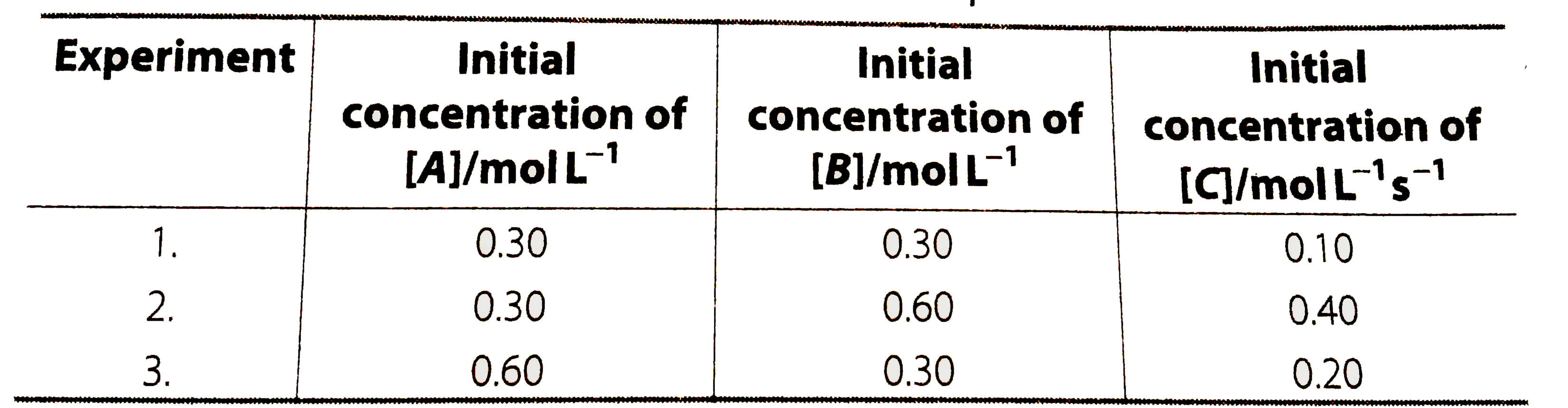
Concentration of either 'A' or 'B' were changed Keeping the concentration of one of the reactants constant and rates were measured as a function of initial concentration. Following result were obtained.
Choose the correct option for the rate equations for this reaction.

A

Rate `= K[A]^(2)[B]`

B

Rate `= K[A][B]^(2)`

C

Rate `= K[A][B]`

D

Rate `= K[A]^(2)[B]^(0)`

Text Solution

Verified by Experts

The correct Answer is:

B

Rate of reactions is change in concentration of reactant with respect to time.
`" "r=k[A]^(x)[B]^(y)`
`" "("Rate of exp. 1")/("Rate of exp.2")=([0.30]^(x)[0.30]^(y))/([0.30]^(x) [0.60]^(y)}`
`" "(0.14)/(0.40) = ([0.30]^(x))/([0.60]^(y))`
`" " (1)/(4) = [(1)/(4)]^(y)`
`" "[(1)/(2)]^(2) =[(1)/(2)]^(y)`
`" " y = 2`
`("Rate of exp.1")/("Rate of exp.3") =([0.30]^(x) [0.30]^(y))/([0.60]^(x)[0.30]^(y))`
`" "(0.10)/(0.20) = [(0.30)/(0.60)]^(x) [(0.30)/(0.30)]^(y)`
`" "(1)/(2) = [(1)/(2)]^(x) [1]^(y)`
`" "(1)/(2) =[(1)/(2)]^(x)`
i.e.,`" "x = 1`
`therefore " ""Rate " = k [A]^(x) [B]^(y)`
`" ""Rate" = k[A]^(1)[B]^(2)`
Promotional Banner

Topper's Solved these Questions

  • CHEMICAL KINETICS

    NCERT EXEMPLAR ENGLISH|Exercise MULTIPLE CHOICE QUESTIONS|12 Videos
  • CHEMICAL KINETICS

    NCERT EXEMPLAR ENGLISH|Exercise SHORT ANSWER TYPE QUESTION|20 Videos
  • BIOMOLECULES

    NCERT EXEMPLAR ENGLISH|Exercise Long Answer Type Questions|5 Videos
  • CHEMISTRY IN EVERYDAY LIFE

    NCERT EXEMPLAR ENGLISH|Exercise Long Answer Type Qns|4 Videos

Similar Questions

Explore conceptually related problems

Compound 'A' and B react according to the following chemical equation. A_((g)) + 2B_((g)) to 2C_((g)) Concentration of either A or B were changed keeping the concentrations of one of the reactants constant and rates were mesured as a function of initial concentration. Following results were obtained. Choose the correct option for the rate equations for this reaction. {:("Experiment","Initial concentration of"[A]//mol L^(-1),"Initial concentration of"[B]mol L^(-1),"Initial rate of formation of"[c]//mol L^(-1)s^(-1)),(1,0.30,0.30,0.10),(2,0.30,0.60,0.40),(3,0.60,0.30,0.20):}

For the reaction A + B rarr C + D , doubling the concentration of both the reactants increases the reaction rate by 8 times and doubling the initial concentration of only B ismply doubles the reaction rate. What is the rate law for the reaction ?

Rate law for the reaction A + 2B to C is found to be Rate =k[A][B] Concentration of reactant 'B' is doubled. Keeping the concentration of 'A' constant, the value of rate constant will be:

Rate law for the reaction, A + 2B to C is found to be Rate = k [A] [B] Concentration of reactant 'B' is doubled keeping the concentration of 'A' constant, the value of rate constant will be _______

A(g) + 3B(g) rarr 4C(g) Initially concentration of A is equal to that of B. The equilibrium concentrations of A and C are equal. Kc is :
