Home
Class 12
CHEMISTRY
Consider the reaction A to B. The conce...

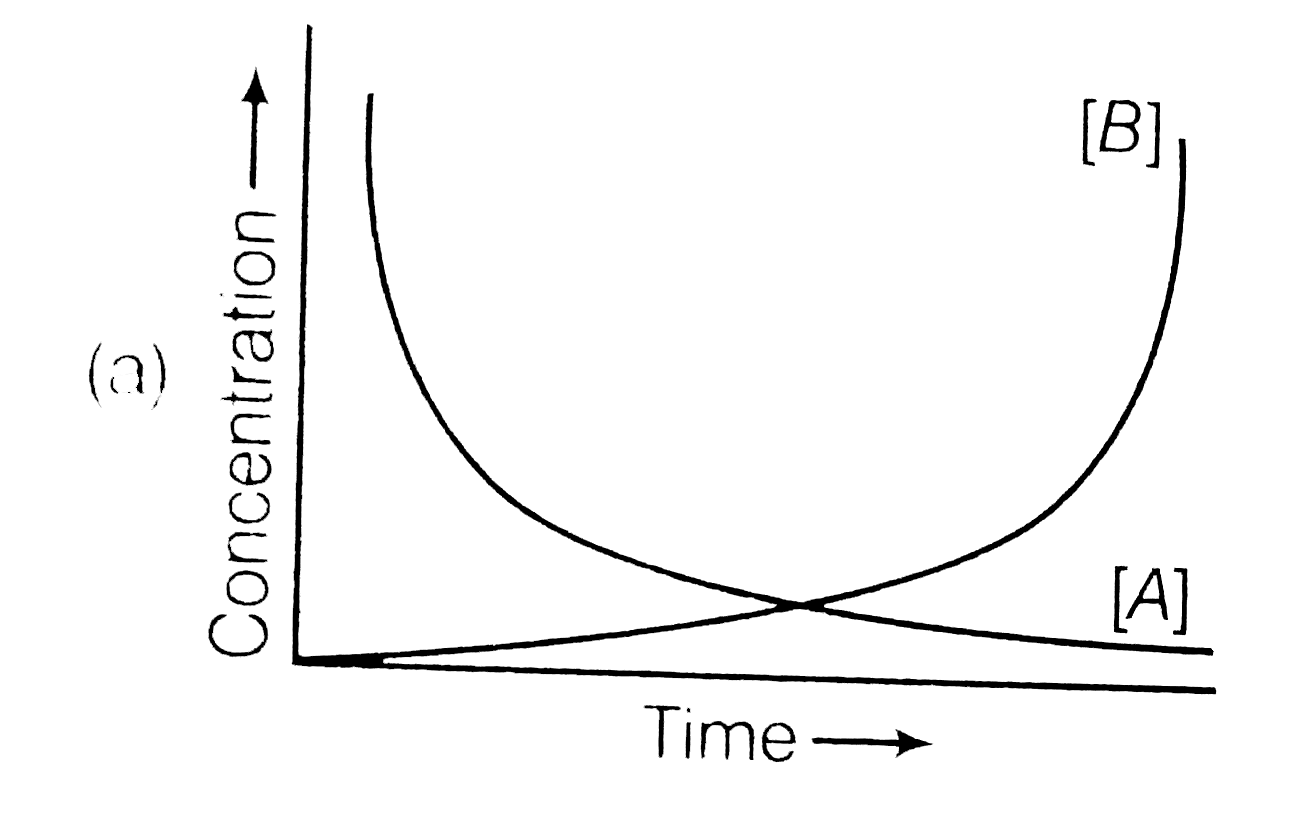
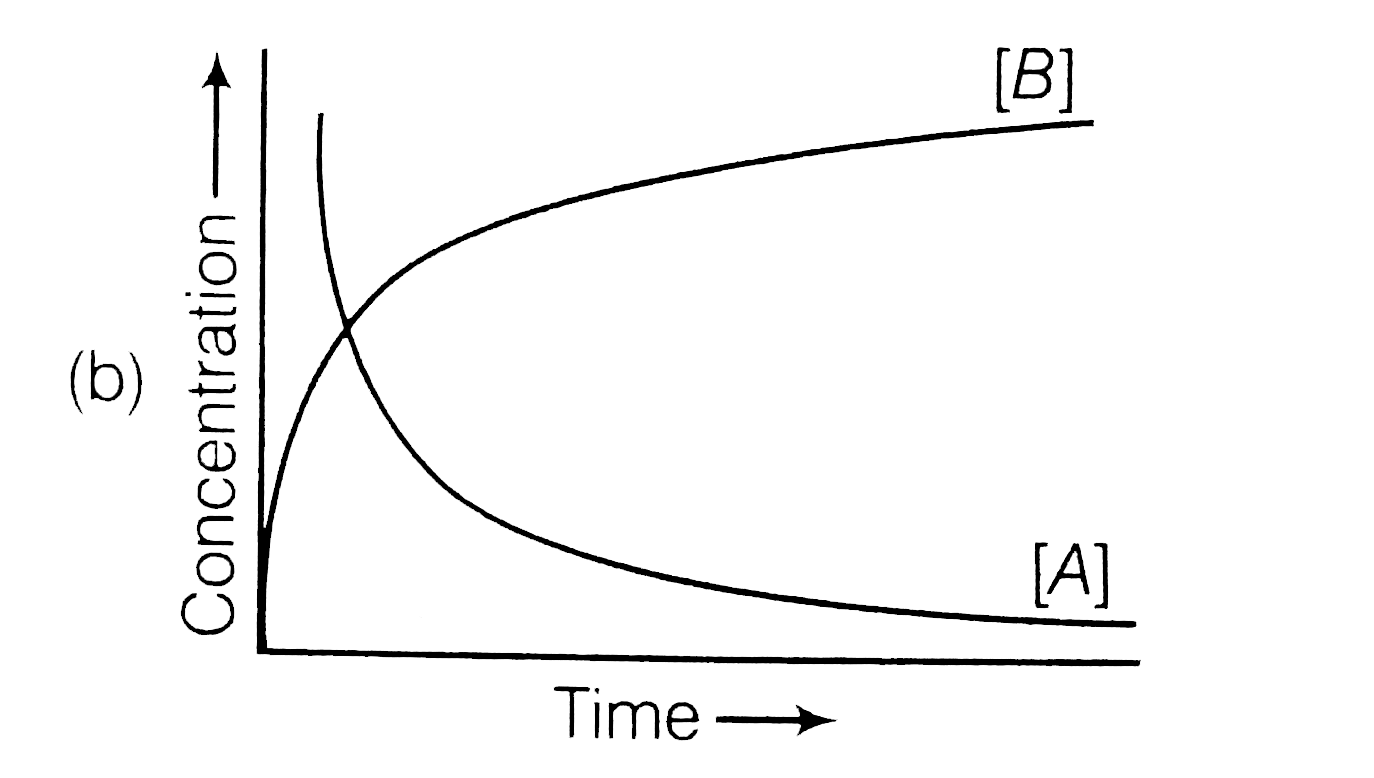
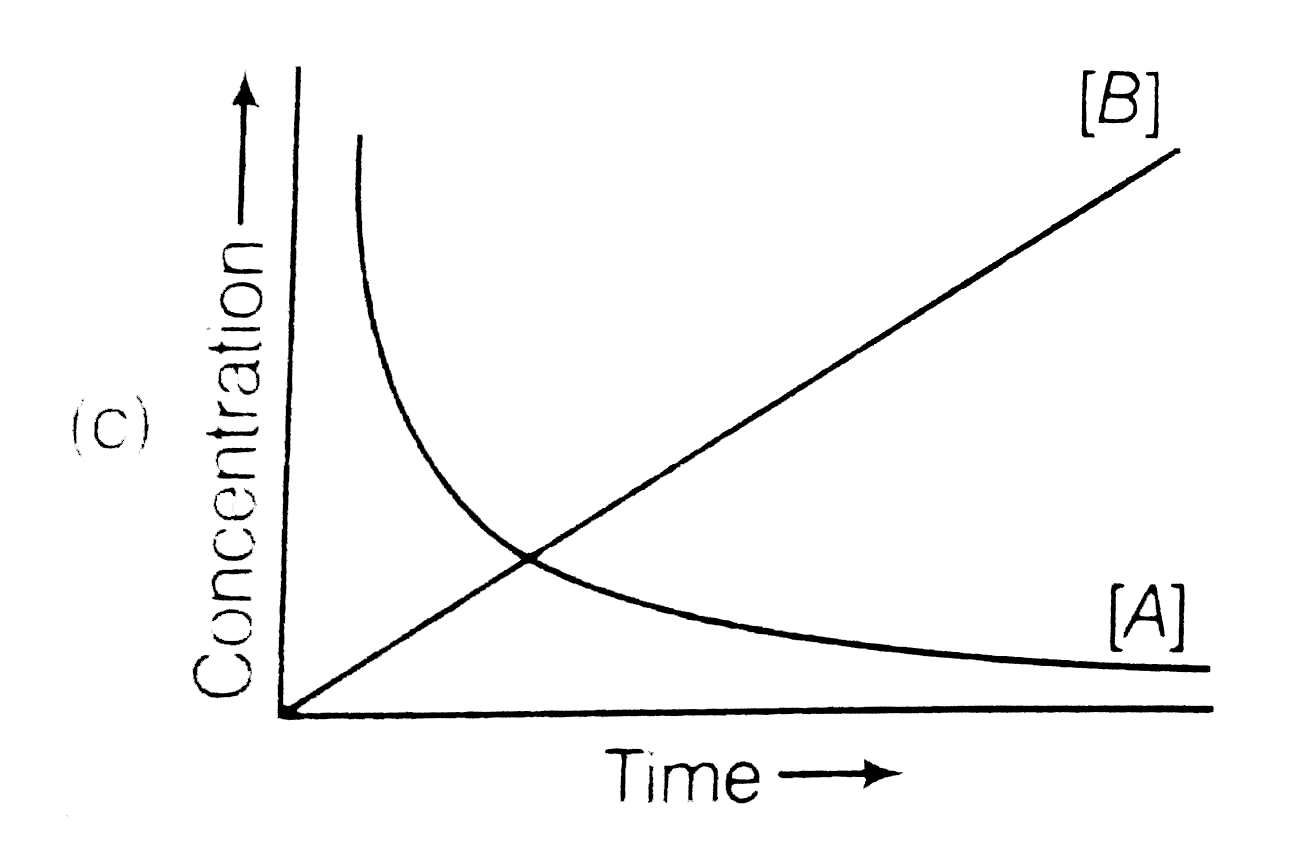
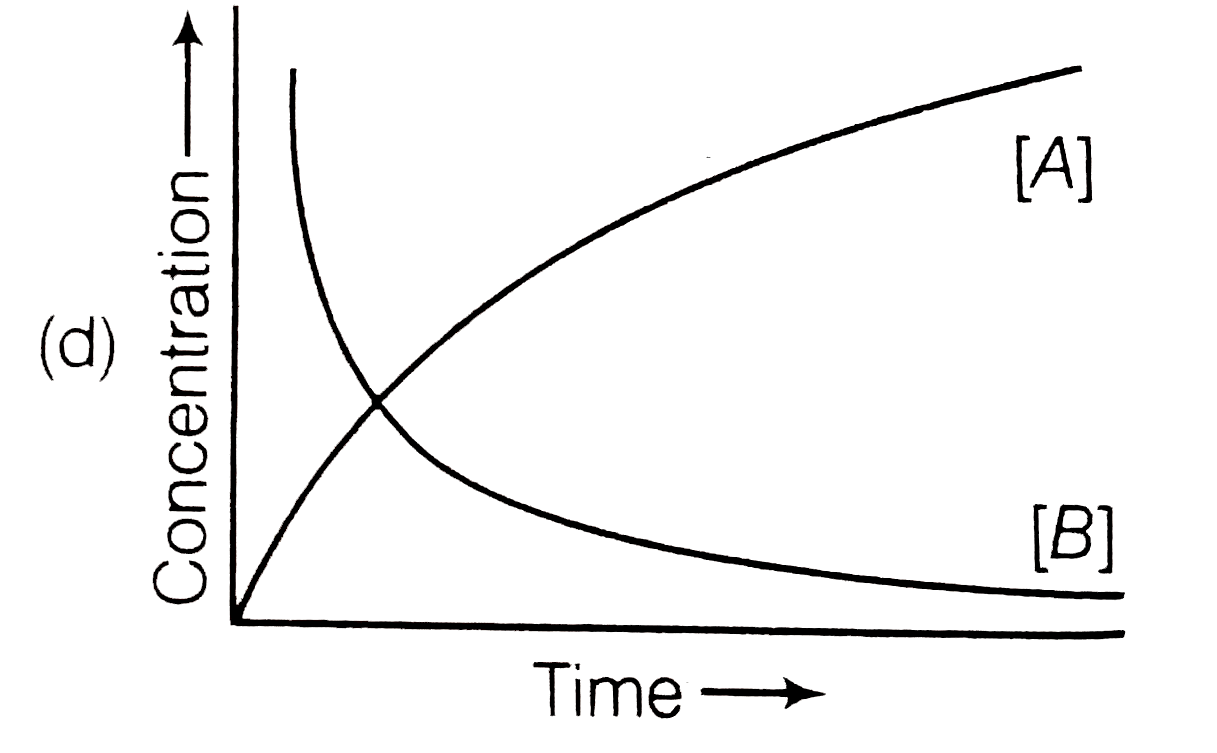
Consider the reaction `A to B`. The concentration of both the reactants and the products varies exponentially with time. Which of the following figure correctly describes the change in concentration of reactants and products with time ?

A

B

C

D

Text Solution

AI Generated Solution

The correct Answer is:

To solve the problem regarding the reaction \( A \to B \) and the exponential variation of concentrations with time, we can follow these steps: ### Step 1: Understand the Reaction The reaction involves a reactant \( A \) that transforms into a product \( B \). As the reaction proceeds, the concentration of \( A \) will decrease while the concentration of \( B \) will increase. ### Step 2: Analyze Concentration Changes Since it is stated that both concentrations vary exponentially with time, we can express this mathematically: - The concentration of \( A \) decreases exponentially with time, which can be represented as: \[ [A] = [A_0] e^{-kt} \] where \( [A_0] \) is the initial concentration of \( A \), \( k \) is the rate constant, and \( t \) is time. - The concentration of \( B \) increases exponentially with time, which can be represented as: \[ [B] = [B_0] (1 - e^{-kt}) \] where \( [B_0] \) is the final concentration of \( B \) that can be achieved as \( t \) approaches infinity. ### Step 3: Sketch the Graphs 1. **Graph for \( A \)**: The graph of \( [A] \) versus time will show an exponential decay. It starts at \( [A_0] \) and approaches zero as time increases. 2. **Graph for \( B \)**: The graph of \( [B] \) versus time will show an exponential increase. It starts at zero and approaches \( [B_0] \) as time increases. ### Step 4: Compare with Given Options Now, we need to compare the sketches of \( [A] \) and \( [B] \) with the provided options to identify which one correctly represents the exponential changes in concentration. - **Option A**: Shows \( [A] \) decreasing exponentially but \( [B] \) increasing incorrectly. - **Option B**: Correctly shows \( [A] \) decreasing exponentially and \( [B] \) increasing exponentially. - **Option C**: Shows \( [A] \) decreasing correctly but \( [B] \) increasing incorrectly. - **Option D**: Incorrectly shows both concentrations. ### Conclusion The correct figure that describes the change in concentration of reactants and products with time is **Option B**, where the concentration of \( A \) decreases exponentially and the concentration of \( B \) increases exponentially. ---

To solve the problem regarding the reaction \( A \to B \) and the exponential variation of concentrations with time, we can follow these steps: ### Step 1: Understand the Reaction The reaction involves a reactant \( A \) that transforms into a product \( B \). As the reaction proceeds, the concentration of \( A \) will decrease while the concentration of \( B \) will increase. ### Step 2: Analyze Concentration Changes Since it is stated that both concentrations vary exponentially with time, we can express this mathematically: - The concentration of \( A \) decreases exponentially with time, which can be represented as: ...
Promotional Banner

Topper's Solved these Questions

  • CHEMICAL KINETICS

    NCERT EXEMPLAR ENGLISH|Exercise MULTIPLE CHOICE QUESTIONS|12 Videos
  • CHEMICAL KINETICS

    NCERT EXEMPLAR ENGLISH|Exercise SHORT ANSWER TYPE QUESTION|20 Videos
  • BIOMOLECULES

    NCERT EXEMPLAR ENGLISH|Exercise Long Answer Type Questions|5 Videos
  • CHEMISTRY IN EVERYDAY LIFE

    NCERT EXEMPLAR ENGLISH|Exercise Long Answer Type Qns|4 Videos

Similar Questions

Explore conceptually related problems

At equilibrium ,the concentrations of all reactants and products become ………..

At chemical equilibrium , the concentration of all reactants and products are equal

An increse in the concentration of the reactants of a reaction leads to change in:

Which of the following expression is correct for first order reaction? Ao refers to initial concentration of reactant

Assertion (A) : For a first order, the concentration of a reaction decreases exponentially with time. Reason (R ): The rate of reaction at any time depends upon the concentration of the reactant at that time.

If concentration of reactant is increased by 2 times then K becomes :-
