Home
Class 11
PHYSICS
A disc of radius R is rotating wit...

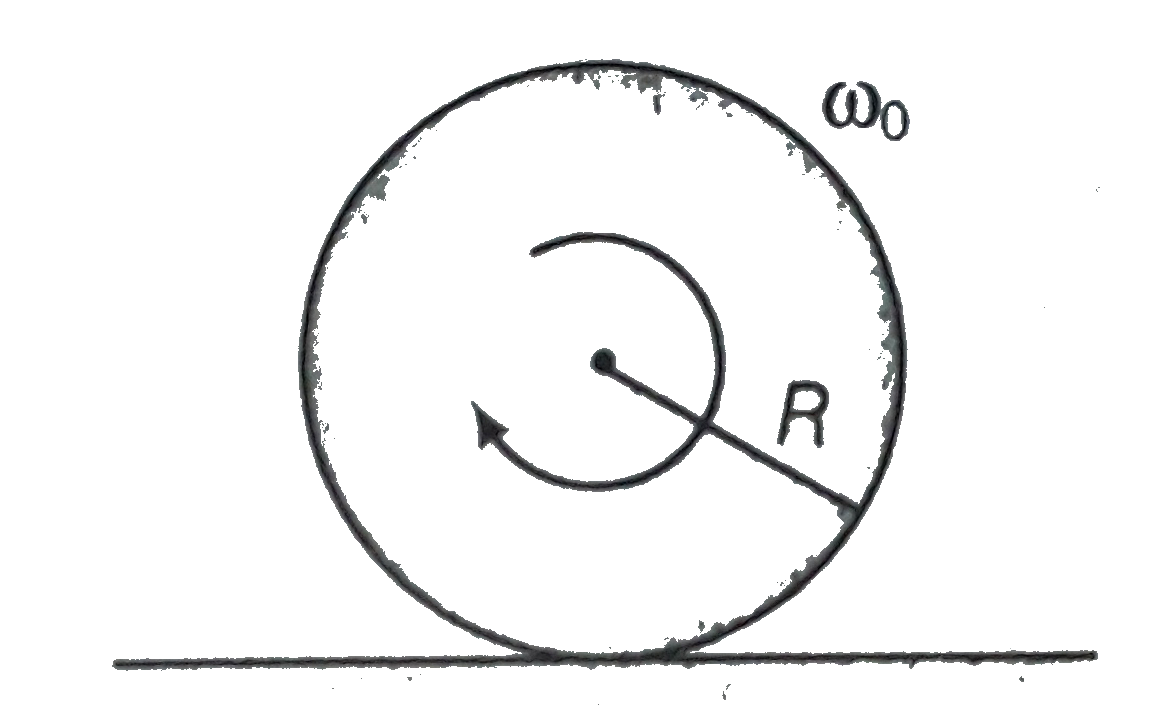
A disc of radius R is rotating with an angular `omega_(0)` about a horizontal axis it is placed on a horizontal table . The coefficient of kinetic friction is `mu _(k)`
(a) what was the velocity of its centre of mass before being brought in contact with a the table ?
(B) what happens to the linear velocity of a point on its rim when placed in contact with the table ?
(c ) what happes to the linear speed of the centre of mass when disc is placed in contact with the table ?
(d) which force is responsible for the effects in (b) and (C ) ?
(e) wht condition should be sattisfied for rolling to begin ?
(f) Calculate the time taken for the rolling to begin .

Text Solution

Verified by Experts
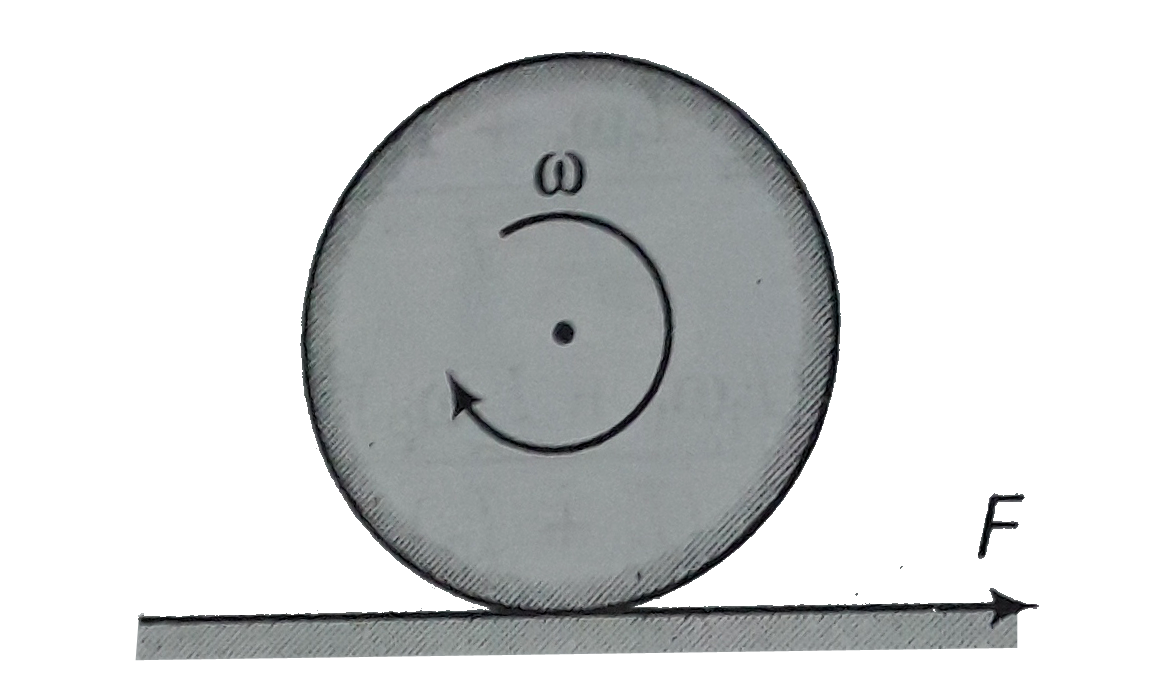
(a) Before being Brought in contact with the the was in in pure rotational motion hence ` v_(CM)=0`

(b) when the disc is placed in contact with the table due to friction velocity of a point on the rim decreases ,
(c) when the rotating disc is placed in correct with the table due to friction centre of mass acquiries some linear velocity .
friction is responsible for the effects in (b) and ( c)
(e) when rolling starts `v_(CM)-omegaR.`

where `omega` is angular speed of the disc when rolling just starts.
(f) Acceleration produced in centre of mass due to friction
`a_(CM)=(F)/(m)=(mu_(k)mg)/(m)=mu_(k)g.`

Angular retardation produced by the torque due to fricton .
`alpha=(tau)/(I)=(mu_(k)mgR)/(I) " "[:' tau=(mu_(k)N)R=mu_(k)mgR]`
`therefore v_(CM=u_(CM))+a_(CM^(t))`
` implies V_(CM)=mu_(k)"gt" ( :'U_(CM)=0)`
` and omega=omega_(0)+at`
` implies omega=omega_(0)-(mu_(k)mgR)/(I)t`
For rolling without sliping ,`(V_(CM))/(R)=omega`
`implies (V_(CM))/(R)=omega_(0)-(mu_(k)mgR)/(I)t`
`(mu_(k)g t)/(R)=omega_(0)-(mu_(k)mgR)/(I)t`
`t=(Romega_(0))/(mu_(k)g(1+(mR^(2))/(I)))`
note in this problem , frictional force help in seting pure rolloing motion .
Promotional Banner

Topper's Solved these Questions

  • SYSTEM OF PARTICLES AND ROTATIONAL MOTION

    NCERT EXEMPLAR ENGLISH|Exercise very short answer type questions|18 Videos
  • OSCILLATIONS

    NCERT EXEMPLAR ENGLISH|Exercise All Questions|36 Videos
  • THERMAL PROPERTIES OF MATTER

    NCERT EXEMPLAR ENGLISH|Exercise Very short Answer type Questions|15 Videos

Similar Questions

Explore conceptually related problems

A ring of radius R is rotating with an angular speed omega_0 about a horizontal axis. It is placed on a rough horizontal table. The coefficient of kinetic friction is mu_k . The time after it starts rolling is.

A hoop of radius r mass m rotating with an angular velocity omega_(0) is placed on a rough horizontal surface. The initial velocity of the centre of the hoop is zero. What will be the velocity of the centre of the hoop when it cases to slip ?

A ring of radius R is first rotated with an angular velocity omega and then carefully placed on a rough horizontal surface. The coefficient of friction between the surface and the ring is mu . Time after which its angular speed is reduced to half is

A disc of mass m and radius R rotating with angular speed omega_(0) is placed on a rough surface (co-officient of friction =mu ). Then

A disc of mass M and Radius R is rolling with an angular speed omega on the horizontal plane. The magnitude of angular momentum of the disc about origin is:

A disc of radius R is spun to an angualr speed omega_(0) about its axis and then imparted a horizontal velocity of magnitude (omega_(0)R)/(4) . The coefficient of friction is mu . The sense of rotation and direction of linear velocity are shown in the figure. The disc will return to its initial position.

A disc is given an initial angular velocity omega_(0) and placed on a rough horizontal surface as shown Fig. The quantities which will not depend on the coefficient of friction is/are

A disc of mass 3 kg and radius 0.5 m is placed on a horizontal frictionless table. With the help of a cue we gives a horizontal impulse of 15 Ns to the disc at topmost point then velocity of centre of mass will be

A gramophone record is revolving with an angular velocity omega . A coin is placed at a distance R from the centre of the record. The static coefficient of friction is mu . The coin will revolve with the record if

A uniform cylinder of radius R is spinned about it axis to the angular velocity omega_(0) and then placed into a corner,. The coeficient of friction between the corner walls and the cylinder is mu_(k) How many turns will the cylinder accomplish before it stops?