Home
Class 11
PHYSICS
two cylindrical hollow drums of radii R...

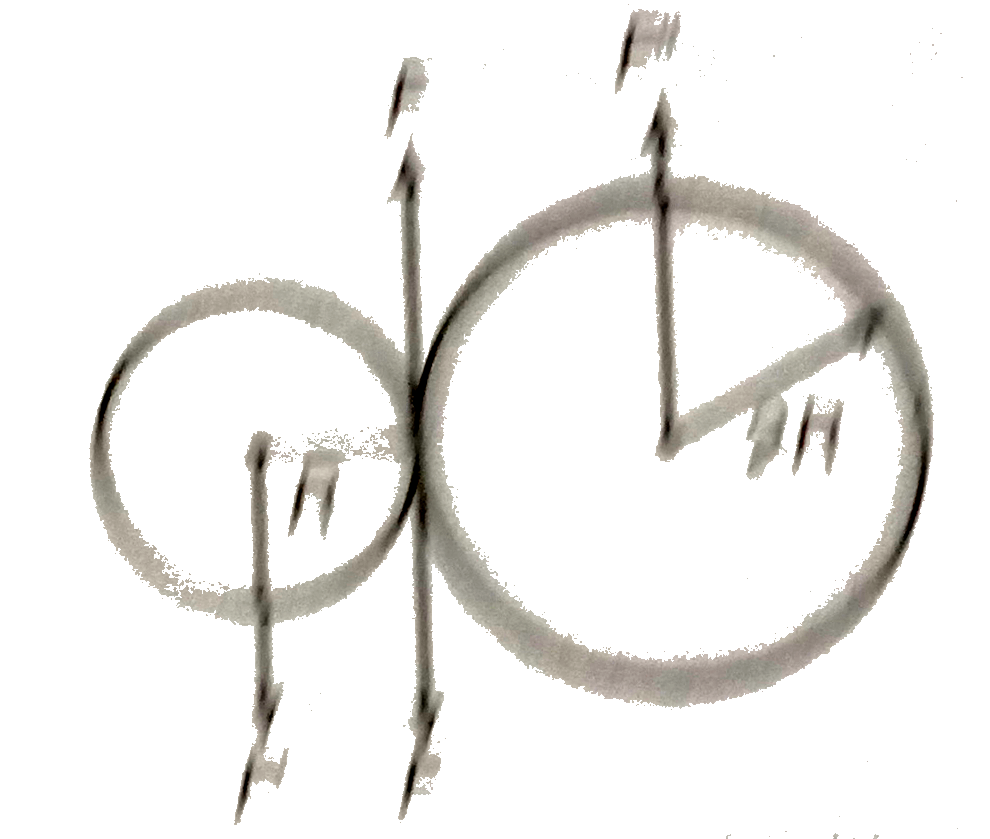
two cylindrical hollow drums of radii R and 2 R, and of a common height h , are rotating with angular velocities `omega` (anti- clockwise ) and `omega` (clockwise ) , respectively , their axes , fixed are parallel and in a horizontal plane separated by by 3R + `delta` , they are now brought in contact `(delta to0)`
(A) show frictional forces just after contact .
(B) identify forces and torque external to the system just after contact ,
(c) what would be the ratio of final of final angular velocities when friction ceases ?

Text Solution

Verified by Experts
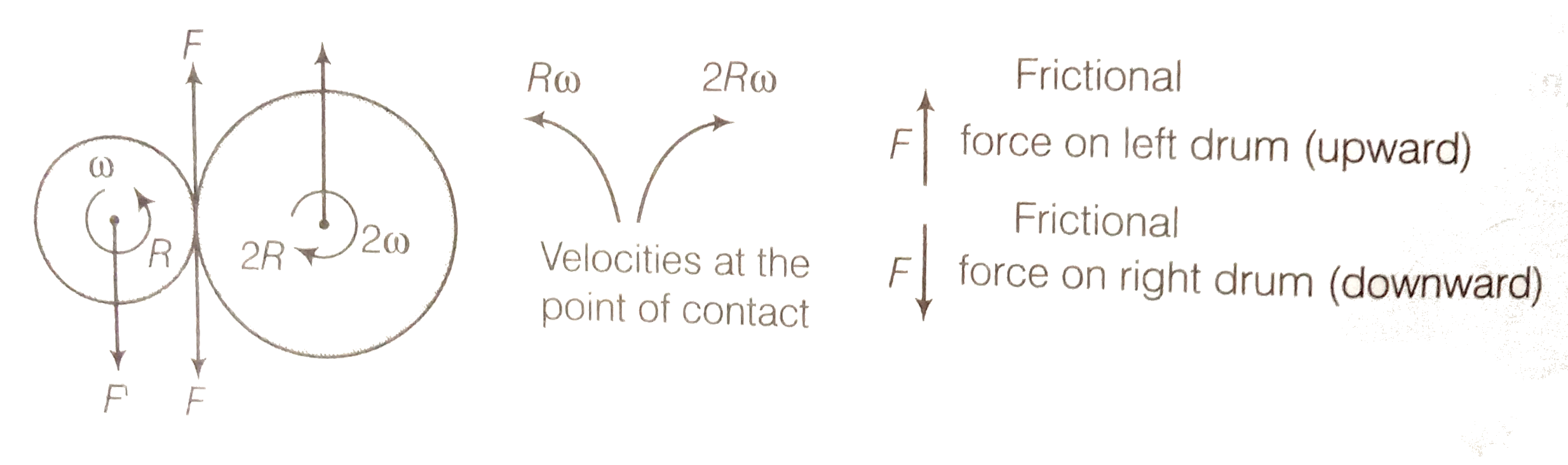
Consider the situation shown below we have shown the frictional forces .

(b) `F'= F=F` where F and F are external forces through support
`implies F_("net")=0 ("one each cylinder")`
External torque `=Fxx3R` (anti- clockwise )

( c) Let `omega _(1)` and `omega_(2)` be final angular velocites of samaller and bigger drum respectively (anti - clokwise and clockwise Respectivelty)
Hence , `Romega_(2)implies(omega_(1))/(omega_(2))=2`
Note :- We should be very careful while indicating direction of frictional forces.
Promotional Banner

Topper's Solved these Questions

  • SYSTEM OF PARTICLES AND ROTATIONAL MOTION

    NCERT EXEMPLAR ENGLISH|Exercise very short answer type questions|18 Videos
  • OSCILLATIONS

    NCERT EXEMPLAR ENGLISH|Exercise All Questions|36 Videos
  • THERMAL PROPERTIES OF MATTER

    NCERT EXEMPLAR ENGLISH|Exercise Very short Answer type Questions|15 Videos

Similar Questions

Explore conceptually related problems

Two cylindrical hollow drums of radii R and 2R , and of a commom height h, are rotating with angular velocities omega (anti-clockwise) and omega (clockwise), respectively. Their axes, fixed are parallel and in a horizontal plane separated by (3R + delta) . They are now brought in contact (delta rarr 0) . (a) Show the frictional forces just after contact. (b) Identify forces and torque external to the system just after contact. (c ) What would be the ratio of final angular velocities when friction ceases ?

A conducting ring of radius r having charge q is rotating with angular velocity omega about its axes. Find the magnetic field at the centre of the ring.

A conducting ring of radius r having charge q is rotating with angular velocity omega about its axes. Find the magnetic field at the centre of the ring.

A ring of radius 'r' and mass per unit length 'm' rotates with an angular velocity 'omega' in free space then tension will be :

Two discs A and B are in contact and rotating with angular velocity with angular velocities omega_(1) and omega_(2) respectively as shown. If there is no slipping between the discs, then

A solid sphere of radius r and mass m rotates about an axis passing through its centre with angular velocity omega . Its K.E . Is

Find velocity of piston A in the given situation if angular velocity of wheel of radius R is omega (constant) in the clockwise sense (O is fixed point)

A ring of mass m and radius R is given a charge q. It is then rotated about its axis with angular velocity omega .Find (iii)Magnetic moment of ring.

If the axes are rotated through an angle of 30^@ in the anti clockwise direction, then coordinates of point (4,-2sqrt3) with respect to new axes are

A disc is rotating with angular velocity omega . A force F acts at a point whose position vector with respect to the axis of rotation is r. The power associated with torque due to the force is given by