Home
Class 12
PHYSICS
Refer to the arrangement of charges in F...

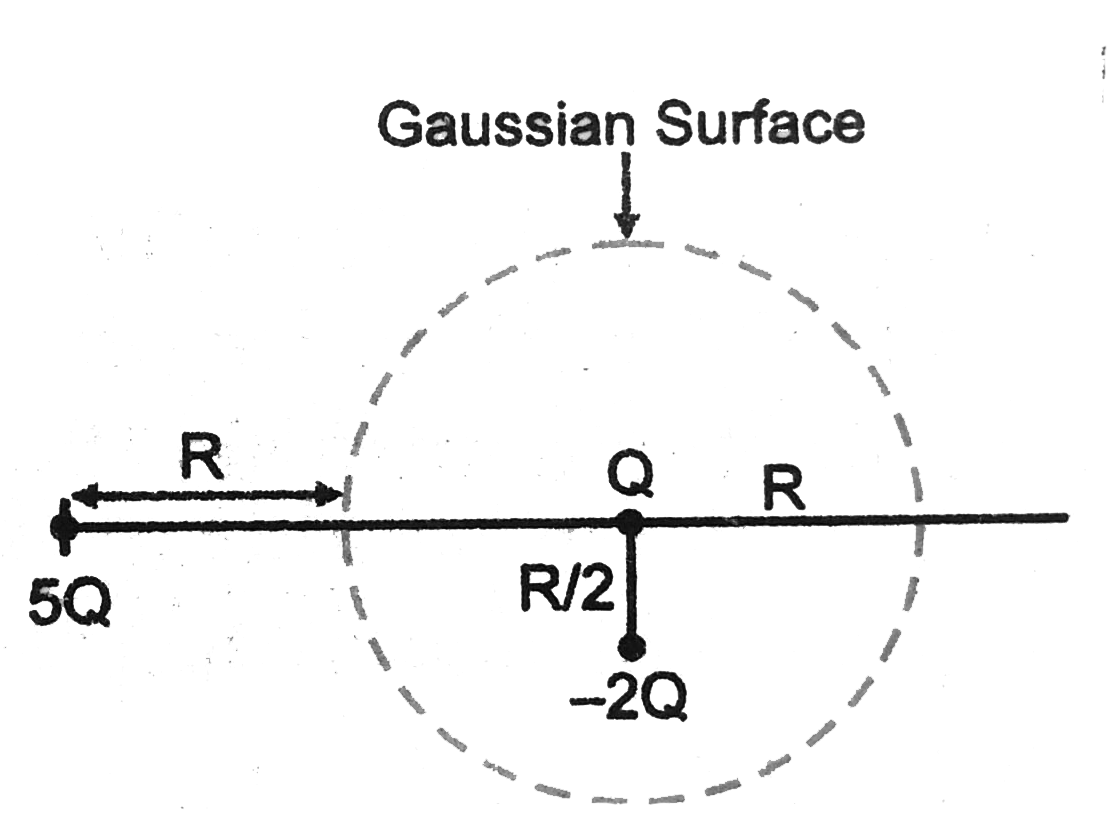
Refer to the arrangement of charges in Fig and a Gaussian surface of radius `R` with `Q` at the centre. Then

A

total flux through the surface of the sphere is `(-Q)/(epsi_(0))`

B

field on the surface of the sphere is `(-Q)/(4piepsi_(0)R^(2))`

C

flux through the surface of sphere due to 5Q is zero

D

field on the surface of sphere due to -2Q is same everywhere

Text Solution

Verified by Experts

The correct Answer is:

A, C

Gauss' law states that total flux of an enclosed surface is given by `(q)/(epsi_(0))` where q is the charge enclosed by the surface. Thus, from figures,
Total charge inside the surface is `=Q-2Q=-Q`
`therefore` Total flux through the surface of the sphere`=(-Q)/(epsi_(0))`
Now, considering charge 5Q. Charge 5Q lies outside the surcae, thus it makes no contribution to electric flux through the given surface.
Promotional Banner

Topper's Solved these Questions

  • ELECTRIC CHARGES AND FIELD

    NCERT EXEMPLAR ENGLISH|Exercise Very short Type Question|6 Videos
  • ELECTRIC CHARGES AND FIELD

    NCERT EXEMPLAR ENGLISH|Exercise Short Answer Type question|6 Videos
  • ELECTRIC CHARGES AND FIELD

    NCERT EXEMPLAR ENGLISH|Exercise Long Answer Type Question|6 Videos
  • DUAL NATURE OF RADIATION AND MATTER

    NCERT EXEMPLAR ENGLISH|Exercise LONG ANSWER TYPE QUESTION|5 Videos
  • ELECTROMAGNETIC INDUCTION

    NCERT EXEMPLAR ENGLISH|Exercise Long|11 Videos

Similar Questions

Explore conceptually related problems

The work done in carrying a charge q once round a circle of radius r with a charge Q at the centre is

An infinite, uniformly charged sheet with surface charge density sigma cuts through a spherical Gaussian surface of radius R at a distance X from its center, as shown in the figure. The electric flux Phi through the Gaussian surface is .

A solid insulating sphere of radius a carries a net positive charge 3Q , uniformly distributed throughout its volume. Concentric with this sphere is a conducting spherical shell with inner radius b and outer radius c and having a net charge -Q, as shown in figure a. Consider a spherical Gaussian surface of radius rgtc, the net charge enclosed by this surface is ............. b. The direction of the electric field rgtc is ............. c. The electric field at rgtc is ............... . d. The electric field in the region with radius r, which cgtrgtb, is ............... e. Consider a spherical Gaussian surface of radius r, where cgtrgtb , the net charge enclosed by this surface is ................ . f. Consider a spherical Gaussian surface of radius r, where bgtrgta , the net charge enclosed by this surface is ................. . g. The electric field in the region bgtrgta is ................ . h. Consider a spherical Gaussian surface of radius rlta . Find an expression for the net charge Q(r) enclosed by this surface as a function of r. Note that the charge inside the surface is less than 3Q. i. The electric field in the region rlta is ................. . j. The charge on the inner surface of the conducting shell is .......... . k. The charge on the outer surface of the conducting shell is .............. . l. Make a plot of the magnitude of the electric field versus r.

q_(1),q_(2),q_(3) and q_(4) are point charges located at point as shown in the figure and s is a spherical Gaussian surface of radius R . Which of the following is true according to the Gauss's law

A positive charge .Q. is fixed at a point, A negatively charged of mass .m. and charge .q. is revolving in a circular path of radius radius r_(1) with .Q. as the centre. The change in potential energy to change the radius of the circular path from r_(1) and r_(2) in joule is

Assertion:- In a given situation of arrangement of charges, an extra charge is placed outside the Gaussion surface. In the Gauss Theroem ointvecEdvecs=(Q_(in))/(epsilon_(0))Q_(in) remains unchanged whereas electric field vecE at the site of the element is changed. Reason:- Electric field vecE at any point on the Gaussian surface is due to inside charge only.

Find the fluz f the electric field through a spherical surface of radius R due to a charge of 10^(-7) C at the centre and another equal charge at a point 2R away from the centre (figure ).

A charge Q is enclosed by a Gaussian spherical surface of radius R . If the radius is doubled, then the outward electric flux will

A conducting sphere of radius R_(2) has a spherical cavity of radius R_(1) which is non concentric with the sphere. A point charge q_(1) is placed at a distance r from the centre of the cavity. For this arrangement, answer the following questions. If q_(1) is shifted to the centre of the cavity, then: (choose the correct alternative)

A point charge q'q is placed at distance 'a' from the centre of an uncharged thin spherical conducting shell of radius R=2a. A point 'P' is located at a distance 4a from the centre of the conducting shell as shown. The electric potential due to induced charge on the inner surface of the conducting shell at point 'P' is
