Home
Class 12
PHYSICS
A parallel plate capacitor is made of tw...

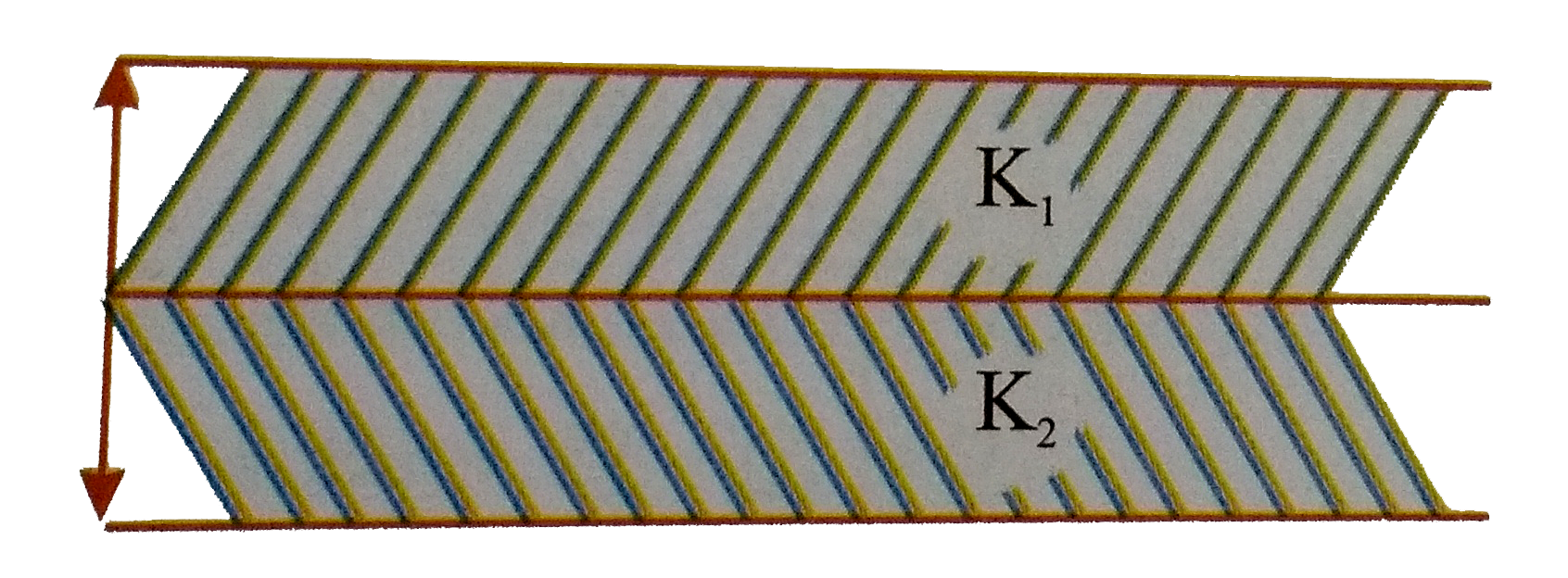
A parallel plate capacitor is made of two dielectric blocks in series. One of the blocks has thickness `d_(1)` and dielectric constant `K_(1)` and the other has thickness `d_(2)` and dielectric constant `K_(2)` as shown in figure. This arrangement can be through as a dielectric slab of thickness `d (= d_(1) + d_(2))` and effective dielectric constant `K`. The `K` is.
.

A

`(K_(1)d_(1)+K_(2)d_(2))/(d_(1)+d_(2))`

B

`(K_(1)d_(1)+K_(2)d_(2))/(K_(1)+K_(2))`

C

`(K_(1)+K_(2)(d_(1)+d_(2)))/((K_(1)d_(1)+K_(2)d_(2)))`

D

`(2K_(1)+K_(2))/(K_(1)+K_(2))`.

Text Solution

Verified by Experts

The correct Answer is:

C

The capacitance of parallel plate capacitor filled with dielectriic block has thickness `d_(1)` and dielectric constant `K_(2)` is given by
`C_(1)=(K_(1)epsi_(0)A)/(d_(1))`
Similarly, capacitance of parallel plate capacitor filled with dielectric lbock has thickness `d_(2)` and dielectric constant `K_(2)` is given by
`C_(2)=(K_(2)epsi_(0)A)/(d_(2))`
Since, the two capacitors are in series combination, the equivalent capacitance is given by
`(1)/(C)=(1)/(C_(1))+(1)/(C_(2))`
or
`C=(C_(1)C_(2))/(C_(1)+C_(2))=((K_(1)epsi_(0)A)/(d_(1))(K_(2)epsi_(0)A)/(d_(2)))/((K_(1)epsi_(0)A)/(d_(1))+(K_(2)epsi_(0)A)/(d_(2)))=(K_(1)K_(2)epsi_(0)A)/(K_(1)d_(2)+K_(2)d_(1))` . . .(i)
But the equivalent capacitances is given by
`C=(Kepsi_(0)A)/(d_(1)+d_(2))`
On comparing we have
`K=(K_(1)K_(2)(d_(1)+d_(2)))/(K_(1)d_(2)+K_(2)d_(1))`.
Promotional Banner

Topper's Solved these Questions

  • ELECTROSTATIC POTENTIAL AND CAPACITANCE

    NCERT EXEMPLAR ENGLISH|Exercise MCQ s (More than one Options)|7 Videos
  • ELECTROSTATIC POTENTIAL AND CAPACITANCE

    NCERT EXEMPLAR ENGLISH|Exercise Very short type question|5 Videos
  • ELECTROMAGNETIC WAVES

    NCERT EXEMPLAR ENGLISH|Exercise LONG ANSWER|5 Videos
  • MAGNETISM AND MATTER

    NCERT EXEMPLAR ENGLISH|Exercise All Questions|24 Videos

Similar Questions

Explore conceptually related problems

Between the plates of a parallel plate condenser, a plate of thickness t_(1) and dielectric constant k_(1) is placed. In the rest of the space, there is another plate of thickness t_(2) and dielectric constant k_(2) . The potential difference across the condenser will be

Between the plates of a parallel plate condenser, a plate of thickness t_(1) and dielectric constant k_(1) is placed. In the rest of the space, there is another plate of thickness t_(2) and dielectric constant k_(2) . The potential difference across the condenser will be

A parallel plate capacitor with square plates is filed with four dielectrics of dielectric constants K_(1),K_(2),K_(3),K_(4), arranged as shown in the figure. The effective dielectric constant K will be :

A parallel plate capacitor of plate area A and separation d is filled with two materials each of thickness d/2 and dielectric constants in_1 and in_2 respectively. The equivalent capacitance will be

A parallel plate capacitor with air as the dielectric has capacitance C. A slab of dielectric constant K and having the same thickness as the separation between plates is introduced so as to fill one-fourth of the capacitor as shown in the figure. The new capacitance will be :

A parallel plate capacitor has plate area A and plate separation d. The space betwwen the plates is filled up to a thickness x (ltd) with a dielectric constant K. Calculate the capacitance of the system.

Find the capacitance between A and B if two dielectric alabs (each of area A ) of dielectric constants K_(1) and K_(2) and thicknesses d_(1) and d_(2) are inserted between the plates of a parallel plate capacitor of plate area A . .

Find the capacitance between A and B if two dielectric slabs (each of thickness d) of dielectric constants K_(1) and K_(2) and areas K_(1) and K_(2) and inserted between the plates of a parallel plate capacitor of plate area A . .

A parallel plate air capacitor has capacitance C. Half of space between the plates is filled with dielectric of dielectric constant K as shown in figure . The new capacitance is C . Then

A battery charges a parallel plate capacitor of thickness (d) so that an energy [U_(0)] is stored in the system. A slab of dielectric constant (K) and thickness (d) is then introduced between the plates of the capacitor. The new energy of the system is given by
