Home
Class 12
PHYSICS
Calculate potential on the axis of a rin...

Calculate potential on the axis of a ring due to charge Q uniformly distributed along the ring of radius R.

Text Solution

Verified by Experts
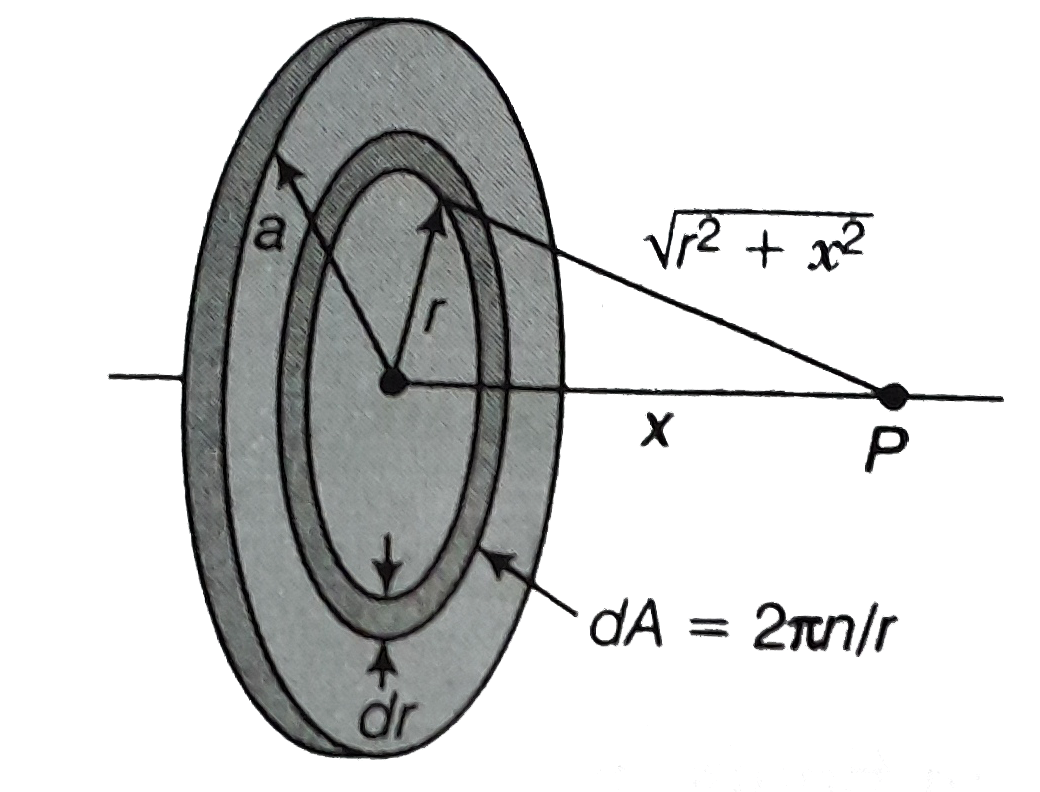
Let the point P lies at a distance x from the centre of the disk and take the plane of the disk to be perpendicular to the x-axis. Let the disc is divided into a number of charged rings as shown in figure.

The electric potential of each ring, of radius r and width dr, have charge dq is given by
`sigmadA=sigma2pirdr`
and potential is given by
`dV=(d_(e)dq)/(sqrt(r^(2)+x^(2)))=(k_(e)sigma2pirdr)/(sqrt(r^(2)+x^(2)))`
where `k_(e)=(1)/(4piepsi_(0))` the total electric potential at P, is given by
`V=pik_(e)sigmaint_(0)^(a)(2r" "dr)/(sqrt(r^(2)+x^(2)))=pik_(e)sigmaint_(0)^(a)(r^(2)+x^(2))^(-1//2)3r" "dr`
`V=2pik_(e)sigma[(x^(2)+a^(2))^(1//2)-x]`
So, we have by substring `k_(e)=(1)/(4piepsi_(0))`
`V=(1)/(4piepsi_(0))(2Q)/(a^(2))[sqrt(x^(2)+a^(2))-x]`.
Promotional Banner

Topper's Solved these Questions

  • ELECTROSTATIC POTENTIAL AND CAPACITANCE

    NCERT EXEMPLAR ENGLISH|Exercise Short Answer Type Question|5 Videos
  • ELECTROMAGNETIC WAVES

    NCERT EXEMPLAR ENGLISH|Exercise LONG ANSWER|5 Videos
  • MAGNETISM AND MATTER

    NCERT EXEMPLAR ENGLISH|Exercise All Questions|24 Videos

Similar Questions

Explore conceptually related problems

A short electric dipole is placed at a distance x from centre O on the axis of a ring of radius R and charge Q is uniformly distributed over tis. The net force acting on the dipole will be

Calculate electric field due to a charge uniformly distributed in a spherical volume

A thin glass rod is bent into a semicircle of radius r. A charge +Q is uniformly distributed along the upper half, and a charge -Q is uniformly distributed along the lower half, as shown in fig. The electric field E at P, the center of the semicircle, is

In a free space, a thin rod carrying uniformly distributed negative charge -q is placed symmetrically along the axis of a tin ring of radius R varrying uniformly dostributed charge Q. The mass of the rod is m and length is l=2R . The ring is fixed and the rod is free to move. The rod is displaced slightly along the axis of the ring and then released. Find the period T to the small amplitude oscillations of the rod.

A ring of radius R is placed in the plane its centre at origin and its axis along the x-asis and having uniformly distributed positive charge. A ring of radius r(ltltR) and coaxial with the larger ring is moving along the axis with constant velcity , then the variation of electrical flux (phi) passing through the smaller ring with position will be best represent by :

Two concentric rings, one of radius R and total charge +Q and second of radius 2R and total charge -sqrt(8)Q , lie in x-y plane (i.e., z=0 plane). The common centre of rings lies at origin and the common axis coincides with z -axis. The charge is uniformly distributed on both rings. At what distance from origin is the net electric field on z -axis zero?

STATEMENT 1: When a negative charge -q is released at a distance R from the centre and along the axis of a uniformly and positvely charged fixed ring of radius R, the negative charge does oscillation but not SHM. STATEMENT 2: The force on negative charge is always towards the centre of the ring but it is not proportional to the displacement from the centre of the ring.

Electric charge Q is uniformly distributed around a thin ring of radius a. find the potential a point P on the axis of the ring at a distance x from the centre of the ring .

Both the ring and the conducting sphere are given the same charge Q . Determine the potential of the sphere. Assume that the centre of the sphere lies on the axis of th ring. Is it necessary that the charge on the ring be uniformly distributed to answer the above question ?

A charge is distributed uniformly over a ring of radius 'a'. Obtain an expression for the electric intensity E at a point on the axis of the ring . Hence show that for points at large distances from the ring it behaves like a point charge .

