Home
Class 12
CHEMISTRY
Give reasons for the following : (i) T...

Give reasons for the following :
(i) Though nitrogen exhibits + 5 oxidation state, it does not fonn pentahalide. (ii) Electron gain enthalpy with negative sign of fluorine is less than that of chlorine. (iii) The two oxygen-oxygen bond lengths in ozone molecule are identical.

Text Solution

Verified by Experts
(i) Nitrogen does not have vacant d-orbitals in its valence shell. Therefore, it cannot extend its valency beyond 3.
(ii) Most of the highest oxidation state metal halides are fluorides eg. `Pb F_(5), VF_(5), BiF_(6)` Corresponding chlorides are either unstable or unknown. This shows stronger oxidising power of `F_(2).`
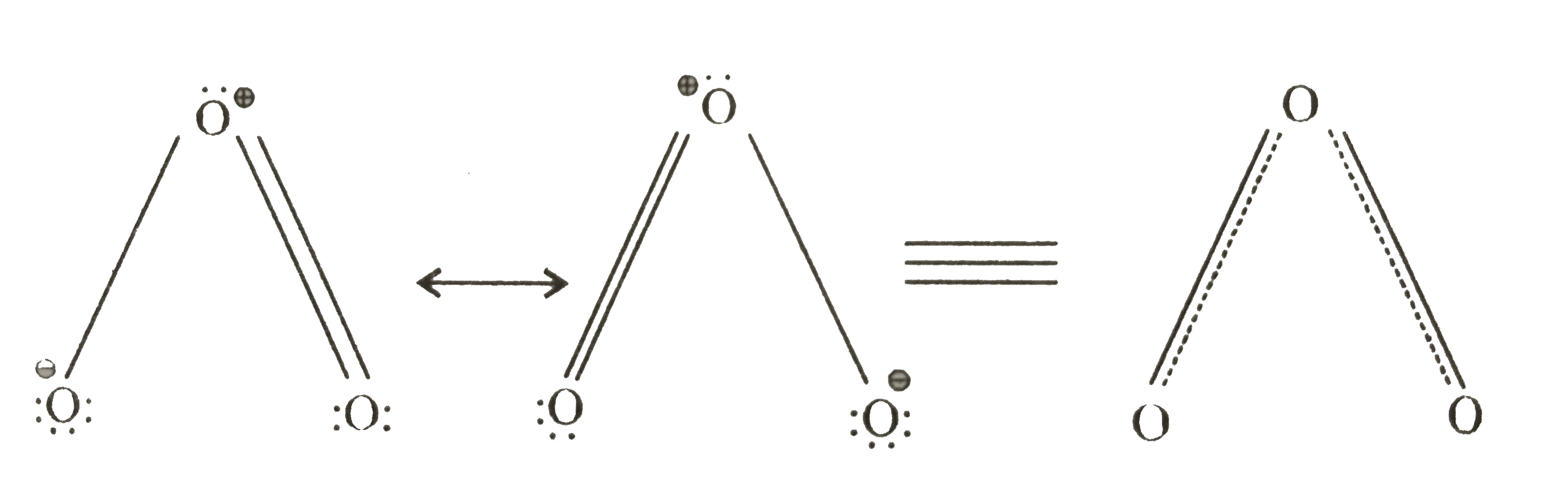
(iii) The structure of ozone molecule is angular as in the given figure. The O - O - O bond angle is `116.8^(@)` and O - O bond length is 127.8 pm

The bond length in ozone molecule is intermediate between single and double bond in oxygen atom. Ozone molecule thus, is considered to be a resonance hybrid of these figure
Promotional Banner

Topper's Solved these Questions

  • XII BOARDS

    XII BOARD PREVIOUS YEAR PAPER ENGLISH|Exercise CHEMISTRY (THEORY)|31 Videos
  • XII BOARDS

    XII BOARD PREVIOUS YEAR PAPER ENGLISH|Exercise C.B.S.E CLASS XII|37 Videos
  • XII BOARDS

    XII BOARD PREVIOUS YEAR PAPER ENGLISH|Exercise SET-II|32 Videos
  • SAMPLE PAPER 2019

    XII BOARD PREVIOUS YEAR PAPER ENGLISH|Exercise SECTION: D|1 Videos

Similar Questions

Explore conceptually related problems

Though nitrogen exhibits +5 oxidation state, it does not form pentahalide. Give reason.

(a) Though nitrogen exhibits +5 oxidation state, it does not form pentahalide. Give reason. (b) PH_3 has lower boiling point than NH_3 . Why ?

(a) Though nitrogen exhibits +5 oxidation state, it does not form pentahalide. Give reason. (b) PH_3 has lower boiling point than NH_3 . Why ?

O_(3) molecule is a resonance hybrid of the two structures I and II . The two oxygen - oxygen bond lengths in ozone molecule are

Give reasons for the following : Fluorine has lower electron gain enthalpy than chlorine.

(A) Explain why- (i) Though nitrogen exhibit +5 oxidation state, it does not form pentahalides. (ii) Interhalogen compounds are more reactive than their constituent elements. (iii) The boiling of HF is very high ? (B) Draw the structure of the molecule and state its geometry.

Assertion : The electron gain enthalpy of chlorine is less negative than that of fluorine. Reason : The fluorine atom is much smaller in size than that of chlorine.

Give reasons : (i) SO_(2) is reducing while TeO_(2) is an oxidizing agent. (ii) Nitrogen does not form pentahalide. (iii) ICl is more reactive than I_(2) .

(a) Draw the structures of the following : (i) XeF_(4) (ii) H_(2)S_(2)O_(7) (iii) SO_(3)^(2-) (b) Explain the following observations : (i) Phosphorous has a greater tendency for catenation than nitrogen. (ii) The negative value of electron gain enthalpy is less for fluorine than that for chlorine. (iii) Hydrogen fluoride has a much higher boiling point than hydrogen chloride.

Account for the following : (i) PCl_(5) is more covalent than PCl_(3) . (ii) Iron on reaction with HCl forms FeCl_(2) and not FeCl_(3) . (iii) The two O-O bond lengths in the ozone molecule are equal.

XII BOARD PREVIOUS YEAR PAPER ENGLISH-XII BOARDS-SET-III
  1. Name the principal ore of aluminium. Explain the significance of leach...

    Text Solution

    |

  2. Define the following terms with an example in each case: (i) Macromo...

    Text Solution

    |

  3. Give reasons for the following : (i) Though nitrogen exhibits + 5 ox...

    Text Solution

    |

  4. Write the main products of the following reactions:

    Text Solution

    |

  5. , Out of which is an example of a benzylic halide?

    Text Solution

    |

  6. Write the formula of the compound of iodine which is obtained when con...

    Text Solution

    |

  7. What type of colloid is formed when a gas is dispersed in a liquid? Gi...

    Text Solution

    |

  8. Write the IUPAC name of the following compound: CH(3)-O-underset(CH(...

    Text Solution

    |

  9. Draw the structure of the following: (a) XeF(4) (b) BrF(5)

    Text Solution

    |

  10. Write the name of the cell which is generally used in transistors. Wri...

    Text Solution

    |

  11. Using IUPAC norms write the formulae for the following: (a) Potassiu...

    Text Solution

    |

  12. (a) What type of isomerism is shown by the complex [Co(NH(3))(5)(SCN)]...

    Text Solution

    |

  13. (a) Based on the nature of intermolecular forces, classify the followi...

    Text Solution

    |

  14. (a) Write the principle of electrolytic refining. (b) Why does coppe...

    Text Solution

    |

  15. Define the following: (a) Cationic detergents (b) Broad spectrum a...

    Text Solution

    |

  16. Write the structures of the monomers used for getting the following po...

    Text Solution

    |

  17. What is meant by reverse osmosis?.

    Text Solution

    |

  18. What type of ores can be concentrated by magnetic separation method ...

    Text Solution

    |

  19. Describle the principal controlling each of the following processe...

    Text Solution

    |

  20. Explain giving reason: (i) Treansition metals and their compounds g...

    Text Solution

    |

