Home
Class 12
CHEMISTRY
(i) What type of isomerism is shown by t...

(i) What type of isomerism is shown by the complex `[Co(NH_(3))_(6)] [Cr(CN)_(6))]` ?
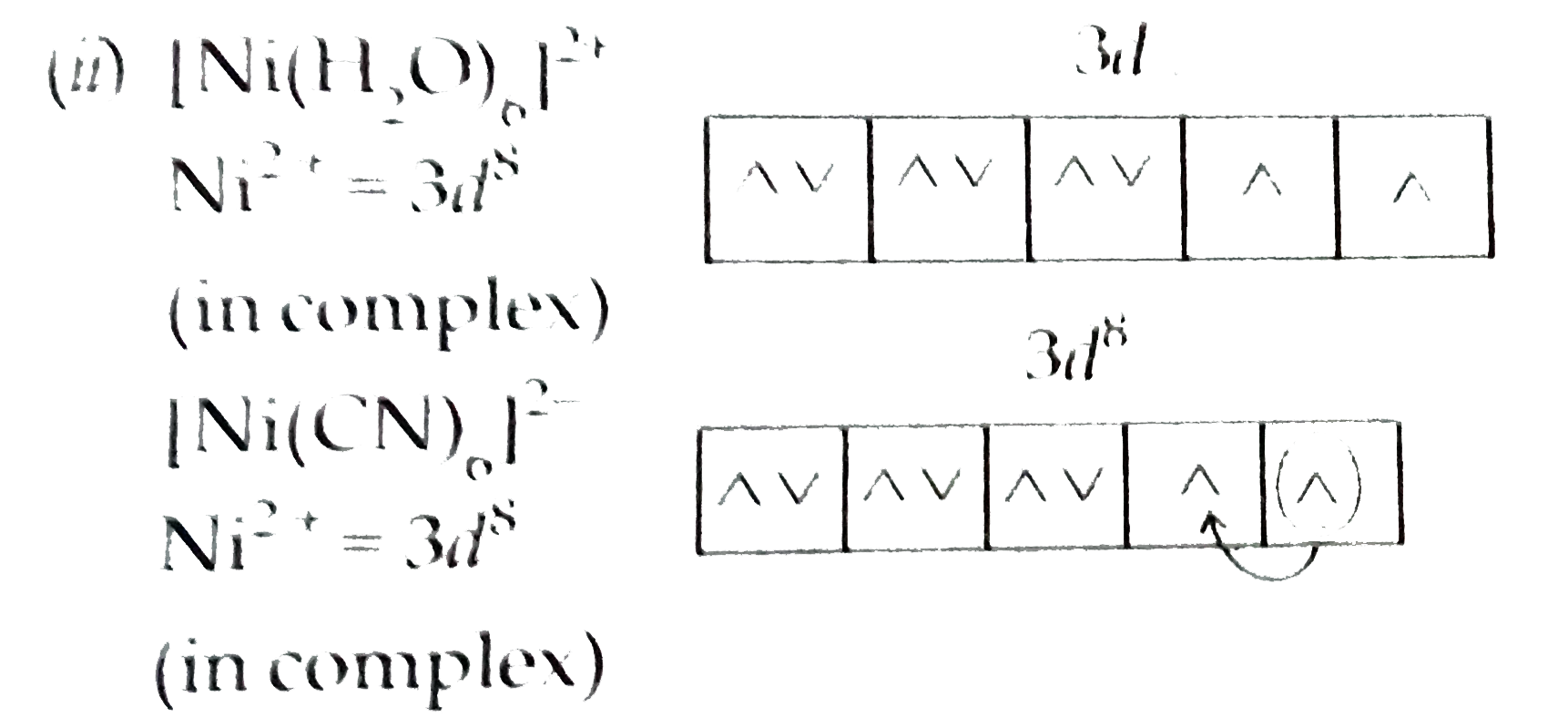
(ii) Why a solution of `[Ni(H_(2)O)_(6)^(2+)` is given while a solution of `[No(CN)_(4)]^(2-)` colourless ? (At. No. of Ni = 28)
(iii) Write the IUPAC name of the following complex : `[Co(NH_(3))_(5) (CO_(3))] Cl`

Text Solution

Verified by Experts
(i) Coordination isomerism is shown by the complex
`[Co(NH_(3))_(6) [Cr(CN)_(6)] and [Cr (NH_(3))_(6)] [Co(CN)_(6)]`
(ii)
In case of `[Ni(H_(2)O)_(6)]^(2+), 2` unpaired electrons are present wherease in `[Ni(CN)_(6)]^(2-)`, there is no free electrons because of the presence of strong field ligand. Hence, `[Ni(H_(2)O)_(6)]^(2+)` solution is green in colour, while a solution of `[Ni(CN)_(4)]` is colourless because of the absence of unpaired electrons. The unpaired electrons in `[Ni(H_(2)O)_(6)]^(2+)` absorb energy and get excited to high energy level and come back to lower energy level an impart colour
(iii) `[Co(NH_(3))_(5) (CO)_(3)] Cl`- Pentaamminecarbonatocobalt (iii) chloride
Promotional Banner

Topper's Solved these Questions

  • XII BOARDS

    XII BOARD PREVIOUS YEAR PAPER ENGLISH|Exercise Set II|10 Videos
  • XII BOARDS

    XII BOARD PREVIOUS YEAR PAPER ENGLISH|Exercise Set III|21 Videos
  • XII BOARDS

    XII BOARD PREVIOUS YEAR PAPER ENGLISH|Exercise OUTSIDE DELHI (SET-I)|35 Videos
  • SAMPLE PAPER 2019

    XII BOARD PREVIOUS YEAR PAPER ENGLISH|Exercise SECTION: D|1 Videos

Similar Questions

Explore conceptually related problems

Write IUPAC name of the following complex : [Co(NH_(3))_(6)]^(3+)

A solution of [Ni(H_(2)O)_(6)]^(2+) is green but a solution of [Ni(CN)_(4)]^(2-) is colourless Explain.

How many type of isomerism is exhibited by the complex [Co(NH_(3))_(4)(NO_(2))_(2)]Cl ?

Write the IUPAC name for the following compounds (a) [Co(NH_(3))_(5)ONO]Cl_(2) (b) K_(3)[Cr(CN)_(6)] .

Assertion A solution of [Ni(H_(2)O)_(6)]^(2+) is green but a solution of [Ni(CN)_(4)]^(2+) is colourless Reason [Ni(CN)_(4)]^(2+) is square planar complex .

Give the IUPAC names for the following : (i) Na_(3)[AIF_(6)] (ii) [Co(NH_(3))_(6)]Cl_(3)

(a) What type of isomerism is shown by the complex [Co(NH_(3))_(5)(SCN)]^(2+) ? (b) why is [NiCl_(4)]^(2-) paramagnetic while [Ni(CN)_(4)]^(2-) is diamagnetic ? (Atomic number of Ni=28) (c) Why are low spin tetrahedral complexes rarely observed?

(a) What type of isomerism is shown by the complex [Co(NH_(3))_(5)(SCN)]^(2+) ? (b) why is [NiCl_(4)]^(2-) paramagnetic while [Ni(CN)_(4)]^(2-) is diamagnetic ? (Atomic number of Ni=28) (c) Why are low spin tetrahedral complexes rarely observed?

Which of the following isomerism is/are not shown by the complex [Co(Cl_(2)(OH)_(2)(NH_(3))_(2)]Br?

(i) What type of isomerism is shown by complex [Co(en)_(3)]Cl_(3) ? (ii) Write the hybridisation and magnetic character of [Co(C_(2)O_(4))_(3)]^(3-) . (At.no. of Co = 27) (iii) Write IUPAC name of the following Complex [Cr(NH_(3))_(3) Cl_(3)]

XII BOARD PREVIOUS YEAR PAPER ENGLISH-XII BOARDS-Set I
  1. A 10% solution (by mass) of sucrose in water has freezing point of 26...

    Text Solution

    |

  2. (a) Calculate the mass of Ag deposited at cathode when a current of 2 ...

    Text Solution

    |

  3. (i) What type of isomerism is shown by the complex [Co(NH(3))(6)] [Cr(...

    Text Solution

    |

  4. Write one difference in each of the following: (i) Lyophobic sol and...

    Text Solution

    |

  5. Following data are obtained for the reaction: N(2)O(5) rarr 2NO(2) +...

    Text Solution

    |

  6. Following compounds are given to you : 2-Bromopentane, 2-Bromo-2-met...

    Text Solution

    |

  7. (a) Write the principle of method used for the refining of germanium ...

    Text Solution

    |

  8. Write structures of compounds A,B and C in each of the following react...

    Text Solution

    |

  9. Do the following conversions in not more than two steps: (i) Benzoic...

    Text Solution

    |

  10. Write the structure of the monomers used for getting the following pol...

    Text Solution

    |

  11. Define the following : (i) Anionic detergents (ii) Broad spectrum ...

    Text Solution

    |

  12. Given reasion: (i) Thermal stability decreases from H(2)O " to " H(2...

    Text Solution

    |

  13. Give reasons for the following (a) Acetylation of aniline reduces it...

    Text Solution

    |

  14. After watching a programme on TV about the presence of carcinogens (ca...

    Text Solution

    |

  15. (a) Account for the following : (i) Transition metals form large num...

    Text Solution

    |

  16. (a) (i) How is the variability in oxidation states of transition metal...

    Text Solution

    |

  17. (a) An element has atomic mass 93 g mol^(1) and density 11.5 g cm^(-3)...

    Text Solution

    |

  18. (a) Calculate the number of unit cells in 8.1g of aluminium if it crys...

    Text Solution

    |

  19. Given simple chemical tests to distinguish between the following pairs...

    Text Solution

    |

  20. Write the formula of reagents used in the following reactions: (i) B...

    Text Solution

    |

