Home
Class 12
CHEMISTRY
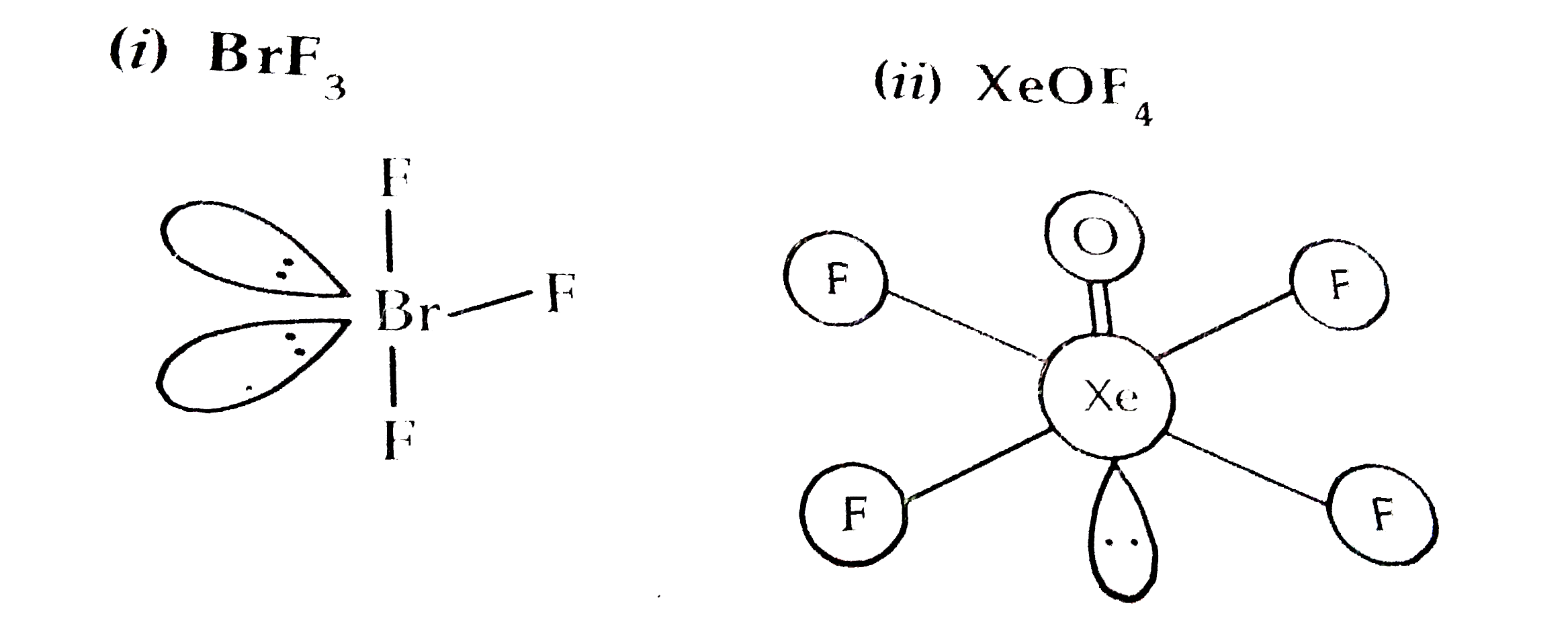
Draw the structure of : {:((i)BrF(3),(ii...

Draw the structure of : `{:((i)BrF_(3),(ii)XeOF_(4)):}`
(b) Explain giving reason in each case :
(i) Why `H_(2)` Te is more acidic than `H_(2)S`?
(ii) Why are halogens strong oxidising agents ?
(iii) Why does nitrogen show catenation tendentcy less than phosphorus ?

Text Solution

Verified by Experts

(i) As the size of element increase down the group bond length increases and hence, bond dissociation energy decreases. Hence H-S bond dissociation energy is higher than that of H- Te bond dissociation energy and hence H- S bond breakes less easily than H- Te bond. Hence `H_(2)` Te is strong acid than `H_(2)S.`
(ii) See Q. 25, (or) (b) (i) Delhi Board (Comptt.) 2016.
(iii) N-N single bond is weaker than P - P single bond because Nitrogen has smaller size, due to that lone pair of electrons on two N-atom repel the bond of N-N bond and hence, it makes N-N single ond weakeer than P-P bond in which the lone pair of electrons fo not replel the bond pair electrons because bigger size of phosphorus. Consequently, Nitrogen shows the little tendency for catenation than phosphorous.
Promotional Banner

Topper's Solved these Questions

  • XII BOARDS

    XII BOARD PREVIOUS YEAR PAPER ENGLISH|Exercise [SET-II]|10 Videos
  • XII BOARDS

    XII BOARD PREVIOUS YEAR PAPER ENGLISH|Exercise [SET-III]|10 Videos
  • XII BOARDS

    XII BOARD PREVIOUS YEAR PAPER ENGLISH|Exercise Delhi Board : Set - III|7 Videos
  • SAMPLE PAPER 2019

    XII BOARD PREVIOUS YEAR PAPER ENGLISH|Exercise SECTION: D|1 Videos

Similar Questions

Explore conceptually related problems

Why is H_(2)S less acidic than H_(2)Te ?

Why is H_(2)S less acidic than H_(2)Te ?

Why is H_2S more acidic than H_2O ?

Draw the structures of the following : (i) XeO_(3) (ii) H_(2)SO_(4)

Draw the structures of the following : (i) H_(4)P_(2)O_(7) (ii) XeOF_(4)

Draw the structures of the following: (i) XeF_4 (ii) H_2S_2O_7

(a) Draw the structures of the following molecules : (i) N_(2)O_(5) (ii) HCIO_(4) (b) Explain the following observations : (i) H_(2)S is more acidic than H_(2)O . (ii)Fluorine does not exhibit any positive oxidation state . (iii) Helium forms no real chemical compound.

Draw electron dot structures of (i) NH_(3) (ii) PCl_(5) (iii) C_(2)H_(2).

Draw the structure of each of the following (i) H_(2)SO_(4) (ii) solid PCl_(5)

Draw the structures of the following : (i) H_(2)S_(2)O_(8) (ii) HClO_(4) (b) How would you account for the following : (i) NH_(3) is a stronger base than PH_(3) . (ii) Sulphur has a greater tendency for catenation than oxygen. (iii) F_(2) is stronger oxidising agent than Cl_(2) .

XII BOARD PREVIOUS YEAR PAPER ENGLISH-XII BOARDS-[SET-I]
  1. Classify the following as primary ,secondary and tertiary alcohols : ...

    Text Solution

    |

  2. How would you account for the following : (i) The metallic radii of ...

    Text Solution

    |

  3. Complete the following reaction equations: (i) R-overset(O)over...

    Text Solution

    |

  4. Describe the following substance with one suitable expample of each t...

    Text Solution

    |

  5. (a) Define the following terms: (i) Mole fraction (ii) Van't Hoff fa...

    Text Solution

    |

  6. (a) What is meant by: (i) Colligative properties (ii)Molality of a sol...

    Text Solution

    |

  7. Draw the structures of the following : (i) H(2)S(2)O(8) (ii...

    Text Solution

    |

  8. Explain the following observation : In the structure of HNO(3) ...

    Text Solution

    |

  9. Write chemical equations to illustrate the following name bearing reac...

    Text Solution

    |

  10. How will you bring about the following conversions : (i) Ethanol...

    Text Solution

    |

  11. Explain the following with an exampe in each : {:((i)"Kolbe's reacti...

    Text Solution

    |

  12. Write the products A and B in the following :

    Text Solution

    |

  13. Write two uses of each of the following polymers. "(i) Polypropylene...

    Text Solution

    |

  14. What are enzyme ? Describe their functions. Name two diseases which ar...

    Text Solution

    |

  15. Ankit's grandfather is not only obses but he is also a diabetic patien...

    Text Solution

    |

  16. (a) What are the two classifications of batteries ? What is the differ...

    Text Solution

    |

  17. (a) What are fuel cells ? Give an example of a fuel cell. (b) Calcu...

    Text Solution

    |

  18. Draw the structure of : {:((i)BrF(3),(ii)XeOF(4)):} (b) Explain givi...

    Text Solution

    |

  19. (a) (i) Why PCl(5) gives fumes in moisture ? (ii) Why Interhalogens ...

    Text Solution

    |

  20. (a) What is meant by the following terms ? Give an example of the reac...

    Text Solution

    |

