Home
Class 12
CHEMISTRY
(a) Give reasons for the following : (...

(a) Give reasons for the following :
(i) Compounds of transition elements are generally coloured.
(ii) MnO is basic while `Mn_(2)O_(7)` acidic.
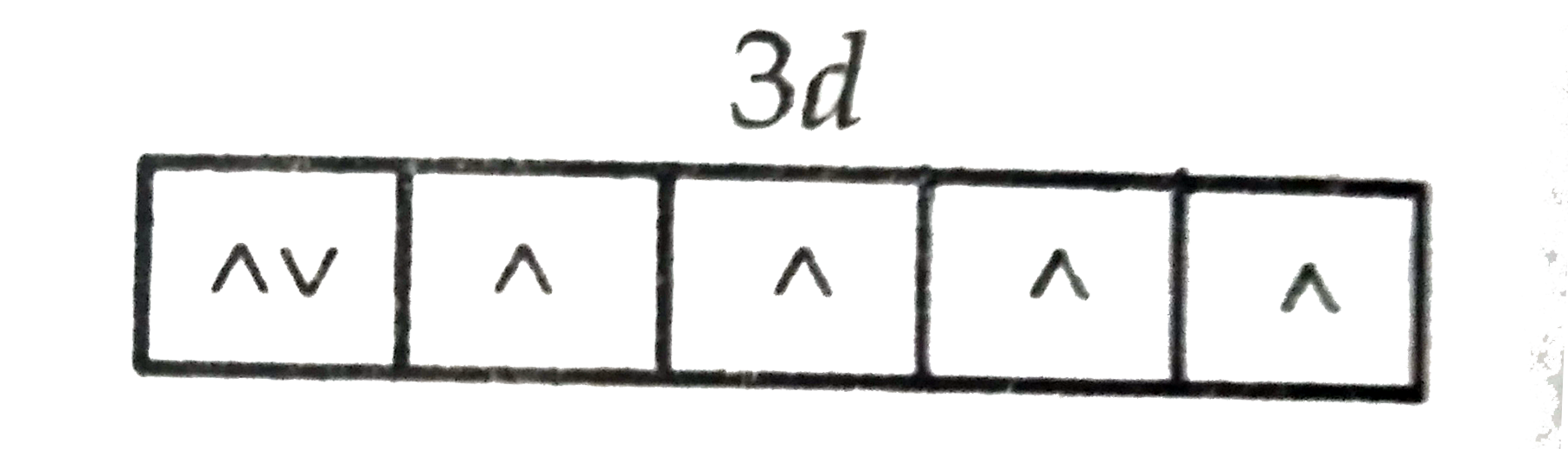
(b) Calculate the magnetic moment of a divalent ion squeous medium of its atomic number is 26.

Text Solution

Verified by Experts
(i) Compounds of transition elements are coloured due to the presence of incomplete d-subshell, i.e., unpaired electrons. These unpaired electrons gain energy and get excited to higher energy level and when they one come back, they radiate energy in vidible rang due to that from coloured compounds.
(ii) MnO is basic while `Mn_(2)O_(7)` is acidic bacause the oxides in lower oxidation states of metals are basic and in their higher oxidation states, they are acidic.
`underset("Basic")underset(("lower oxidation"))overset(+2)(MnO)and underset("Acidic")underset(("higher oxidation"))overset(+7)(Mn_(2)O_(7))`
(b) Magnetic moment `(mu)=sqrt(n(n+2))B.M`
`underset(("ion"))underset(M^(2+)=3d^(6))(m(26)=1s^(2))2s^(2)2p^(6)3s^(2)3p^(6)4s^(2)3d^(6).`

Unpaied `e^(-)s=4,i.e., n=4`
`mu-sqrt(4(4+2))`
`mu=sqrt(24)=4.90B.M`
Promotional Banner

Topper's Solved these Questions

  • XII BOARDS

    XII BOARD PREVIOUS YEAR PAPER ENGLISH|Exercise Outside Delhi: Set-II|11 Videos
  • XII BOARDS

    XII BOARD PREVIOUS YEAR PAPER ENGLISH|Exercise Outside Delhi Board: Set-III|10 Videos
  • XII BOARDS

    XII BOARD PREVIOUS YEAR PAPER ENGLISH|Exercise SET-1|20 Videos
  • SAMPLE PAPER 2019

    XII BOARD PREVIOUS YEAR PAPER ENGLISH|Exercise SECTION: D|1 Videos

Similar Questions

Explore conceptually related problems

Assign reasons for each of the following : (i) Transiti9n metals generally form coloured compounds. (ii) Manganese exhibits the highest oxidation state of+ 7 among the 3d series of transition elements.

Assertion: MnO is basic whereas Mn_2O_7 is acidic. Reason: Higher the oxidation state of a transition metal in its oxide, greater is the acidic character.

Assign reasons for the following : (i) The enthalpies of atomisation of transition elements are high. (ii) The transition metals and many of their compounds act as good catalyst. (iii) From element to element the actinoid contraction is greater than the lanthanoid contraction. (iv) The E^(@) value for the Mn^(3+)//Mn^(2+) couple is much more positive than that for Cr^(3+)//Cr^(2+) . (v) Scandium (Z = 21) does not exhibit variable oxidation states and yet it is regarded as transition element.

Give reasons for the following: (i) Transition elements and their compounds act as catalysts (ii) E^(@) value for (Mn^(2+) | Mn) is negative whereas for (Cu^(2+) | Cu) is positive. (iii) Actinoids show irregularities in their electronic configuration.

(a) Complete the following chemical reaction equations : (i) MnO_(4(aq))^(-) + C_(2)O_(4(aq))^(2-) + H_((aq))^(+) to (ii) Cr_(2) O_(7 (aq))^(2-) + Fe_((aq))^(2+) + H_((aq))^(+) to (b) Explain the following observations about the transition/inner transition elements : (i) There is in general an increase in density of element from titanium (Z = 22) to copper ( Z= 29). (ii) There occurs much more frequent metal-metal bonding in compounds of heavy transition elements ( 3^(rd) series). (iii) The members in the actinoid series exhibit a larger number of oxidation states than the corresponding members in the lanthanoid series.

(a) Account for the following : (i) Copper(I) compounds are white whereas Copper(II) compounds are coloured. (ii) Chromates change their colour when kept in an acidic solution. (iii) Zn,Cd, Hg are considered as d-block elements but not as transition elements. (b) Calculate the spin only moment of Co^(2+) (Z=27) by writing the electronic configuration of Co and Co^(2+)

Complete the following chemical equation: (i) MnO_(4)^(-)(aq)+s_(2)O_(3)^(2-)(aq)+H_(2)O(I) to (ii) MnO_(4)^(-) +NO_(2)^(-)+H^(+) to State reason for the following : (i) Cu(I) ion is not stable in an aqueous solution. (ii) Unlike Cr^(3+),Mn^(2+),Fe^(3+) and the subsequently other M^(2+) ions of the 3d series of elements, the 4d and the 5d series metals generally do not form stable cationic species.

Give reason for the following features of transition metal chemistry: (i). The lowerst oxide of a transition metal (say, chromium, atomic number 24) is basic whereas the highest oxide is usually acidic. (ii) . Transitio metals sometimes oxhibit very low oxidation states such as +1 and 0.

Explain the following observations: (i) Transition elements are known to form many interstitial compounds.. (ii) With the same d^4 configuration Cr^(2+) ion is reducing while Mn^(3+) ion is oxidising. (iii) The enthalpies of atomization of the transition elements are quite high.

(a) Account for the following : (i) Transition metals form large number of complex compounds (ii) The lowest oxide of transition metal is basic whereas the highest oxide is amphoteric or acidic (iii) E^(@) value for the Mn^(3+)//Mn^(2+) couple is highly positive (+1.57V) as compare to Cr^(3+)//Cr^(2+) (b) Write one similarity and one difference between the chemistry of lanthanoid and actinoid elements.

XII BOARD PREVIOUS YEAR PAPER ENGLISH-XII BOARDS-[SET-1]
  1. An element exists in bcc lattice with a cell edge of 288 pm. Calculate...

    Text Solution

    |

  2. Calculate Delta(r)G^(@) and log K(c) for the following reaction at 29...

    Text Solution

    |

  3. For a first order reaction, show that the time required for 99% comple...

    Text Solution

    |

  4. Define the following terms: (i) Tyndall effect (ii) Electrophoresi...

    Text Solution

    |

  5. (a) Write the principle involved in the following : {:((i)"Zone refi...

    Text Solution

    |

  6. A mixed oxide of iron and chromium is fused with sodium carbonate in f...

    Text Solution

    |

  7. (a) Give reasons for the following : (i) Compounds of transition ele...

    Text Solution

    |

  8. For the complex ion [F(en)(2)CI(2)]^(+) write the hybridization type a...

    Text Solution

    |

  9. Rearrange the compounds of each of the following sets in order of reac...

    Text Solution

    |

  10. (a) Why phenol is more acidic than than ethanol ? (b) Write the mech...

    Text Solution

    |

  11. Identify A, B and C in the following reactions : (i) CH(3)CH(2)Clun...

    Text Solution

    |

  12. (a) Why water soluble vitamins must be supplied regularly in the dite ...

    Text Solution

    |

  13. (i) Name a substance which can be used as an antiseptic as well as dis...

    Text Solution

    |

  14. Once there was heavy downpour for about 3 hours in the early morning. ...

    Text Solution

    |

  15. (a) Explain why on addition of 1 mole glucose to 1 litre water the boi...

    Text Solution

    |

  16. (a) Define the following terms : {:((i)"Ideal solution",(ii)"Osmotic...

    Text Solution

    |

  17. (a) When concentrated sulphuric acid was added to an unknown salt pres...

    Text Solution

    |

  18. (a)Account for the following (i) Reducing character decreases from S...

    Text Solution

    |

  19. (a) Account for the following : (i) Propanal is more reactive than p...

    Text Solution

    |

  20. Write structure of A, B C and D in the following eactin sequence : {...

    Text Solution

    |

