

Home
Class 12
PHYSICS
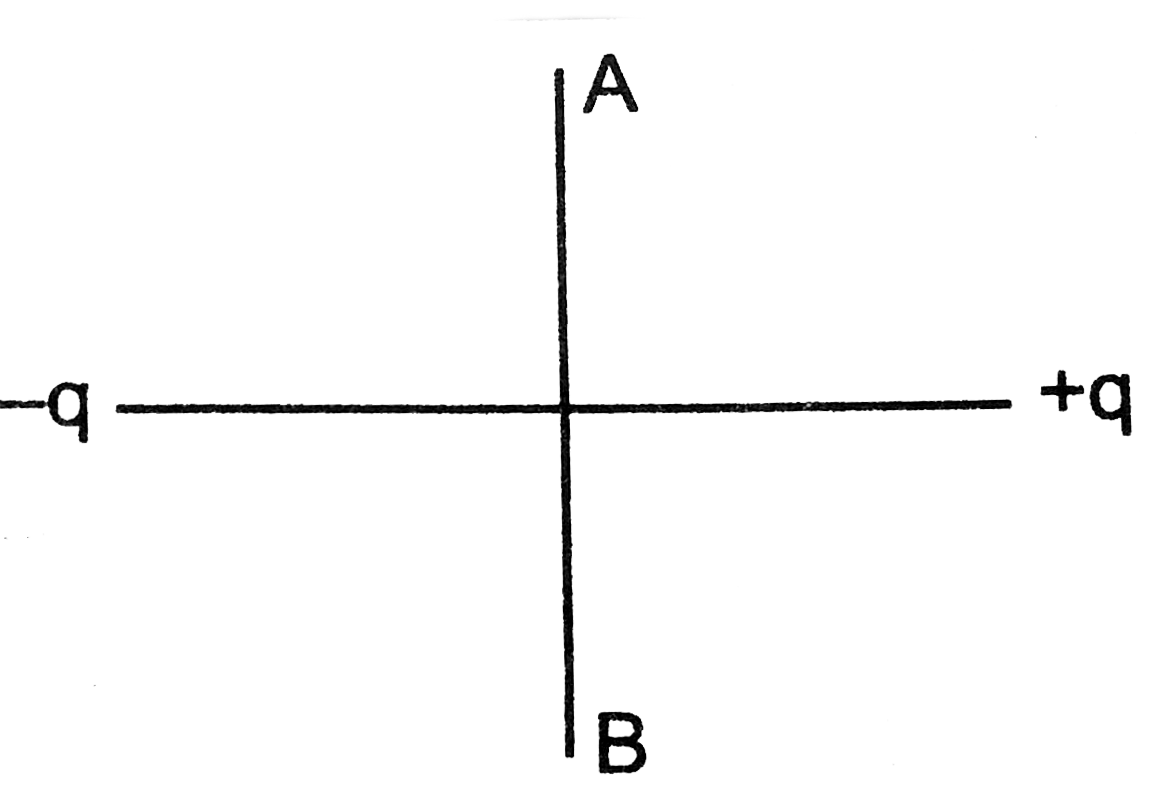
A charge q is moved from a point A above...

A charge q is moved from a point A above a dipole moment p to a point B below the dipole on equatorial plane without acceleration. Find the work done in the process.

Promotional Banner

Similar Questions

Explore conceptually related problems

In figure below a charge Q is fixed. Another charge q is moved along a circular arc MN of radius r around it, from the point M to the point N such that the length of the arc MN = 1. The work done in this process is :

The electric field at a point on equatorial of a dipole and direction of the dipole moment

Electric potential at any point in equatorial plane of a dipole is ………. .

Four charge particles each having charge Q=1 C are fixed at the corners of the base(A,B,C, and D) of a square pyramid with slant length a(AP=BP=PC=a=sqrt(2)m) , a charge -Q is fixed at point P. A dipole with dipole moment p=1 C-m is placed at the center of the bases and perpendicular to its plane as shown in fig. Force on the dipole due to the charge particles is (square)/(4 pi epsilon_(0))N .

On moving a charge of 2C from a point A where potential is +12V to a point B where potential is -12 V, the work done is -

The electric field intensity vec(E) , , due to an electric dipole of dipole moment vec(p) , at a point on the equatorial line is :

A dipole is placed in the field of a point charge, the distance between the dipole and the field source being much greater than the dipole separation. Find the force acting on the dipole and the torque, if the dipole is arranged: In the direction of the line of force.

A dipolo is placed in the field of a point charge, the distance between the dipole and the field source being much greater than the dipole separation. Find the force acting on the dipole and the torque, if the dipole is arranged: perpendicular to the line of force.

A charge q is removed from A to B in the region of a fixed ideal dipole P find the work done on the charge (Assume gravity free space )

A point charge +Q is placed at a distance r from a short dipole of dipole moment vecp as shown in figure. The line joining the point charge Q to the centre dipole is perpendicular to dipole moment vecp , which of the following statement are true?