

Home
Class 12
BIOLOGY
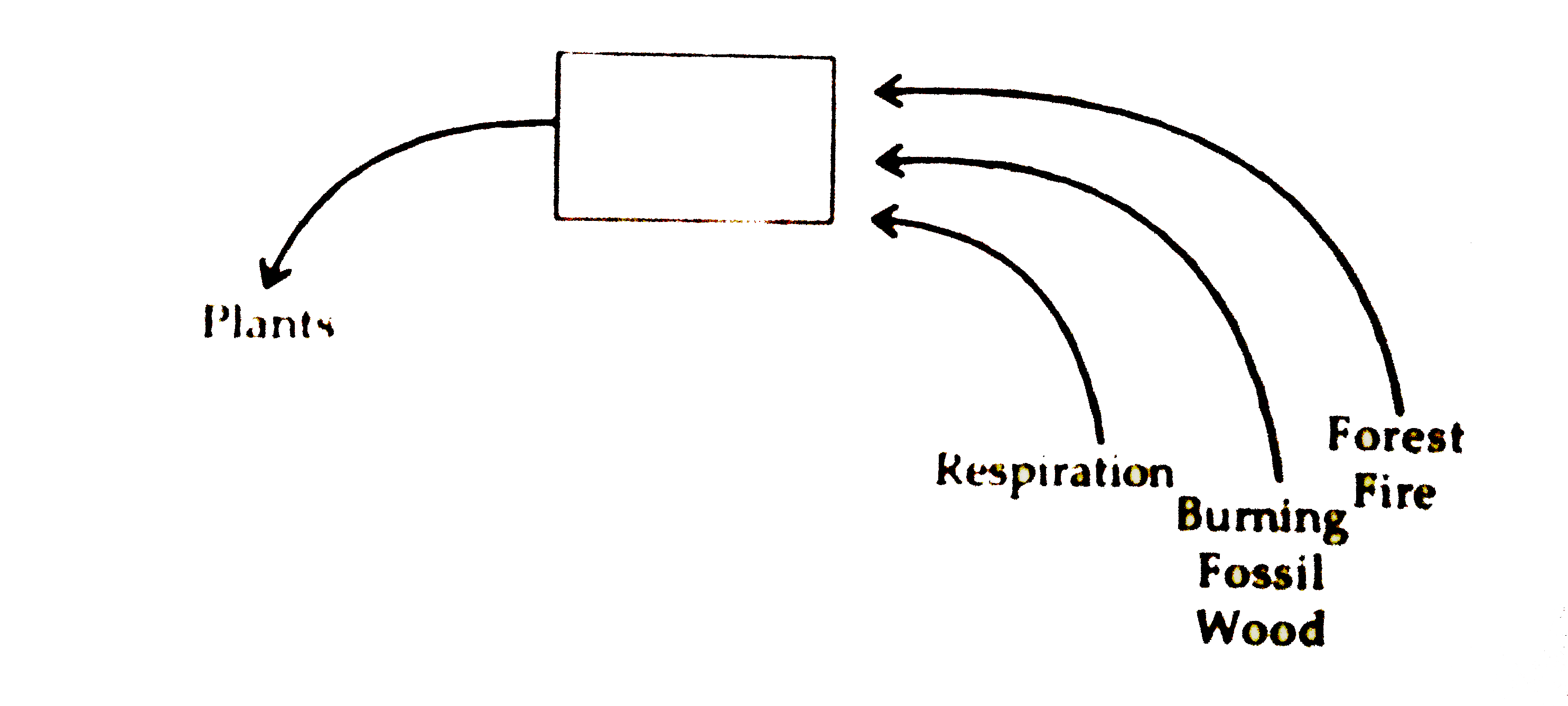
(i) Name the biogeochemical (nutrient) c...


(i) Name the biogeochemical (nutrient) cycle shown above.
(ii) Name an activity of the living organisms not depicted in the cycle by which this nutrient is returned to the atmosphere.
(b) How would the flow of the nutrient in the cycle be affected due to large scale deforestation? Explain giving reasons.
(c) Describe the effect of an increased level of this nutrient in the atmosphere on our environment.

Promotional Banner

Similar Questions

Explore conceptually related problems

Carbon -14 used to determine the age of organic material. The procedure is absed on the formation of C^(14) by neutron capture iin the upper atmosphere. ._(7)N^(14)+._(0)n^(1) rarr ._(6)C^(14)+._(1)H^(1) C^(14) is absorbed by living organisms during photosynthesis. The C^(14) content is constant in living organism. Once the plant or animal dies, the uptake of carbon dioxide by it ceases and the level of C^(14) in the dead being falls due to the decay, which C^(14) undergoes. ._(6)C^(14)rarr ._(7)N^(14)+beta^(c-) The half - life period of C^(14) is 5770 year. The decay constant (lambda) can be calculated by using the following formuls : lambda=(0.693)/(t_(1//2)) The comparison of the beta^(c-) activity of the dead matter with that of the carbon still in circulation enables measurement of the period of the isolation of the material from the living cycle. The method, however, ceases to be accurate over periods longer than 30000 years. The proportion of C^(14) to C^(12) in living matter is 1:10^(12) . A nuclear explosion has taken place leading to an increase in the concentration of C^(14) in nearby areas. C^(14) concentration is C_(1) in nearby areas and C_(2) in areas far away. If the age of the fossil is determined to be T_(1) and T_(2) at the places , respectively, then

Carbon -14 used to determine the age of organic material. The procedure is absed on the formation of C^(14) by neutron capture iin the upper atmosphere. ._(7)N^(14)+._(0)n^(1) rarr ._(6)C^(14)+._(1)H^(1) C^(14) is absorbed by living organisms during photosynthesis. The C^(14) content is constant in living organism. Once the plant or animal dies, the uptake of carbon dioxide by it ceases and the level of C^(14) in the dead being falls due to the decay, which C^(14) undergoes. ._(6)C^(14)rarr ._(7)N^(14)+beta^(c-) The half - life period of C^(14) is 5770 year. The decay constant (lambda) can be calculated by using the following formuls : lambda=(0.693)/(t_(1//2)) The comparison of the beta^(c-) activity of the dead matter with that of the carbon still in circulation enables measurement of the period of the isolation of the material from the living cycle. The method, however, ceases to be accurate over periods longer than 30000 years. The proportion of C^(14) to C^(12) in living matter is 1:10^(12) . What should be the age of fossil for meaningful determination of its age ?