Home
Class 10
CHEMISTRY
(a) Distingusih between esterfication ...

(a) Distingusih between esterfication and saponification reactions with the help of chemical equations for each.
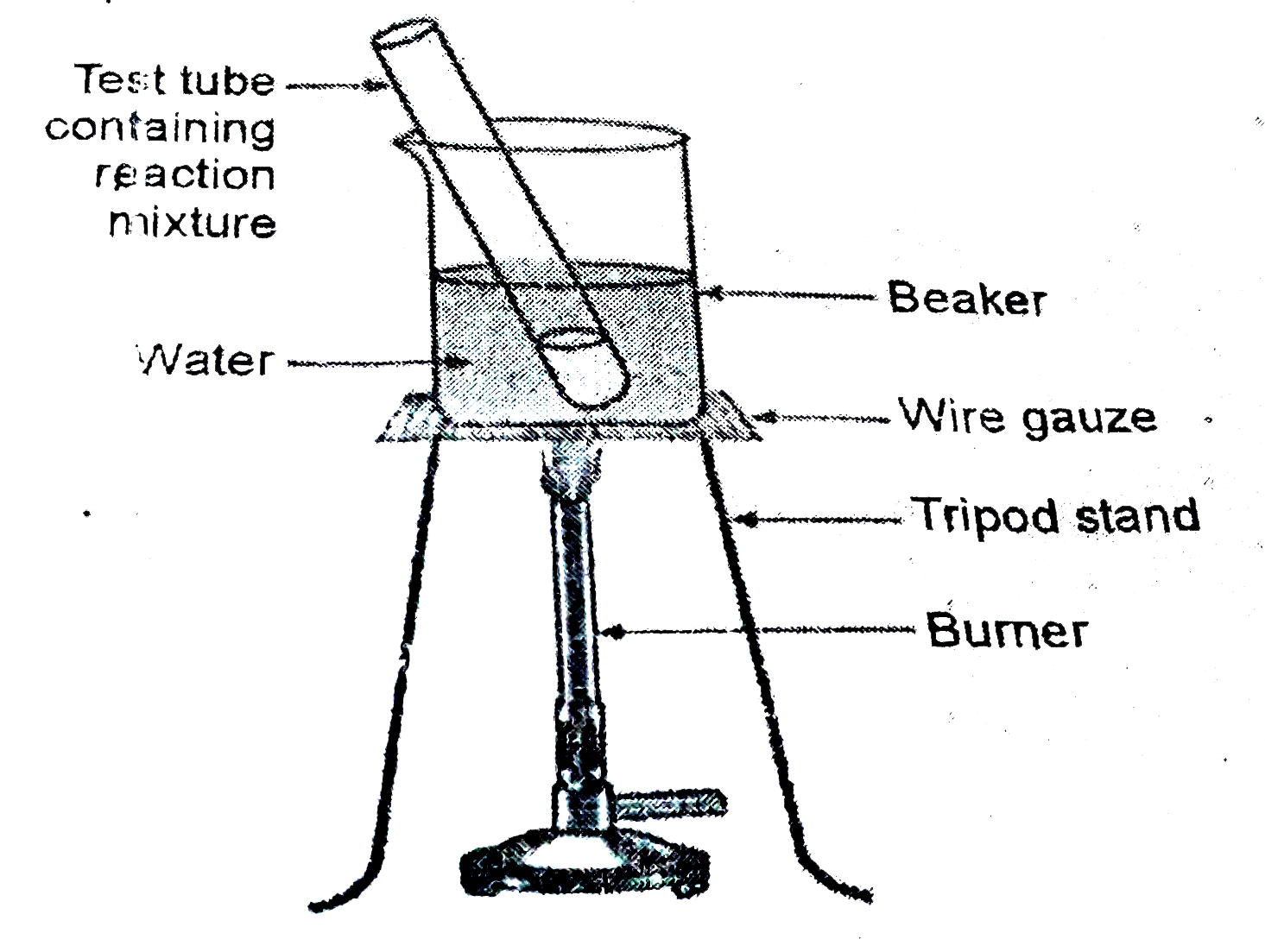
(b) With a labelled digaram describle in brief an acitivity to show the formation of an ester.

Text Solution

Verified by Experts
(a) Difference between esterification and saponification .
(b) Activity to show the formation of ester.
Take 1 ml of ethanol in a test tube.
Add few drops of conc `H_(2)SO_(4)` in the mixture.
Heat the content on water bath for 5 minutes.
Smel the resulting fruity smelling ester is formed.
Promotional Banner

Similar Questions

Explore conceptually related problems

Distinguish between esterification and saponification reactions of organic compounds with the help of the chemical equation for each. Write one use of (i) esters and (ii) saponification process?

With the help of a balanced chemical equation, show that B(OH)_3 behaves as an acid in water.

Ethanoic acid reacts with sodium hydrogen carbonate to produce a salt 'X' and a gas 'Y'. Identify 'X' and 'Y' and write their chemical names. With the help of a labelled diagram describe an activity to confirm that the gas 'Y' is correctly identified by you. Also write the chemical equation of the reaction involved.

Write balanced chemical equations to show the formation of the following salts by neutralisation reaction: NaCl

(a) Give a chemical test to distinguish between saturated and unsaturated hydrocarbon. (b) Name the products formed when ethane burns in air. Write the balanced chemical equatioin for the reaction showing the types of energies liberated. (c) Why is reactiion between methane and chlorine in the presence of sunlight considered a substitution reaction ?

Identify the type of reactions taking place in each of the following cases and write the balanced chemical equation for the reactions. (a) Zinc reacts with silver nitrate to produce zinc nitrate and silver. (b) Potassium iodide reacts with lead nitrate to produce potassium nitrate and lead iodide.

Write balanced chemical equations to show the formation of the following salts by neutralisation reaction: BaSO_(4)

If reaction between A and B to give C shows first order kinetics in A and second order in B, the rate equation can be written as

Write the balanced chemical equations for the following reactions and identify the type of reaction in each case. (a) Nitrogen gas is treated with hydrogen gas in the presence of a catalyst at 773 K to form ammonia gas. (b) Sodium hydroxide solution is treated with acetic acid to form sodium acetate and water. (c) Ethanol is warmed with ethanoic acid to form ethyl acetate in the presence of concentrated H_2SO_(4) . (d) Ethane is burnt in the presence of oxygen to form carbon dioxide, water and releases heat and light.

Write balanced chemical equations to show the formation of the following salts by neutralisation reaction: Na_(2)SO_(4)

