

Home
Class 12
MATHS
Masses M(1), M(2) and M(3) are connected...

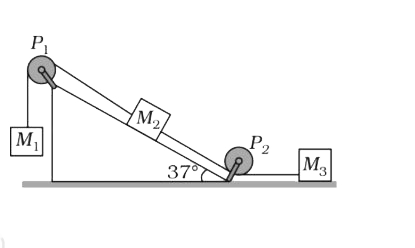
Masses `M_(1), M_(2)` and `M_(3)` are connected by strings of negligible mass which pass over massless and frictionless pulleys `P_(1)` and `P_(2)` as shown in the figure. The masses move such that the portion of the string between`P_(1)` and `P_(2)` is parallel to the inclined plane and the portion of the string between `P_(2)` and `M_(3)` is horizontal. The masses `M_(2)` and `M_(3)` are 4.0 kg each and the coefficient of kinetic friction between both the masses and the surfaces is 0.25. The inclined plane makes an angle of 37° with the horizontal. If the mass `M_(1)` moves downwards with a uniform velocity, find
(i) the mass of `M_(1)` in kg
(ii) the tension in the horizontal portion of the string in Newton

Promotional Banner

Topper's Solved these Questions

  • APPLICATION OF DERIVATIVES

    CENGAGE ENGLISH|Exercise MATRIX MATCH TYPE|3 Videos
  • APPLICATIONS OF DERIVATIVES

    CENGAGE ENGLISH|Exercise Comprehension Type|5 Videos

Similar Questions

Explore conceptually related problems

Masses M_(1),M_(2) and M_(3) are connected by string of negligible mass which pass over massless and frictionless pulleys P_(1) and P_(2) as shown in figure 7.15. The masses move such that the string between P_(1) and P_(2) is parallel to the incline and the portion of the string between P_(2) and M_(3) is horizontal. The masses M_(2) and M_(3) are 4.0 kg each and the coefficient of kinetic friction between the masses and the surfces is 0.25. The inclined plane makes an angle of 37^(@) with the horizontal. If the mass M_(1) moves downwards with a uniform velocity, find (i) the mass of M_(1) , (ii) the tension in the horizontal portion. (g=9.8 ms^(-2) , sin 37^(@)=(3)/(5))

Two blocks of masses m_(1) and m_(2) are connected by a string of negligible mass which pass over a frictionless pulley fixed on the top of an inclined plane as shown in figure. The coefficient of friction between m_(1) and plane is mu .

Blocks of mass M_(1) and M_(2) are connected by a cord which passes over the pulleys P_(1) and P_(2) as shown in the figure. If there is no friction, the acceleration of the block of mass M_(2) will be

Two masses M and M/ 2 are joint together by means of a light inextensible string passes over a frictionless pulley as shown in figure. When bigger mass is released the small one will ascend with an acceleration of

A string of negligible mass going over a clamped pulley of mass m supports a block of mass M as shown in the figure. The force on the pulley by the clamp is given by

A string of negligible mass going over a clamped pulley of mass m supports a block of mass M as shown in the figure. The force on the pulley by the clamp is given by

Three masses m_1 = m ,m_2 = 2m and m_3 = 3m are hund on a string passing over a frictionless pulley as shown in Figure . The mass of the string in negligible . The system is released from rest. The tension in the string between masses m_1 and m_2 is

Three masses m_1 = m ,m_2 = 2m and m_3 = 3m are hund on a string passing over a frictionless pulley as shown in Figure . The mass of the string in negligible . The system is released from rest. The tension in the string between masses m_2 and m_3 is

Two blocks each of mass m are connected over two light and frictionless pulleys and a fixed wedge by a light string as shown in figure. The tension in the string is :

Two masses m_(1) and m_(2) are connected to the end of a string passing over a smooth pulley . The magnitude of tension in the string is T and the masses are moving with magnitude of acceleration a . If the masses are interchanged , then

CENGAGE ENGLISH-APPLICATION OF INTEGRALS-All Questions
  1. The area bounded by the x-axis, the curve y=f(x), and the lines x=1,x=...

    Text Solution

    |

  2. A particle moves along x-axis such that its position veries with time ...

    Text Solution

    |

  3. Masses M(1), M(2) and M(3) are connected by strings of negligible mass...

    Text Solution

    |

  4. The area bounded by the two branches of curve (y-x)^2=x^3 and the stra...

    Text Solution

    |

  5. The area bounded by the curves y=loge x and y=(loge x)^2 is (A) ...

    Text Solution

    |

  6. The area of the region containing the points (x , y) satisfying 4lt=x^...

    Text Solution

    |

  7. Let f(x)=x^3+3x+2a n dg(x) be the inverse of it. Then the area bound...

    Text Solution

    |

  8. Consider two curves C1: y^2=4[sqrt(y)]x a n dC2: x^2=4[sqrt(x)]y , whe...

    Text Solution

    |

  9. The area enclosed between the curve y^2(2a-x)=x^3 and the line x=2a ab...

    Text Solution

    |

  10. The area of the region of the plane bounded by max(|x|,|y|)lt=1 and x ...

    Text Solution

    |

  11. The area of the figure bounded by the parabola (y-2)^(2)=x-1, the tang...

    Text Solution

    |

  12. The area of the loop of the curve a y^2=x^2(a-x) is

    Text Solution

    |

  13. The area of the region bounded by x=0,y=0,x=2,y=2,ylt=e^x and ygeq1nx ...

    Text Solution

    |

  14. If f(x)=sinx ,AAx in [0,pi/2],f(x)+f(pi-x)=2,AAx in (pi/2,pi]a n df(x)...

    Text Solution

    |

  15. The area enclosed by the curve y=sqrt(4-x^2),ygeqsqrt(2)sin((xpi)/(2sq...

    Text Solution

    |

  16. The area bounded by the curves y=xe^x,y=xe^-x and the lines x=1 is

    Text Solution

    |

  17. The area enclosed by the curves xy^2=a^2(a-x) and (a-x)y^2=a^2x is

    Text Solution

    |

  18. The area bounded by the loop of the curve 4y^2=x^2(4-x^2) is (a)7/3 sq...

    Text Solution

    |

  19. The area bounded by the curve f(x)=x+sinx and its inverse function bet...

    Text Solution

    |

  20. The area enclosed by the curve y=sinx+cosxa n dy=|cosx-sinx| over the ...

    Text Solution

    |