Home
Class 12
MATHS
The following Venn diagram shows three e...

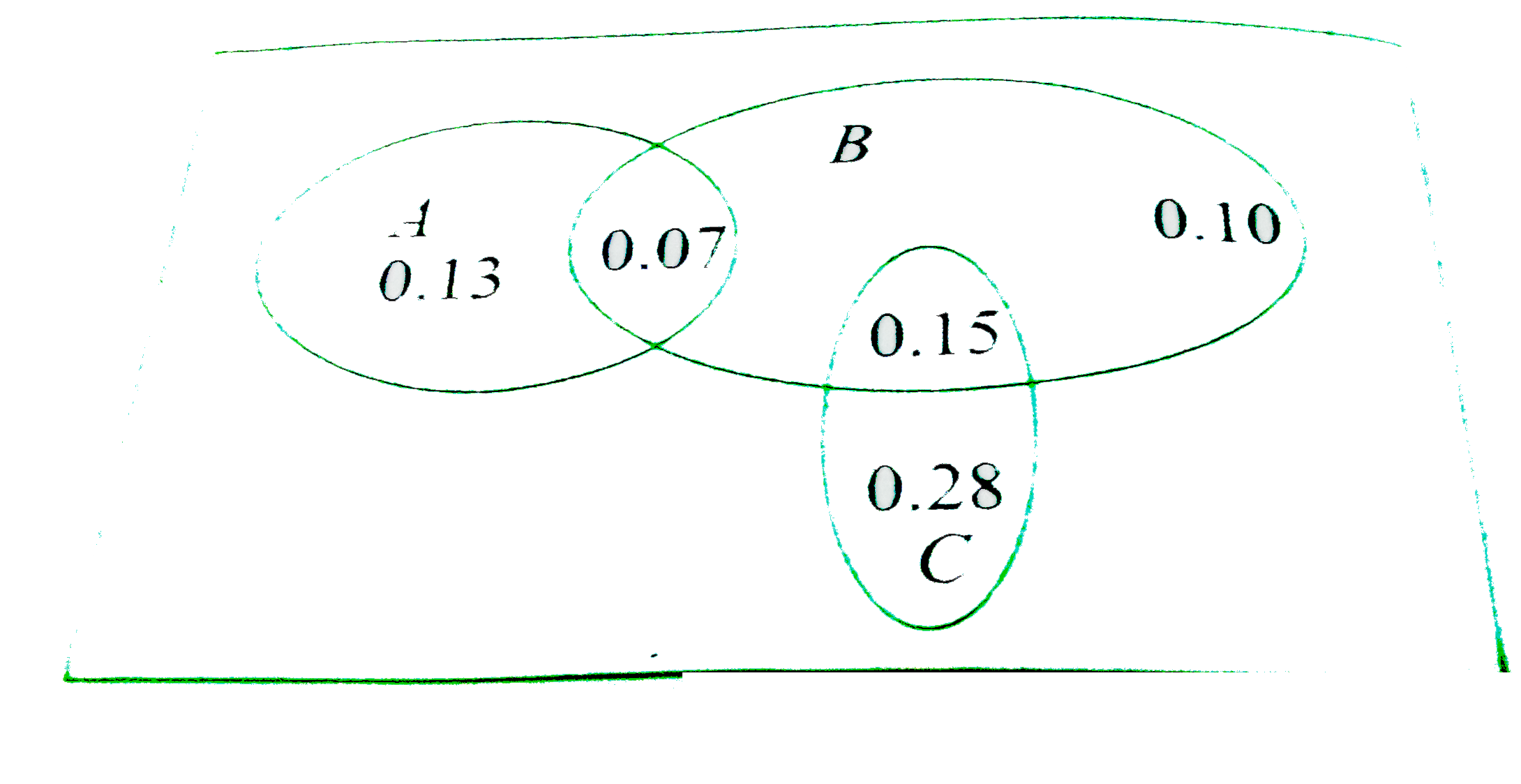
The following Venn diagram shows three events, A, B, and C, and also the probabilities of the various intersections.
Determine
(a) P(A)
(b) `P(B nn barC)`
(c ) `P(A uu B)`
(d) `P(A nn barB)`
(e) `P(B nn C)`
(f) Probability of the event that exactly one of A, B, and C occurs.

Text Solution

Verified by Experts

From the above Venn diagram,
(a) `P(A) = 0.13 + 0.07 = 0.20`
(b) `P(B nn barC) = P(B) - P(B nn C)`
= 0.07 + 0.10 + 0.15 - 0.15 = 0.17
(c ) `P(A uu B) = P(A) + P(B) - P(A nn B)`
`= 0.13 + 0.07 + 0.07 + 0.10 + 0.15 - 0.07 = 0.45`
(d) `P(A nn barB) = P(A) - P(A nn B) = 0.13 + 0.07 - 0.07 = 0.13`
(e) `P(B nn C) = 0//15`
(f) P (exactly one of the three occurs) = 0.13 + 0.10 + 0.28 = 0.51
Promotional Banner

Topper's Solved these Questions

  • PROBABILITY I

    CENGAGE ENGLISH|Exercise Solved Example|9 Videos
  • PROBABILITY I

    CENGAGE ENGLISH|Exercise Exercise 9.1|6 Videos
  • PROBABILITY

    CENGAGE ENGLISH|Exercise Comprehension|2 Videos
  • PROBABILITY II

    CENGAGE ENGLISH|Exercise MULTIPLE CORRECT ANSWER TYPE|6 Videos

Similar Questions

Explore conceptually related problems

Figure shows three events A ,B ,C and also the probabilities of the various intersections (for instance P(AnnB)=0. 07 ) determine P(A) (ii) P(Bnn C ) (iii) P(AnnB) (iv) P(Ann B ) (v) P(BnnC) (vi) probability of exactly one of the three events.

The accompanying Venn diagram shows three events, A, B and C and also the probabilities of the various intersections ["for instance", P (AcupB)=0.7]. Determine (i) P (A) (ii) P (Bcapoverset(-)C) (iii) P (AcupB) (iv) P (Acapoverset(-)B) (v) P (BcapC) (vi) Probability of exactly one of the three occurs.

If A and B are arbitrary events, then a) P(A nn B) ge P(A)+ P(B) (b) P(A uu B) le P(A)+ P(B) (c) P(AnnB)=P(A)+ P(B) (d)None of these

If A and B are two independent events, prove that P(AuuB).P(A'nnB')<=P(C) , where C is an event defined that exactly one of A and B occurs.

If A and B are two independent events, prove that P(AuuB).P(A'nnB')<=P(C) , where C is an event defined that exactly one of A and B occurs.

Three events A , B and C have probabilities 2/5,1/3a n d1/2 respecively. Given tat P(AnnC)=1/5a n dP(BnnC)=1/4, find the values of P(C//B)a n dP( A^- nn C^- )dot

If A and B are any two events such that P(A) + P(B) - P(A a n d B) = P(A) ? then(A) P(B | A) = 1 (B) P(A | B) = 1 (C) P(B | A) = 0 (D) P(A | B) = 0

If Aa n dB are two events, the probability that exactly one of them occurs is given by P(A)+P(B)-2P(AnnB) P(Ann B )+P( A nnB) P(AuuB)-P(AnnB) P( A )+P( B )-2P( A nn B )

If A and B are two events, then which of the following does not represent the probability that exactly one of A ,B occurs is. (a) P(A) + P(B) - P(A nn B) (b) P(A nn B') + P(A' nn B) (c) P(A') + P(B') - 2P(A' nn B') (d) P(A) + P(B) -2 P(A nn B)

A, B, C are any three events. If P(S) denotes the probability of S happening, then P(A cap (B cup C)) =
