Home
Class 12
MATHS
A point moves so that the distance betwe...

A point moves so that the distance between the foot of perpendiculars from it on the lines `a x^2+2hx y+b y^2=0` is a constant `2d` . Show that the equation to its locus is `(x^2+y^2)(h^2-a b)=d^2{(a-b)^2+4h^2}dot`

Text Solution

Verified by Experts
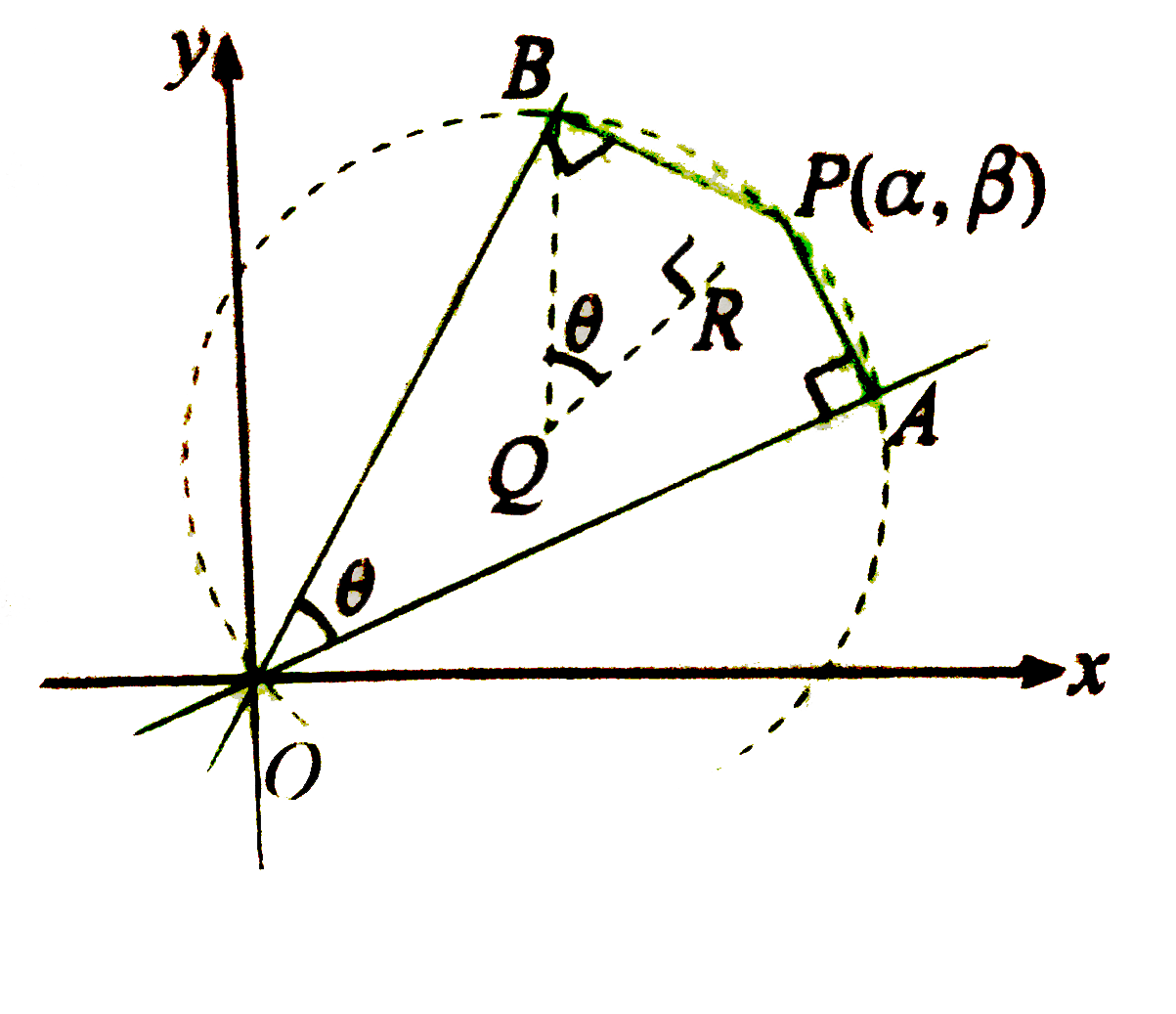

From point `p(alpha , beta),` perpendiculars are dropped on the given pair of lines.
According to the question , AB=2d. Clearly OAPB is a cyclic quadrilateral and OP will be the diameter of the circumcircle of this quadrilateral.
`OP =sqrt(alpha^(2)+ beta^(2))`
Let Q be the center of the circle.
therefore , in `DeltaQRB`,
`sintheta=(BR)/(QB)=(2d)/(sqrt(alpha^(2)+beta^(2)))` (1)
Also , angle between the lines is
`tantheta=(2sqrt(h^(2)-b))/(a+b)` (2)
Therefore , from (1) and (2), we get
`(2sqrt(h^(2)-ab))/(a+b)=(2d)/(sqrt(alpha^(2)+beta^(2)-4d^(2)))`
Therefore , the locus of `P(alpha,beta)`is
`(x^(2)+y^(2))(h^(2)-ab)=d^(2){(a-b)^(2)4h^(2)}`
Promotional Banner

Topper's Solved these Questions

  • PAIR OF STRAIGHT LINES

    CENGAGE ENGLISH|Exercise Exercise 3.1|6 Videos
  • PAIR OF STRAIGHT LINES

    CENGAGE ENGLISH|Exercise Exercise 3.2|7 Videos
  • PAIR OF STRAIGHT LINES

    CENGAGE ENGLISH|Exercise Illustration 3.17|1 Videos
  • MONOTONOCITY AND NAXINA-MINIMA OF FUNCTIONS

    CENGAGE ENGLISH|Exercise Comprehension Type|6 Videos
  • PARABOLA

    CENGAGE ENGLISH|Exercise Matching Column Type|1 Videos

Similar Questions

Explore conceptually related problems

A point moves so that the sum of its distances from (a e ,0)a n d(-a e ,0) is 2a , prove that the equation to its locus is (x^2)/(a^2)+(y^2)/(b^2)=1 , where b^2=a^2(1-e^2)dot

A point moves so that the sum of its distances from (a e ,0)a n d(-a e ,0) is 2a , prove that the equation to its locus is (x^2)/(a^2)+(y^2)/(b^2)=1 , where b^2=a^2(1-e^2)dot

Show that the locus of the foot of the perpendicular drawn from focus to a tangent to the hyperbola x^2/a^2 - y^2/b^2 = 1 is x^2 + y^2 = a^2 .

Show that the locus of the foot of the perpendicular drawn from focus to a tangent to the hyperbola x^2/a^2 - y^2/b^2 = 1 is x^2 + y^2 = a^2 .

Prove that the product of the perpendiculars from (alpha,beta) to the pair of lines a x^2+2h x y+b y^2=0 is (aalpha^2+2halphabeta+b beta^2)/(sqrt((a-b)^2+4h^2))

Prove that the product of the perpendiculars from (alpha,beta) to the pair of lines a x^2+2h x y+b y^2=0 is (aalpha^2+2halphabeta+b beta^2)/(sqrt((a-b)^2+4h^2))

The straight lines joining any point P on the parabola y^2=4a x to the vertex and perpendicular from the focus to the tangent at P intersect at Rdot Then the equation of the locus of R is (a) x^2+2y^2-a x=0 (b) 2x^2+y^2-2a x=0 (c) 2x^2+2y^2-a y=0 (d) 2x^2+y^2-2a y=0

Find the locus of the feet of the perpendiculars drawn from the point (b, 0) on tangents to the circle x^(2) + y^(2) =a^(2)

Prove that the product of the perpendiculars from (alpha,beta) to the pair of lines a x^2+2h x y+b y^2=0 is (aalpha^2-2halphabeta+bbeta^2)/(sqrt((a-b)^2+4h^2))

The locus of the foot of the perpendicular from the foci an any tangent to the ellipse x^(2)/a^(2) + y^(2)/b^(2) = 1 , is

