Text Solution
Verified by Experts



Topper's Solved these Questions
Similar Questions
Explore conceptually related problems
CENGAGE ENGLISH-GRAPHICAL TRANSFORMATIONS-ILLUSTRATION
- Solve |x-1|-|x+3|lt6 graphically
Text Solution
|
- For alt=0 , determine all real roots of the equation (1986, 5M) x^2-2a...
Text Solution
|
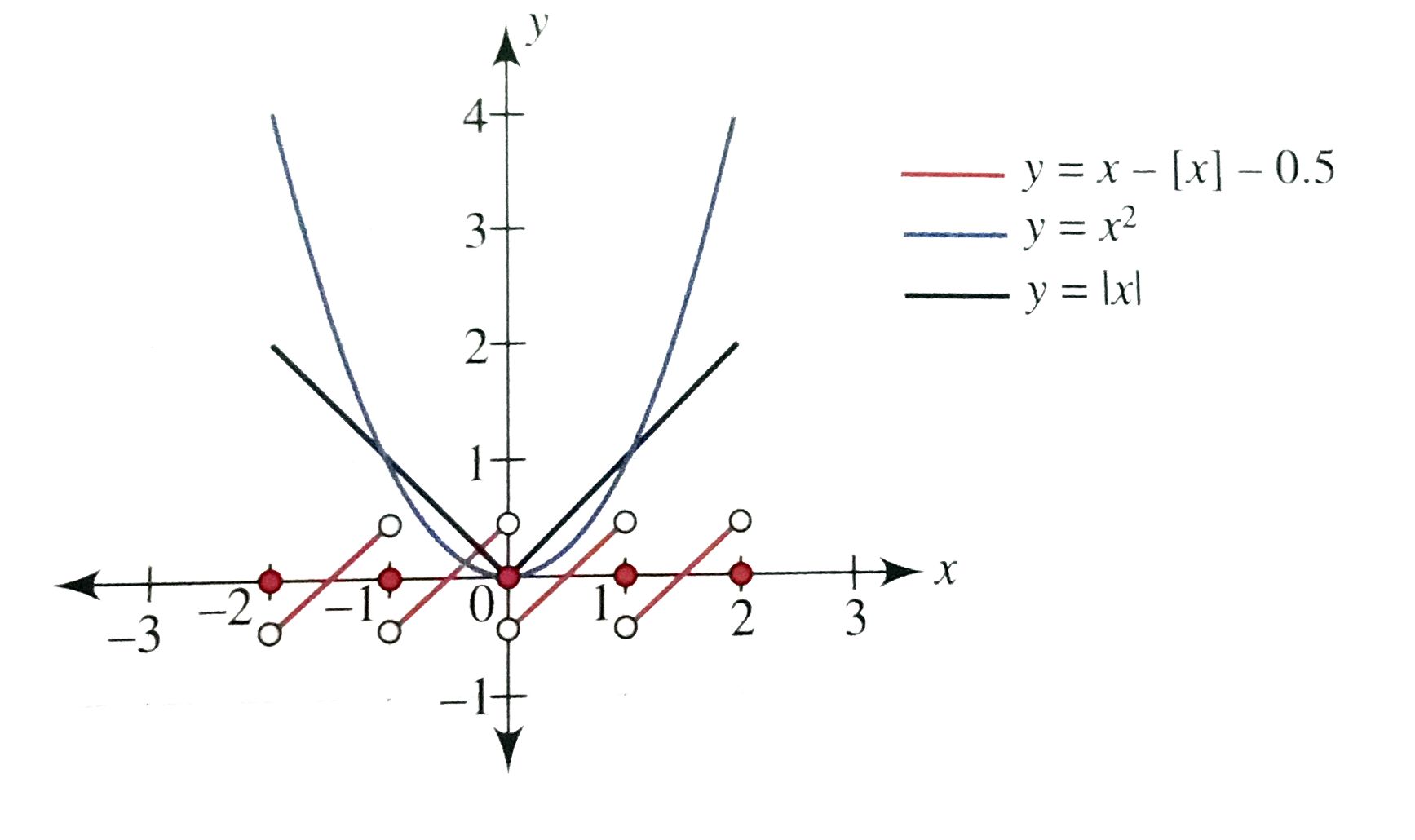
- Consider the function f(x)={{:(x-[x]-(1)/(2),x !in),(0, "x inI):} wher...
Text Solution
|
- Draw the graph of y=log(e)3x and compare with y=log(e)x.
Text Solution
|
- Draw the graph of y=cos^(-1)(x//4) and compare with y=cos^(-1)x.
Text Solution
|
- Draw the graph of y=0.5(x-1)^(2) and compare with y=(x-1)^(2).
Text Solution
|
- Plot y=sinxa n dy=sin2xdot
Text Solution
|
- If nsinx=log(e)x has exactly 1 root, then find the possible value of n...
Text Solution
|
- Plot the curve y=(log)e(-x)dot
Text Solution
|
- Draw the graph of y=2^(-x).
Text Solution
|
- Draw the graph of y=cot^(-1)(-x).
Text Solution
|
- Draw the graph of y=-cot^(-1)x.
Text Solution
|
- Draw the graph of y=-log(e)x.
Text Solution
|
- Draw the graph of y=2-|x-1|.
Text Solution
|
- Draw the graph of y=sin^(-1)(cosx).
Text Solution
|
- Given the graph of y=f(x). Draw the graphs of the followin. (a)...
Text Solution
|
- Draw the graph of y=|logx|.
Text Solution
|
- Draw the graph of y=|sinx| and hence the graph of y=sin^(-1)|sinx|.
Text Solution
|
- Draw the graph of y=f(x)=sqrt(1-cosx)
Text Solution
|
- Drew the graph of y=|sinx-0.5|.
Text Solution
|