Home
Class 12
MATHS
For an ideal gas, an illustration of thr...

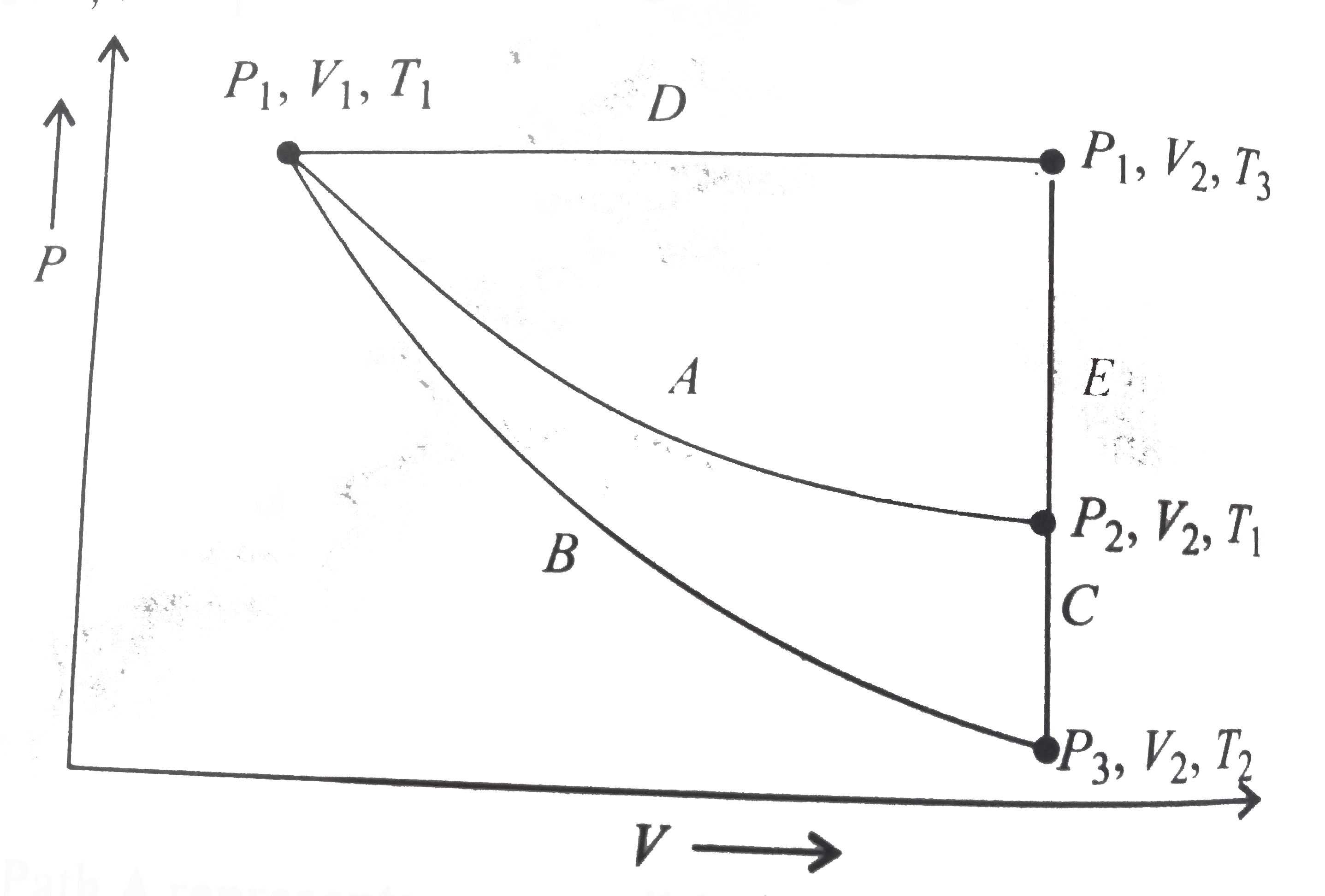
For an ideal gas, an illustration of three different paths `A(B+C)` and `(D+E)` from an initial state `P_(1), V_(1), T_(1)` to a final state `P_(2), V_(2),T_(1)` is shown in the given figure.

Path `A` represents a reversible isothermal expansion form `P_(1),V_(1)` to `P_(2),V_(2)`, Path `(B+C)` represents a reversible adiabatic expansion `(B)` from `P_(1),V_(1),T_(1)to P_(3),V_(2),T_(2)` followed by reversible heating the gas at constant volume `(C)`from `P_(3),V_(2),T_(2)` to `P_(2),V_(2),T_(1)`. Path `(D+E)` represents a reversible expansion at constant pressure `P_(1)(D)` from `P_(1),V_(1),T_(1)` to `P_(1),V_(2),T_(3)` followed by a reversible cooling at constant volume `V_(2)(E)` from `P_(1),V_(2),T_(3) to P_(2),V_(2),T_(1)`.
What is `DeltaS` for path `(D +E)`?

A

Both the statements are true, and Statement 2 is the correct explanation for Statement 1.

B

Both the Statements are true, but Statement 2 is not the correct explanation for Statement 1.

C

Statement 1 is true and Statement 2 is false.

D

Statement 1 is false and Statement 2 is true.

Text Solution

Verified by Experts

The correct Answer is:

d

Direction ratios of the given lines are `(-3, 1, -1) and (1, 2, -1)`. Hence, the lines are perpendicular as `(-3)(1)+ (1)(2)+ (-1)(-1)=0`.
Also lines are coplanar as
`" "|{:(0-2,,1-3,,-1+(13//7)),(-3,,1,,-1),(1,,2,,-1):}|=0`
But Statement 2 is not enough reason for the shortest distance to be zero, as two skew lines can also be perpendicular.
Promotional Banner

Topper's Solved these Questions

  • THREE-DIMENSIONAL GEOMETRY

    CENGAGE ENGLISH|Exercise LINKED COMPREHENSION TYPE|12 Videos
  • THREE-DIMENSIONAL GEOMETRY

    CENGAGE ENGLISH|Exercise MATRIX-MATCH TYPE|5 Videos
  • THREE-DIMENSIONAL GEOMETRY

    CENGAGE ENGLISH|Exercise MULTIPLE CORRECT ANSWER TYPE|17 Videos
  • THREE DIMENSIONAL GEOMETRY

    CENGAGE ENGLISH|Exercise All Questions|294 Videos
  • TRIGONOMETRIC EQUATIONS

    CENGAGE ENGLISH|Exercise Archives (Matrix Match Type)|1 Videos

Similar Questions

Explore conceptually related problems

For an ideal gas, an illustration of three different paths A,(B+C) and (D+E) from an initial state P_(1), V_(1), T_(1) to a final state P_(2), V_(2),T_(1) is shown in the given figure. Path A represents a reversible isothermal expansion form P_(1),V_(1) to P_(2),V_(2) , Path (B+C) represents a reversible adiabatic expansion (B) from P_(1),V_(1),T_(1)to P_(3),V_(2),T_(2) followed by reversible heating the gas at constant volume (C) from P_(3),V_(2),T_(2) to P_(2),V_(2),T_(1) . Path (D+E) represents a reversible expansion at constant pressure P_(1)(D) from P_(1),V_(1),T_(1) to P_(1),V_(2),T_(3) followed by a reversible cooling at constant volume V_(2)(E) from P_(1),V_(2),T_(3) to P_(2),V_(2),T_(1) . What is q_(rev) , for path A ?

For an ideal gas, an illustratio of three different paths A(B+C) and (D+E) from an initial state P_(1), V_(1), T_(1) to a final state P_(2), V_(2),T_(1) is shown in the given figure. Path A represents a reversible isothermal expansion form P_(1),V_(1) to P_(2),V_(2) , Path (B+C) represents a reversible adiabatic expansion (B) from P_(1),V_(1),T_(1)to P_(3),V_(2),T_(2) followed by reversible heating the gas at constant volume (C) from P_(3),V_(2),T_(2) to P_(2),V_(2),T_(1) . Path (D+E) represents a reversible expansion at constant pressure P_(1)(D) from P_(1),V_(1),T_(1) to P_(1),V_(2),T_(3) followed by a reversible cooling at constant volume V_(2)(E) from P_(1),V_(2),T_(3) to P_(2),V_(2),T_(1) . What is q_(rev) , for path (D+E) ?

For an ideal gas, an illustratio of three different paths A(B+C) and (D+E) from an initial state P_(1), V_(1), T_(1) to a final state P_(2), V_(2),T_(1) is shown in the given figure. Path A represents a reversible isothermal expansion form P_(1),V_(1) to P_(2),V_(2) , Path (B+C) represents a reversible adiabatic expansion (B) from P_(1),V_(1),T_(1)to P_(3),V_(2),T_(2) followed by reversible heating the gas at constant volume (C) from P_(3),V_(2),T_(2) to P_(2),V_(2),T_(1) . Path (D+E) represents a reversible expansion at constant pressure P_(1)(D) from P_(1),V_(1),T_(1) to P_(1),V_(2),T_(3) followed by a reversible cooling at constant volume V_(2)(E) from P_(1),V_(2),T_(3) to P_(2),V_(2),T_(1) . What is q_(rev) , for path (A) ?

A gas with (c_(p))/(c_(V))=gamma goes from an intial state (p_(1), V_(1), T_(1)) to a final state (p_(2), V_(2), T_(2)) through an adiabatic process. The work done by the gas is

A system changes from the state (P_(1),V_(1)) to (P_(2),V_(2)) as shown in the diagram. The work done by the system is

One mole of hydrogen, assumed to be ideal, is adiabatically expanded from its initial state (P_(1), V_(1), T_(1)) to the final state (P_(2), V_(2), T_(2)) . The decrease in the internal energy of the gas during this process will be given by

An ideal gas is expand from (p_(1),V_(1),T_(1)) to (p_(2),V_(2),T_(2)) under different conditions. The correct statement(s) among the following is (are):

Assertion: When ideal gas expand from P_(1), V_(1), T_(1), to P_(2), V_(2), T_(2) two steps, and work done is high in which number of steps are high Reason: Work is path function

For an ideal gas V - T curves at constant pressure P_(1) & P_(2) are shown in figure, from the figure

An ideal gas expands adiabatically from an initial temperature T_(1) to a final temperature T_(2) . Prove that the work done by the gas is C_(V) (T_(1) - T_(2)) .
