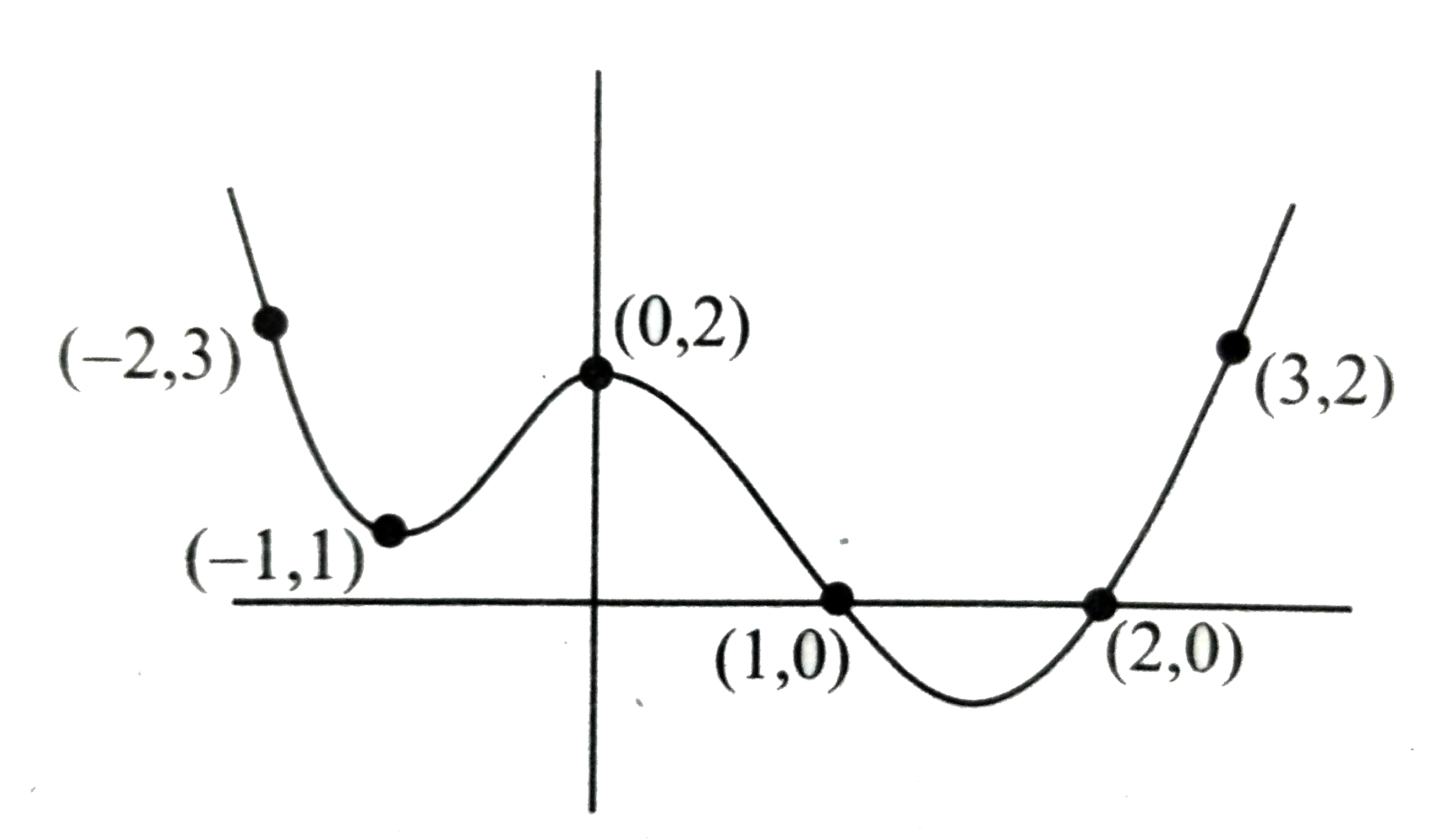
In the given figure graph of `y=p(x)=x^(4)+ax^(3)+bx^(2)+cx+d` is given The product of all imaginary roots of `p(x)=0` is
(a) 1
(b) 2
(c) `1/3`
(d) `1/4`
CENGAGE ENGLISH|Exercise ARCHIVES (NUMERICAL VALUE TYPE)|1 Videos
THREE DIMENSIONAL GEOMETRY
CENGAGE ENGLISH|Exercise All Questions|294 Videos
Similar Questions
Explore conceptually related problems
In the given figure graph of : y =p (x) = x ^(n)+a_(1) x ^(n-1) +a_(2) x ^(n-2)+ ….. + a _(n) is given. The product of all imaginary roots of p(x) =0 is:
In the given figure graph of : y =p (x) = x ^(n)+a_(1) x ^(n-1) +a_(2) x ^(n-2)+ …..+ a _(n) is given. The minimum number of real roots of equation (p' (x))^(2) +p(x)p''(x) =0 are:
Given P(x) =x^(4) +ax^(3) +bx^(2) +cx +d such that x=0 is the only real root of P'(x) =0 . If P(-1) lt P(1), then in the interval [-1,1]
If (x-1)^3 is a factor of x^4+ax^3+bx^2+cx-1=0 then the other factor is
If the roots of ax^(3) + bx^2 + cx + d=0 are in G.P then the roots of dx^3 - cx^2 + bx -a=0 are in
In Figure, the graph of a polynomial p(x) is shown. The number of zeroes of p(x) is (a)4 (b) 1 (c) 2 (d) 3
If the product of the roots of the equation 2x^2 + ax + 4 sina = 0 is 1, then roots will be imaginary, if
if x^2+x+1 is a factor of ax^3+bx^2+cx+d then the real root of ax^3+bx^2+cx+d=0 is : (a) -d/a (B) d/a (C) a/b (D)none of these
Find the values of a,b,c,d, if 1,2,3,4 are the roots of x^4 +ax^3 +bx^2 +cx +d=0
If 1,2,3 are the roots of ax^3 +bx^2 + cx +d=0 then the roots of ax sqrt(x) + bx +c sqrt (x ) +d=0 are
CENGAGE ENGLISH-THEORY OF EQUATIONS-JEE ADVANCED (Numerical Value Type )