Home
Class 12
MATHS
Let ABCD is a unit square and each side ...


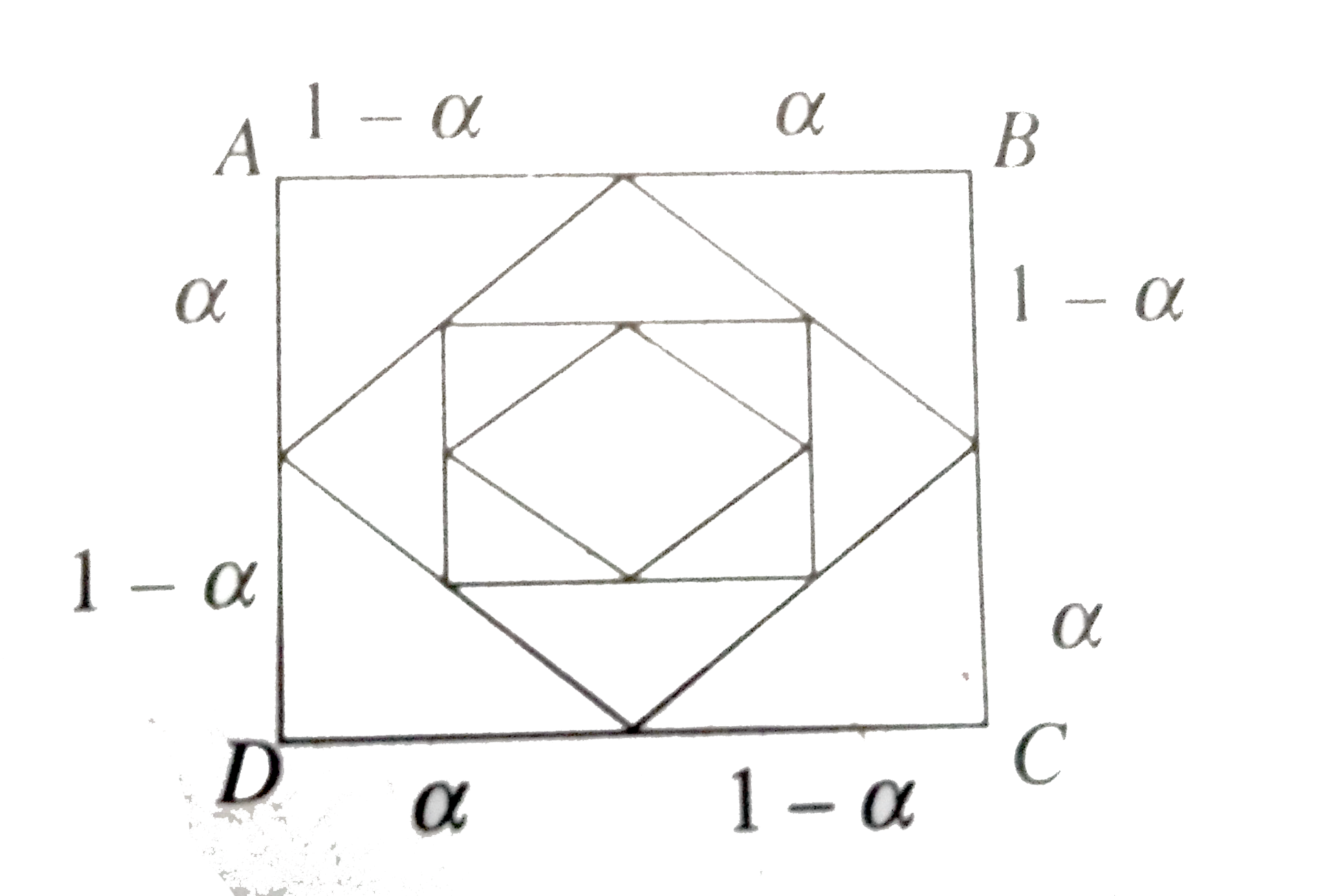
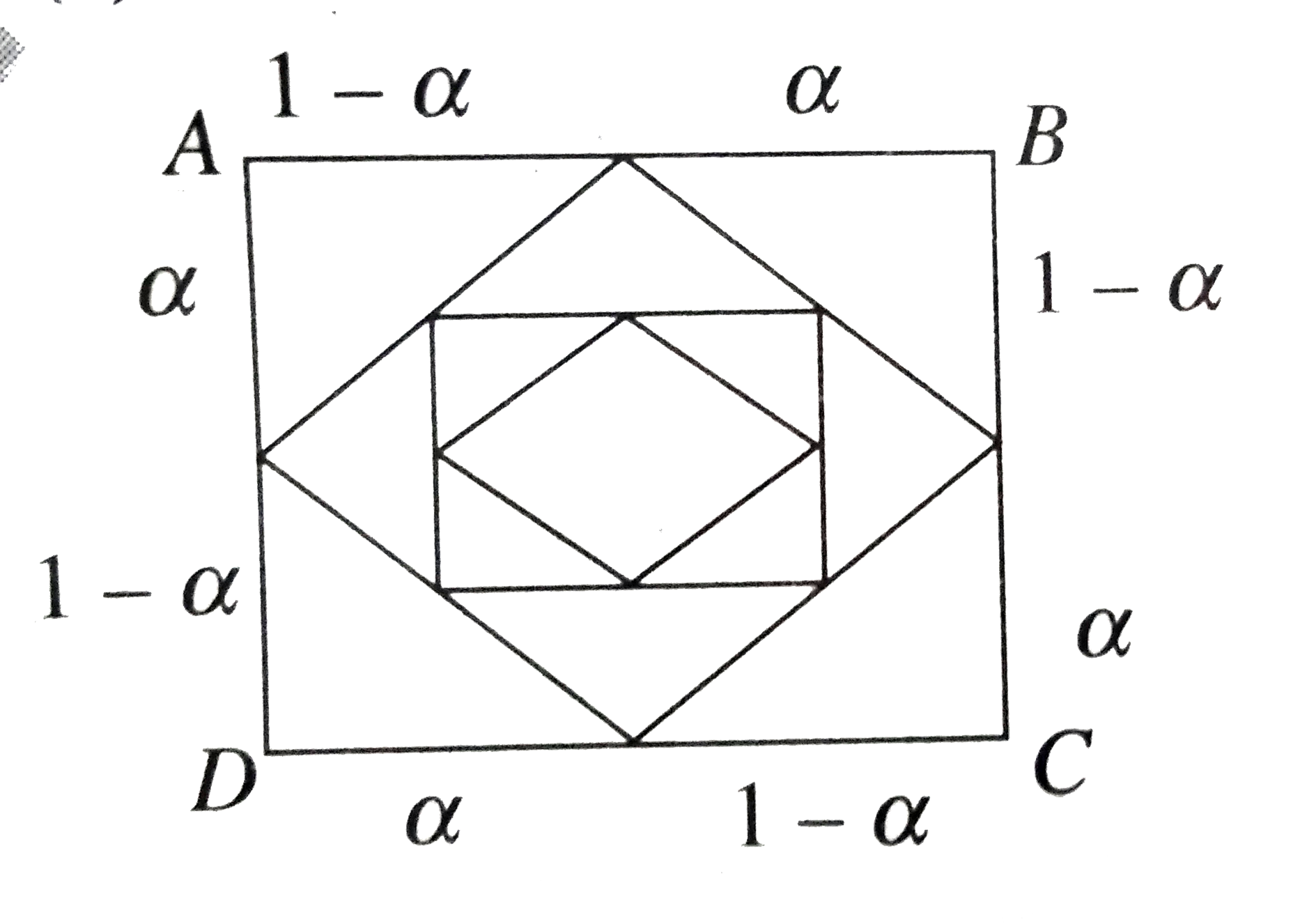
Let `ABCD` is a unit square and each side of the square is divided in the ratio `alpha : (1-alpha) (0 lt alpha lt 1)` . These points are connected to obtain another square. The sides of new square are divided in the ratio `alpha : (1-alpha)` and points are joined to obtain another square. The process is continued idefinitely. Let `a_(n)` denote the length of side and `A_(n)` the area of the `n^(th)` square
The value of `alpha` for which `sum_(n=1)^(oo)A_(n)=(8)/(3)` is/are

A

`(1)/(3)`, `(2)/(3)`

B

`(1)/(4)`, `(3)/(4)`

C

`(1)/(5)`, `(4)/(5)`

D

`(1)/(2)`

Text Solution

Verified by Experts

The correct Answer is:
B

`(b)`
Clearly from the diagram,
`a_(1)=1`
`(a_(n+1))^(2)=[(1-alpha)^(2)+alpha^(2)](a_(n))^(2)impliesA_(n+1)=[2alpha^(2)-2alpha+1]A_(n)`
For `alpha=(1)/(3)`, `(a_(n+1))^(2)=(5)/(9)(a_(n))^(2)`
`implies(A_(n+1))/(A_(n))=(5)/(9)`
`impliesA_(2)=(5)/(9)`, `A_(3)=((5)/(9))^(2)`,...
`impliesA_(n)=((5)/(9))^(n-1)`
`A_(n) lt (1)/(10) implies ((5)/(9))^(n-1) lt (1)/(10)`
`implies` Least value of `n` is `5`.
`sum_(n=1)^(oo)A_(n)=(8)/(3)`
`implies(1)/(1-(2alpha^(2)-2alpha+1))=(8)/(3)`
`implies16alpha^(2)-16alpha+3=0`
`implies16alpha^(2)-12alpha-4alpha+3=0`
`implies(4alpha-1)(4alpha-3)=0`
`impliesalpha=(1)/(4)`, `(3)/(4)`
The side of `n^(th)` square equal to the diagonal of `(n+1)^(th)` square. ,brgt `impliessqrt(2)a_(n)=a_(n+1)`
`implies((a_(n+1))^(2))/((a_(n))^(2))=(1)/(2)`
`implies4alpha^(2)-4alpha+1=0`
`impliesalpha=1//2`
Promotional Banner

Topper's Solved these Questions

  • PROGRESSION AND SERIES

    CENGAGE ENGLISH|Exercise Multiple Correct Answer|4 Videos
  • PROGRESSION AND SERIES

    CENGAGE ENGLISH|Exercise ILLUSTRATION 5.1|1 Videos
  • PROBABILITY II

    CENGAGE ENGLISH|Exercise MULTIPLE CORRECT ANSWER TYPE|6 Videos
  • PROPERTIES AND SOLUTIONS OF TRIANGLE

    CENGAGE ENGLISH|Exercise Archives (Numerical Value Type)|3 Videos

Similar Questions

Explore conceptually related problems

Let ABCD is a unit square and each side of the square is divided in the ratio alpha : (1-alpha) (0 lt alpha lt 1) . These points are connected to obtain another square. The sides of new square are divided in the ratio alpha : (1-alpha) and points are joined to obtain another square. The process is continued idefinitely. Let a_(n) denote the length of side and A_(n) the area of the n^(th) square The value of alpha for which side of n^(th) square equal to the diagonal of (n+1)^(th) square is

img src="https://d10lpgp6xz60nq.cloudfront.net/physics_images/CEN_ALG_DPP_4_2_E01_231_Q01.png" width="80%"gt Let ABCD is a unit square and each side of the square is divided in the ratio alpha : (1-alpha) (0 lt alpha lt 1) . These points are connected to obtain another square. The sides of new square are divided in the ratio alpha : (1-alpha) and points are joined to obtain another square. The process is continued idefinitely. Let a_(n) denote the length of side and A_(n) the area of the n^(th) square If alpha=(1)/(3) , then the least value of n for which A_(n) gt (1)/(10) is

The side of a given square is equal to a. The mid-points of its sides are joined to form a new square. Again, the mid-points of the sides of this new square are joined to form another square. This process is continued indefinitely. Find the sum of the areas of the squares and the sum of the perimeters of the squares.

Solve : tan ^(2) alpha + sec alpha - 1 = 0,0 le alpha lt 2pi.

The sides of the triangle are sin alpha , cos alpha and sqrt(1+sinalphacosalpha) for some 0 lt alpha lt (pi)/2 . Then the greatest angle of the triangle is

A square is drawn by joining mid pint of the sides of a square. Another square is drawn inside the second square in the same way and the process is continued in definitely. If the side of the first square is 16 cm, then what is the sum of the areas of all the squares ?

A square is drawn by joining the mid-points of the sides of a square. A third square is drawn inside the second square in the same way and the processes continued indefinitely. If the side of the square is 10 c m , find the sum of the areas of all the squares so formed.

If one side of the square is 2x-y+6=0, then one of the vertices is (2,1) . Find the other sides of the square.

If one side of the square is 2x-y+6=0, then one of the vertices is (2,1) . Find the other sides of the square.

The sum of the areas of two squares is 85. If the sides of both squares have integer lengths, what is the least possible value for the length of a side of the smaller square?

