Home
Class 12
MATHS
If the join of (x1,y1) and (x2,y2) makes...

If the join of `(x_1,y_1)` and `(x_2,y_2)` makes on obtuse angle at `(x_3,y_3),` then prove that `(x_3-x_1)(x_3-x_2)+(y_3-y_1)(y_3-y_2)<0`

Text Solution

Verified by Experts
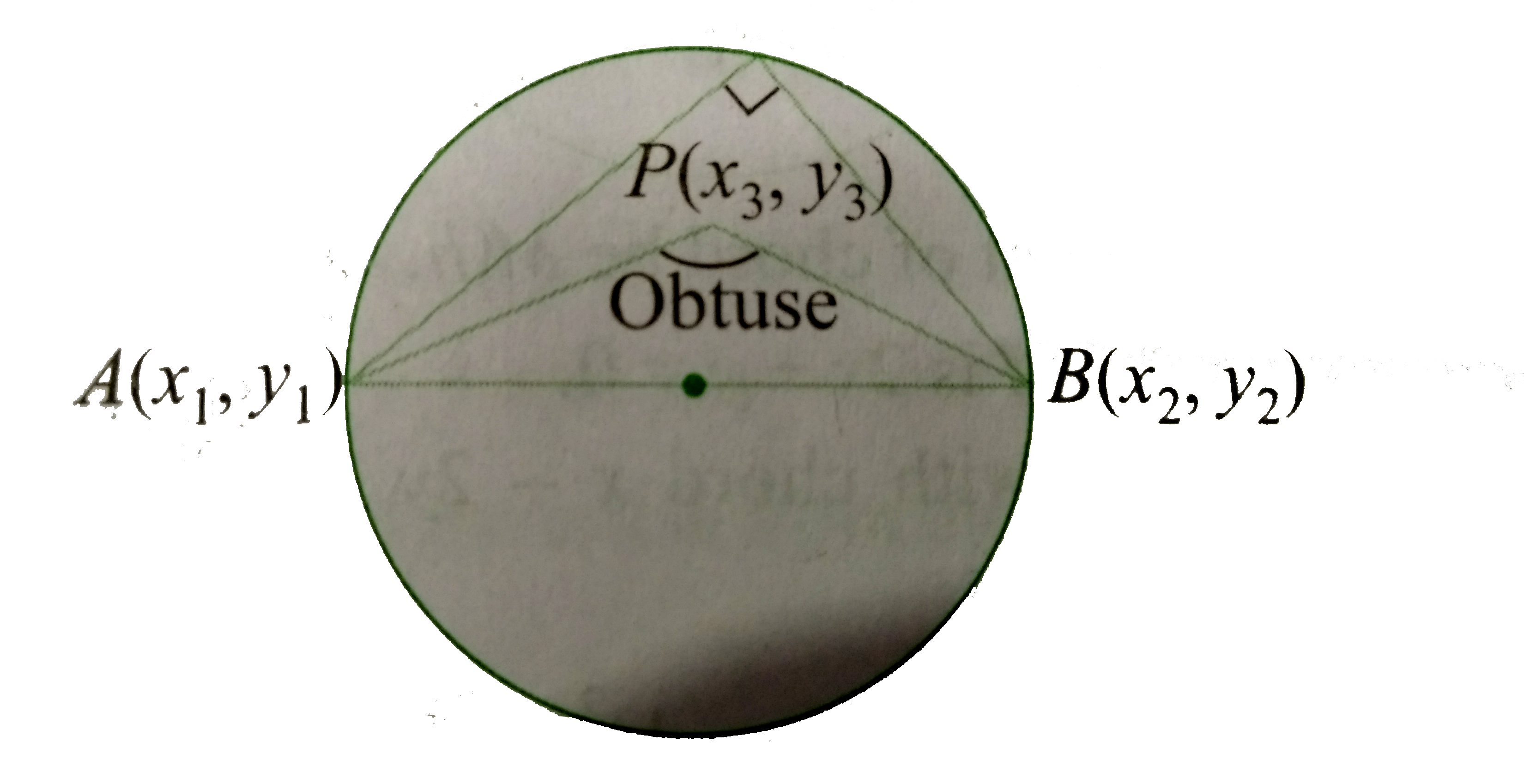
The equation of the circle with AB as diameter is
`(x-x_(1))(x-x_(2))+(y-y_(1))(y-y_(2))=0`

Since AB subtends an obtuse angle at `(x_(3),y_(3))` , P lies inside the circle. Therefore,
`(x_(3)-x_(1))(x_(3)-x_(2))+(y_(3)-y_(1))(y_(3)-y_(2))lt0`
Promotional Banner

Topper's Solved these Questions

  • CIRCLE

    CENGAGE ENGLISH|Exercise CONCEPT APPLICATION EXERCISE 4.5|5 Videos
  • CIRCLE

    CENGAGE ENGLISH|Exercise CONCEPT APPLICATION EXERCISE 4.6|6 Videos
  • CIRCLE

    CENGAGE ENGLISH|Exercise CONCEPT APPLICATION EXERCISE 4.3|3 Videos
  • BINOMIAL THEOREM

    CENGAGE ENGLISH|Exercise Matrix|4 Videos
  • CIRCLES

    CENGAGE ENGLISH|Exercise Comprehension Type|8 Videos

Similar Questions

Explore conceptually related problems

If three points (x_1,y_1),(x_2, y_2),(x_3, y_3) lie on the same line, prove that (y_2-y_3)/(x_2x_3)+(y_3-y_1)/(x_3x_1)+(y_1-y_2)/(x_1x_2)=0

If the points (x_1, y_1),(x_2,y_2), and (x_3, y_3) are collinear show that (y_2-y_3)/(x_2x_3)+(y_3-y_1)/(x_3x_1)+(y_1-y_2)/(x_1x_2)=0

If the normals to the ellipse x^2/a^2+y^2/b^2= 1 at the points (x_1, y_1), (x_2, y_2) and (x_3, y_3) are concurrent, prove that |(x_1,y_1,x_1y_1),(x_2,y_2,x_2y_2),(x_3,y_3,x_3y_3)|=0 .

If the tangent at (x_1,y_1) to the curve x^3+y^3=a^3 meets the curve again in (x_2,y_2), then prove that (x_2)/(x_1)+(y_2)/(y_1)=-1

If the tangent at (x_1,y_1) to the curve x^3+y^3=a^3 meets the curve again in (x_2,y_2), then prove that (x_2)/(x_1)+(y_2)/(y_1)=-1

If the points (x_1,y_1),(x_2,y_2)and(x_3,y_3) are collinear, then the rank of the matrix {:[(x_1,y_1,1),(x_2,y_2,1),(x_3,y_3,1)]:} will always be less than

If y=(a x+b)/(x^2+c), prove that (2x y_1+y)y_3=3(x y_2+y_1)y_2.

A triangle has vertices A_i(x_i , y_i)fori=1,2,3 If the orthocentre of triangle is (0,0), then prove that |x_2-x_3 y_2-y_3 y_1(y_2-y_3)+x_1(x_2-x_3) x_3-x_1y_2-y_3y_2(y_3-y_1)+x_1(x_3-x_1) x_1-x_2y_2-y_3y_3(y_1-y_2)+x_1(x_1-x_2)|=0

A triangle has vertices A_(i) (x_(i),y_(i)) for i= 1,2,3,. If the orthocenter of triangle is (0,0) then prove that |{:(x_(2)-x_(3),,y_(2)-y_(3),,y_(1)(y_(2)-y_(3))+x_(1)(x_(2)-x_(3))),(x_(3)-x_(1) ,,y_(3)-y_(1),,y_(2)(y_(3)-y_(1))+x_(2)(x_(3)-x_(1))),( x_(1)-x_(2),,y_(1)-y_(2),,y_(3)(y_(1)-y_(2))+x_(3)(x_(1)-x_(2))):}|=0

An equilateral triangle has each side to a. If the coordinates of its vertices are (x_(1), y_(1)), (x_(2), y_(2)) and (x_(3), y_(3)) then the square of the determinat |(x_(1),y_(1),1),(x_(2),y_(2),1),(x_(3),y_(3),1)| equals

