Home
Class 12
MATHS
Let C1 and C2 be two circles whose equat...

Let `C_1` and `C_2` be two circles whose equations are `x^2+y^2-2x=0` and `x^2+y^2+2x=0` and `P(lambda, lambda)` is a variable point . List 1 a) P lies inside C1 ​ but outside C2 ​ 2)P lies inside C2 ​ but outside C1 ​ c)P lies outside C1 ​ but outside C2 ​ d)P does not lie inside C2 ​ List 2 p)λ ϵ (−∞,−1)∪(0,∞) q)λ ϵ (−∞,−1)∪(1,∞) r)λ ϵ (−1,0) s)λ ϵ (0,1)

A

r,s,p,q

B

p,s,q,r

C

q,p,s,r

D

s,r,q,p

Text Solution

Verified by Experts

The correct Answer is:
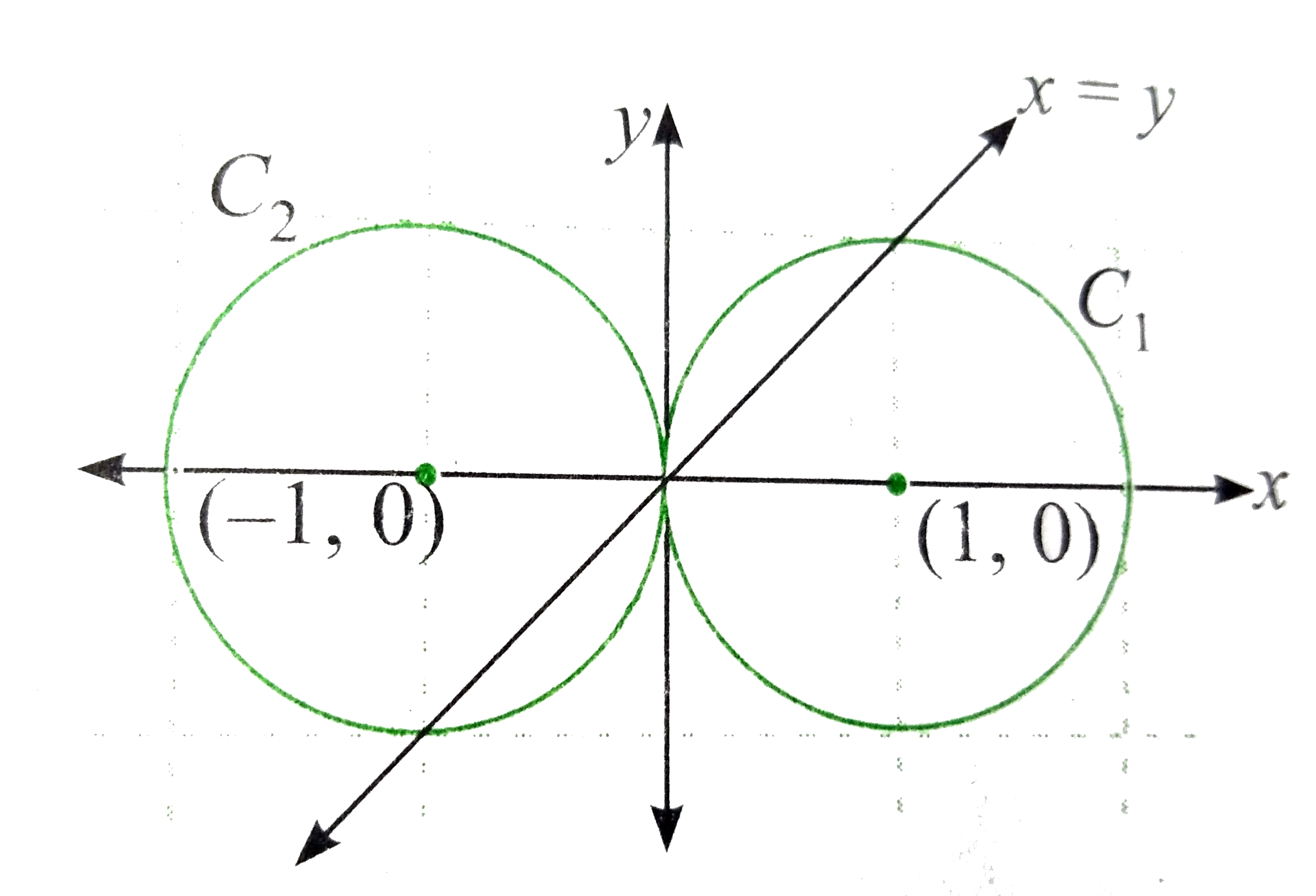
4


`( lambda, lambda)` lies on the line `y=x` ltbr. From the diagram, answer is (4)
Promotional Banner

Topper's Solved these Questions

  • CIRCLE

    CENGAGE ENGLISH|Exercise For problems 3 and 4|2 Videos
  • BINOMIAL THEOREM

    CENGAGE ENGLISH|Exercise Matrix|4 Videos
  • CIRCLES

    CENGAGE ENGLISH|Exercise Comprehension Type|8 Videos

Similar Questions

Explore conceptually related problems

Let C_1 and C_2 are circles defined by x^2+y^2 -20x+64=0 and x^2+y^2+30x +144=0 . The length of the shortest line segment PQ that is tangent to C_1 at P and to C_2 at Q is

Let C_1 and C_2 are circles defined by x^2+y^2 -20x+64=0 and x^2+y^2+30x +144=0 . The length of the shortest line segment PQ that is tangent to C_1 at P and to C_2 at Q is

Let C_1 and C_2 are circles defined by x^2+y^2 -20x+64=0 and x^2+y^2+30x +144=0 . The length of the shortest line segment PQ that is tangent to C_1 at P and to C_2 at Q is

Let E be the ellipse (x^2)/9+(y^2)/4=1 and C be the circle x^2+y^2=9 . Let Pa n dQ be the points (1, 2) and (2, 1), respectively. Then Q lies inside C but outside E Q lies outside both Ca n dE P lies inside both C and E P lies inside C but outside E

If circles x^(2)+y^(2)+2x+2y+c=0 and x^(2)+y^(2)+2ax+2ay+c=0 where c in R^(+), a != 1 are such that one circle lies inside the other, then

C1 and C2 are two concentric circles, the radius of C2 being twice that of C1. From a point P on C2, tangents PA and PB are drawn to C1. Then the centroid of the triangle PAB (a) lies on C1 (b) lies outside C1 (c) lies inside C1 (d) may lie inside or outside C1 but never on C1

If a, b are the roots of equation x^(2)-3x + p =0 and c, d are the roots of x^(2) - 12x + q = 0 and a, b, c, d are in G.P., then prove that : p : q =1 : 16

If b_1. b_2=2(c_1+c_2) then at least one of the equation x^2+b_1x+c_1=0 and x^2+b_2x+c_2=0 has a) imaginary roots b) real roots c) purely imaginary roots d) none of these

If p and q are the roots of the equation x^2-p x+q=0 , then (a) p=1,\ q=-2 (b) p=1,\ q=0 (c) p=-2,\ q=0 (d) p=-2,\ q=1

Let C_1 and C_2 are concentric circles of radius 1and 8/3 respectively having centre at (3,0) on the argand plane. If the complex number z satisfies the inequality log_(1/3)((|z-3|^2+2)/(11|z-3|-2))>1, then (a) z lies outside C_(1) but inside C_(2) (b) z line inside of both C_(1) and C_(2) (c) z line outside both C_(1) and C_(2) (d) none of these

