Home
Class 12
MATHS
Normal to the ellipse (x^2)/(84)+(y^2)/(...

Normal to the ellipse `(x^2)/(84)+(y^2)/(49)=1` intersects the major and minor axes at `Pa n dQ` , respectively. Find the locus of the point dividing segment `P Q` in the ratio 2:1.

Text Solution

Verified by Experts
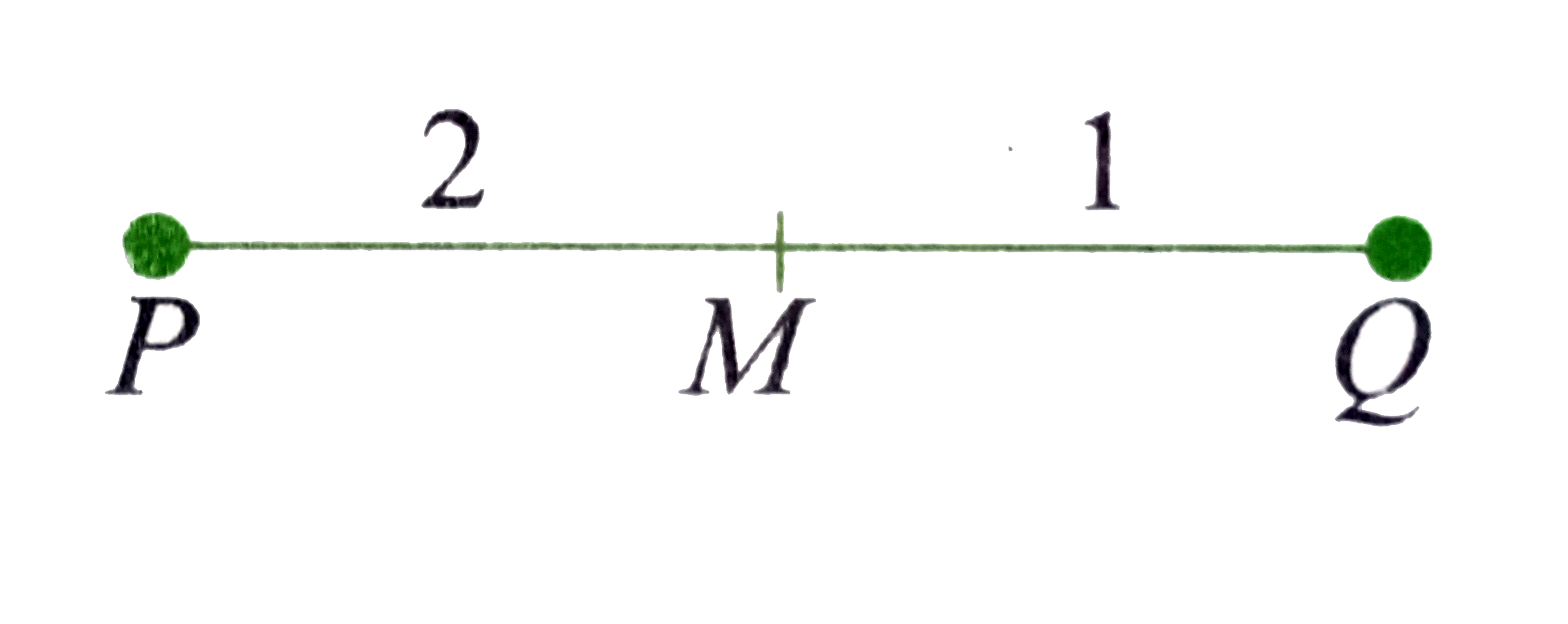
The equation of normal is `8x sec thea-7y=15`
It meets the exes at
`P((15)/(8)costheta,0) and Q(0,(-15)/(7)sin theta)`
Let M(h,k) divides PQ in ratio `2:1` Thefefore,
`3h=(15)/(8)cos theta, 3k=-(30)/(7)sin theta`
`:. Cos theta=(8h)/(5),sin theta=(-7k)/(10)`

Eliminating `theta`m we get the locus as
`(64x^(2))/(25)+(49y^(2))/(100)=1`
Promotional Banner

Similar Questions

Explore conceptually related problems

Normal to the ellipse (x^2)/(64)+(y^2)/(49)=1 intersects the major and minor axes at Pa n dQ , respectively. Find the locus of the point dividing segment P Q in the ratio 2:1.

A tangent having slope of -4/3 to the ellipse (x^2)/(18)+(y^2)/(32)=1 intersects the major and minor axes at points A and B , respectively. If C is the center of the ellipse, then find area of triangle A B Cdot

P is any point on the auxililary circle of the ellipse (x^(2))/(a^(2))+(y^(2))/(b^(2))=1 and Q is its corresponding point on the ellipse. Find the locus of the point which divides PQ in the ratio of 1:2 .

For the ellipse 4(x - 2y + 1)^2 +9(2x+y+ 2)^2 = 180 , lengths of major and minor axes are respectively

If normal at any poin P on the ellipse (x^(2))/(a^(2))+(y^(2))/(b^(2))=1 (agtbgt0) meets the major and minor axes at Q and R, respectively, so that 3PQ=2PR, then find the eccentricity of ellipse

If a tangent to the circle x^(2)+y^(2)=1 intersects the coordinate axes at distinct points P and Q, then the locus of the mid-point of PQ is :

If the normal at any point P of the ellipse (x^(2))/(16)+(y^(2))/(9) =1 meets the coordinate axes at M and N respectively, then |PM|: |PN| equals

If the normal at any point P on the ellipse cuts the major and minor axes in G and g respectively and C be the centre of the ellipse, then

If the normal at any point P of the ellipse x^2/a^2 + y^2/b^2 = 1 meets the major and minor axes at G and E respectively, and if CF is perpendicular upon this normal from the centre C of the ellipse, show that PF.PG=b^2 and PF.PE=a^2 .

The given equation of the ellipse is (x^(2))/(81) + (y^(2))/(16) =1 . Find the length of the major and minor axes. Eccentricity and length of the latus rectum.

