Home
Class 12
MATHS
The point of intersection of the tangent...

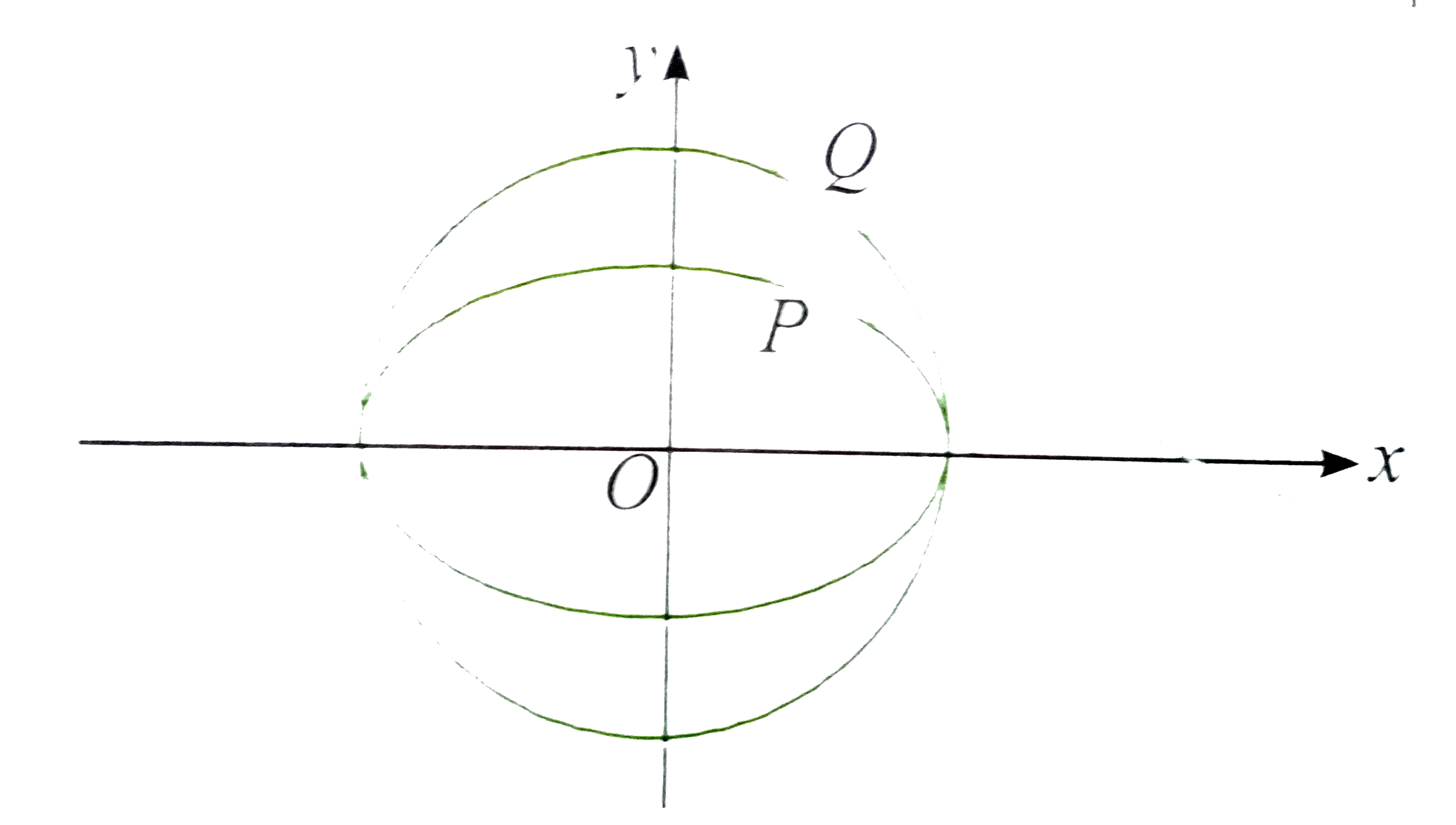
The point of intersection of the tangents at the point `P` on the ellipse `(x^2)/(a^2)+(y^2)/(b^2)=1` and its corresponding point `Q` on the auxiliary circle meet on the line `x=a/e` (b) `x=0` `y=0` (d) none of these

A

x=a/e

B

x=0

C

y=0

D

none of these

Text Solution

Verified by Experts


Tangent to the ellipse at point `P(a cos theta, a sin theta)` is `(x)/(a)cos thea+(y)/(b) sin theta=1" (1)`
Tangent (1) and (2) intersect at `(a//cos theta, 0)` which lies on y=0
Promotional Banner

Similar Questions

Explore conceptually related problems

The point of intersection of the tangents at the point P on the ellipse (x^2)/(a^2)+(y^2)/(b^2)=1 and its corresponding point Q on the auxiliary circle meet on the line (a) x=a/e (b) x=0 (c) y=0 (d) none of these

The locus of the point of intersection of tangents to the ellipse (x^(2))/(a^(2))+(y^(2))/(b^(2))=1 which meet at right , is

The point of intersection of tangents drawn to the hyperbola (x^2)/(a^2)-(y^2)/(b^2)=1 at the points where it is intersected by the line l x+m y+n=0 is

The locus of the point of intersection of tangents to the ellipse x^(2)/a^(2) + y^(2)/b^(2) = 1 at the points whose eccentric angles differ by pi//2 , is

The locus of the point of intersection of tangents to the ellipse x^(2)/a^(2) + y^(2)/b^(2) = 1 at the points whose eccentric angles differ by pi//2 , is

The locus of point of intersection of tangents to an ellipse x^2/a^2+y^2/b^2=1 at two points the sum of whose eccentric angles is constant is

The locus of point of intersection of tangents to an ellipse x^2/a^2+y^2/b^2=1 at two points the sum of whose eccentric angles is constant is

The locus of the point of intersection of the tangent at the endpoints of the focal chord of the ellipse (x^2)/(a^2)+(y^2)/(b^2)=1 ( b < a) (a) is a an circle (b) ellipse (c) hyperbola (d) pair of straight lines

The line x = at^(2) meets the ellipse x^(2)/a^(2) + y^(2)/b^(2) = 1 in the real points iff

The locus of the point of intersection of the perpendicular tangents to the circle x^(2)+y^(2)=a^(2), x^(2)+y^(2)=b" is "