Home
Class 12
MATHS
Tangents are drawn to the ellipse (x^2)/...

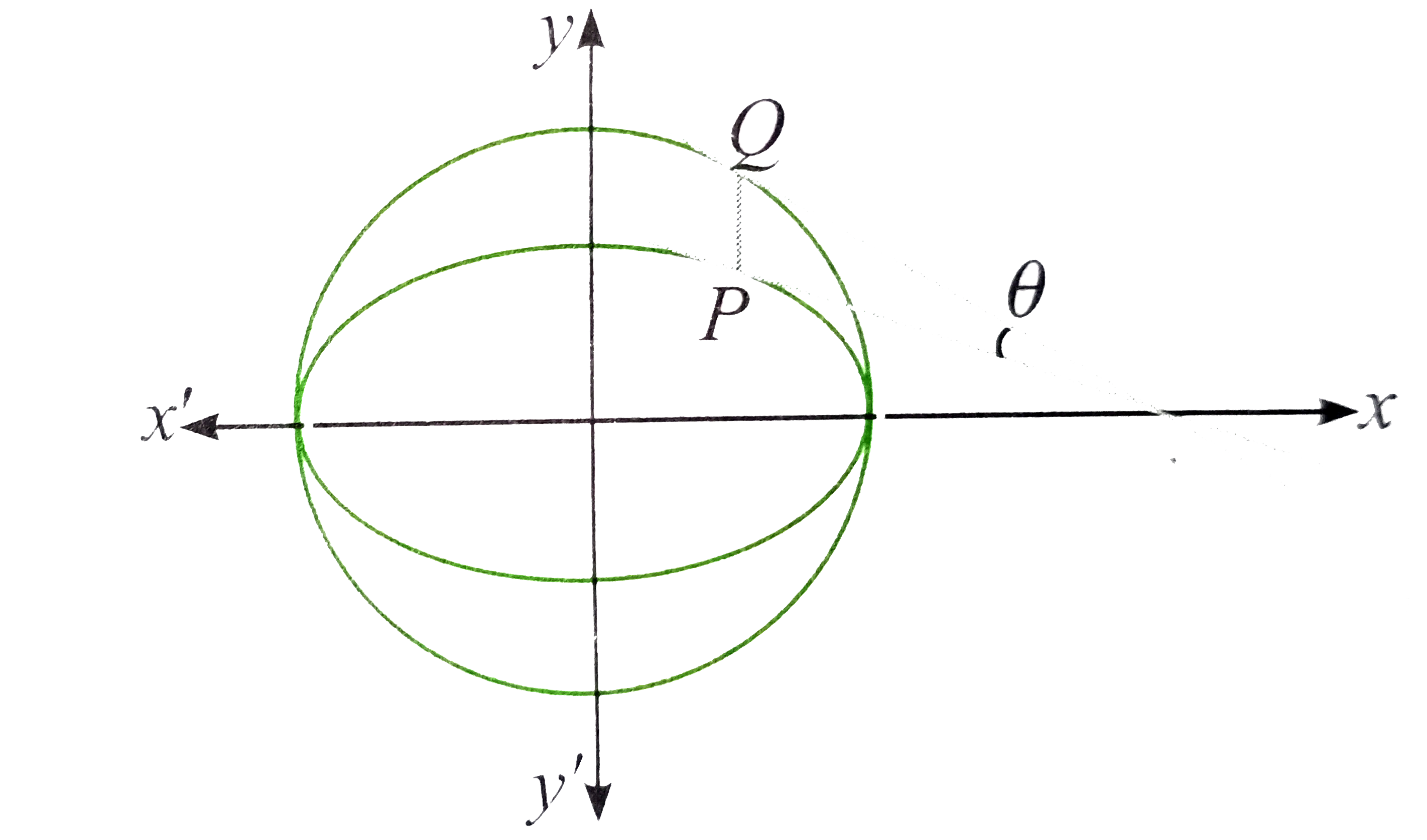
Tangents are drawn to the ellipse `(x^2)/(a^2)+(y^2)/(b^2)=1,(a > b),` and the circle `x^2+y^2=a^2` at the points where a common ordinate cuts them (on the same side of the x-axis). Then the greatest acute angle between these tangents is given by `tan^(-1)((a-b)/(2sqrt(a b)))` (b) `tan^(-1)((a+b)/(2sqrt(a b)))` `tan^(-1)((2a b)/(sqrt(a-b)))` (d) `tan^(-1)((2a b)/(sqrt(a+b)))`

A

`tan^(-1)((a-b)/(2sqrt(ab)))`

B

`tan^(-1)((a+b)/(2sqrt(ab)))`

C

`tan^(-1)((2ab)/(2sqrt(a-b)))`

D

`tan^(-1)((2ab)/(2sqrt(a+b)))`

Text Solution

Verified by Experts


Tanent to the ellipse at `P( a cos alpha, b sin alpha)` is `(x)/(a) cos alpha+(y)/(b) isn alpha=1" "(1)`
Tangent to the circle at `Q(a cos, alpha, a sin alpha)` is ` cos ax+sin alphay=a " "(2)`
Now, the angle between the tangents is `theta`. Then, `tan theta=|(-(b)/(a)cotalpha-(-cot alpha))/(1+(-(b)/(a)cot alpha)(-cot alpha))|`
`=|(cos alpha(1-(b)/(a)))/(1+(b)/(a)cot^(2)alpha)|=|(a-b)/(a tan alpha+b cot alpha)|`
`=|(a-b)/((sqrt(atanalpha)-sqrt(bcotalpha))^(2)+2sqrt(ab))|`
Now, the greatest value of the above expression is `|(a-b)/(2sqrt(ab))|` when `sqrt(tan alpha)= sqrt (b tan alpha)`. Therefore,
`theta_("maximum")=tan^(-1)((a-b)/(2sqrt(ab)))`
Promotional Banner

Similar Questions

Explore conceptually related problems

Tangents are drawn to the ellipse (x^2)/(a^2)+(y^2)/(b^2)=1,(a > b), and the circle x^2+y^2=a^2 at the points where a common ordinate cuts them (on the same side of the x-axis). Then the greatest acute angle between these tangents is given by (A) tan^(-1)((a-b)/(2sqrt(a b))) (B) tan^(-1)((a+b)/(2sqrt(a b))) (C) tan^(-1)((2a b)/(sqrt(a-b))) (D) tan^(-1)((2a b)/(sqrt(a+b)))

If a tangent of slope 1/3 of the ellipse (x^2)/a^2+y^2/b^2=1(a > b) is normal to the circle x^2 + y^2 + 2x + 2 y +1=0 then

Prove that the ellipse x^2/a^2 + y^2/b^2 = 1 and the circle x^2 + y^2 = ab intersect at an angle tan^(-1) (|a-b|/sqrt(ab)) .

A normal to parabola, whose inclination is 30^(@) , cuts it again at an angle of (a) tan^(-1)((sqrt(3))/(2)) (b) tan^(-1)((2)/(sqrt(3))) (c) tan^(-1)(2sqrt(3)) (d) tan^(-1)((1)/(2sqrt(3)))

Tangents are drawn to the ellipse from the point ((a^2)/(sqrt(a^2-b^2)),sqrt(a^2+b^2))) . Prove that the tangents intercept on the ordinate through the nearer focus a distance equal to the major axis.

A tangent is drawn to the ellipse to cut the ellipse x^2/a^2+y^2/b^2=1 and to cut the ellipse x^2/c^2+y^2/d^2=1 at the points P and Q. If the tangents are at right angles, then the value of (a^2/c^2)+(b^2/d^2) is

If 3tan^(-1)(1/(2+sqrt(3)))-tan^(-1)1/x=tan^(-1)1/3, then x is equal to 1 (b) 2 (c) 3 (d) sqrt(2)

Find the equations of the tangent and the normal to the curve (x^2)/(a^2)-(y^2)/(b^2)=1 at (sqrt(2)a ,\ b) at indicated points.

The slopes of the common tangents of the ellipse (x^2)/4+(y^2)/1=1 and the circle x^2+y^2=3 are +-1 (b) +-sqrt(2) (c) +-sqrt(3) (d) none of these

If a , b , c >0 and s=(a+b+c)/2,p rov et h a t tan^(-1)sqrt((2a s)/(b c))+tan^(-1)sqrt((2b s)/(c a))+tan^(-1)sqrt((2c s)/(a b))=pi