Home
Class 12
MATHS
If alpha-beta= constant, then the locus ...

If `alpha-beta=` constant, then the locus of the point of intersection of tangents at `P(acosalpha,bsinalpha)` and `Q(acosbeta,bsinbeta)` to the ellipse `(x^2)/(a^2)+(y^2)/(b^2)=1` is a circle (b) a straight line an ellipse (d) a parabola

A

a cricle

B

a straigth line

C

an ellipse

D

a parabola

Text Solution

Verified by Experts

Tangents to the ellipse at P and Q are, respectively,
`(x)/(a) cos alpha+(y)/(b) sin alpha=`
`and (x)/(a) cos beta+(y)/(b) sin beta=1`
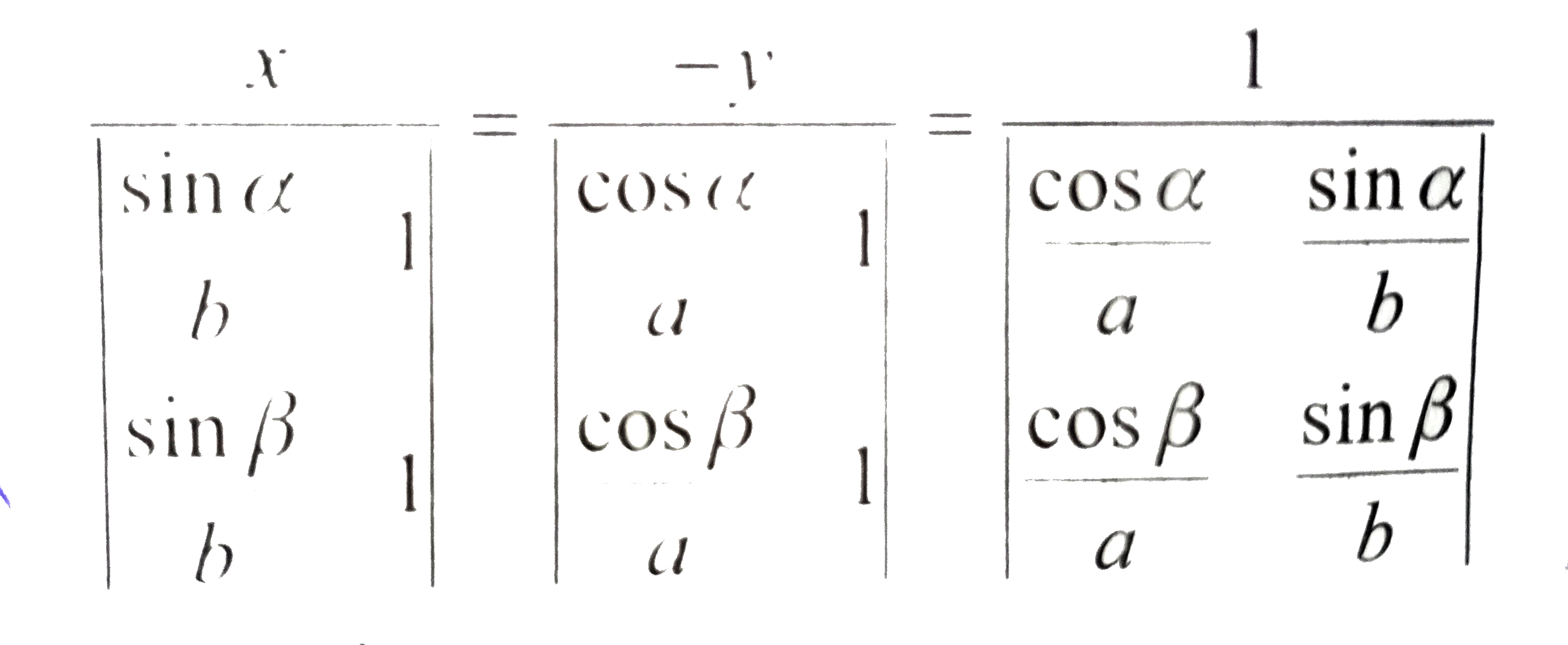
Solving, (1) and (2) , we get

or `x=(a(sinalpha-sinbeta))/(sin(beta-alpha))`
and `y=(-b(cosalpha-cosbeta))/(sin(beta-alpha))`
`and =(-xsin(beta-alpha))/(a)=sinalpha-sinbeta`
`y=(-ysin(beta-alpha))/(a)=(cosalpha-cosbeta)`
Saqring and adding. we get
`sin^(2)(beta-alpha)((x^(2))/(a^(2))+(y^(2))/(b^(2)))=2`
`(x^(2))/(a^(2))+(y^(2))/(b^(2))=(2)/(sin^(2)c) " "` [ where `beta-alpha=c` (constant) given]
which is an ellipse
Promotional Banner

Similar Questions

Explore conceptually related problems

If alpha-beta= constant, then the locus of the point of intersection of tangents at P(acosalpha,bsinalpha) and Q(acosbeta,bsinbeta) to the ellipse (x^2)/(a^2)+(y^2)/(b^2)=1 is: (a) a circle (b) a straight line (c) an ellipse (d) a parabola

The line x cos alpha +y sin alpha =p is tangent to the ellipse (x^(2))/(a^(2))+(y^(2))/(b^(2))=1. if

The line x cos alpha + y sin alpha =p is tangent to the ellipse (x^(2))/(a^(2))+(y^(2))/(b^(2))=1. if

The locus of the point of intersection of the tangent at the endpoints of the focal chord of the ellipse (x^2)/(a^2)+(y^2)/(b^2)=1 ( b < a) (a) is a an circle (b) ellipse (c) hyperbola (d) pair of straight lines

The ellipse (x^2)/(a^2)+(y^2)/(b^2)=1 and the straight line y=mx+c intersect in real points only if:

The locus of the point of intersection of tangents to the ellipse x^(2)/a^(2) + y^(2)/b^(2) = 1 , which make complementary angles with x - axis, is

If the locus of the point of intersection of perpendicular tangents to the ellipse x^2/a^2+y^2/b^2=1 is a circle with centre at (0,0), then the radius of the circle would be

The locus of the point of intersection of tangents to the ellipse x^(2)/a^(2) + y^(2)/b^(2) = 1 at the points whose eccentric angles differ by pi//2 , is

The locus of the point of intersection of tangents to the ellipse x^(2)/a^(2) + y^(2)/b^(2) = 1 at the points whose eccentric angles differ by pi//2 , is

Find the locus of the points of the intersection of tangents to ellipse x^(2)/a^(2)+y^(2)/b^(2)=1 which make an angle theta.