Home
Class 12
MATHS
The coordinates (2, 3) and (1, 5) are th...

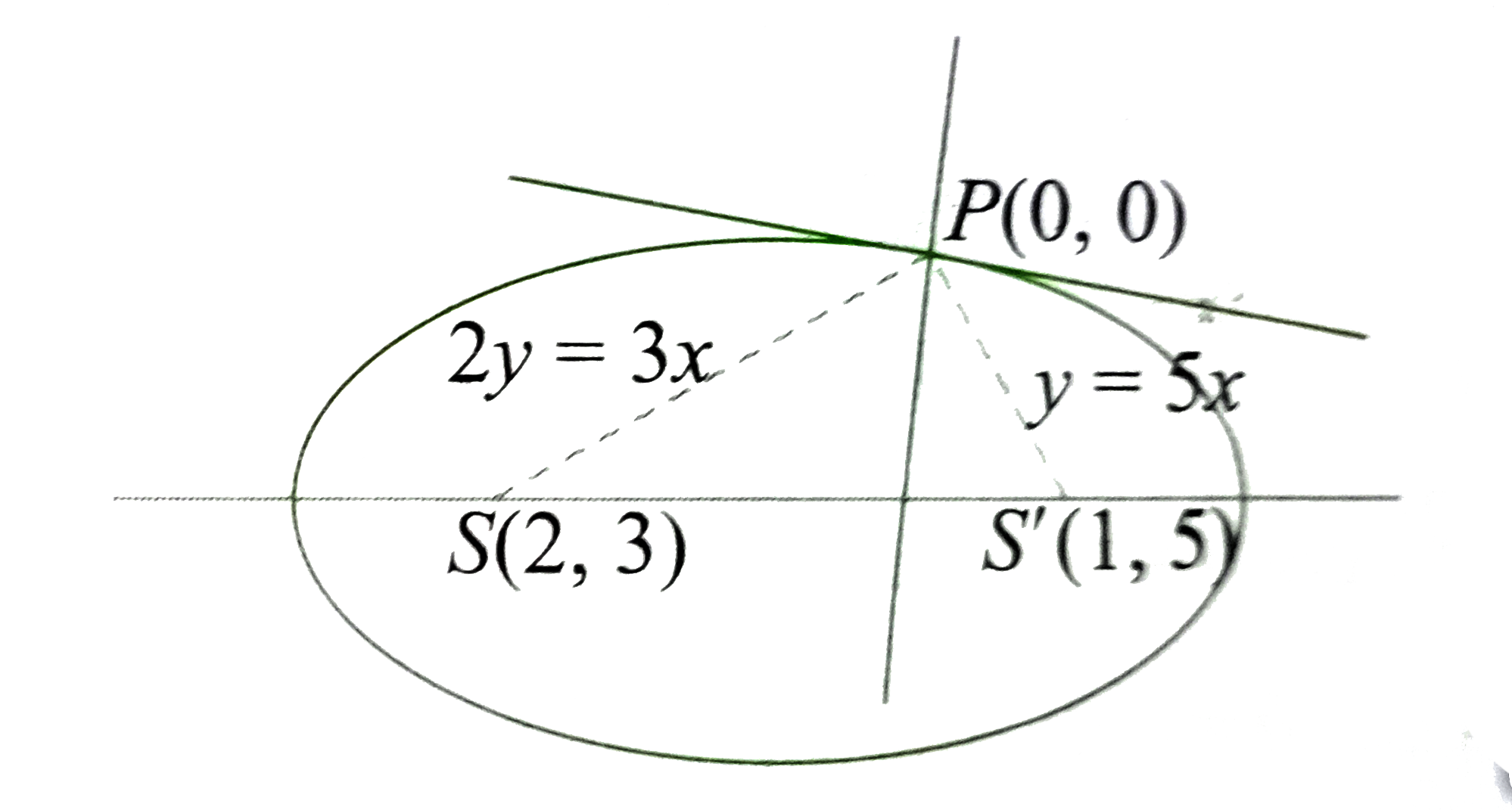
The coordinates (2, 3) and (1, 5) are the foci of an ellipse which passes through the origin. Then the equation of the tangent at the origin is `(3sqrt(2)-5)x+(1-2sqrt(2))y=0` tangent at the origin is `(3sqrt(2)+5)x+(1+2sqrt(2)y)=0` tangent at the origin is `(3sqrt(2)+5)x-(2sqrt(2+1))y=0` tangent at the origin is `(3sqrt(2)-5)-y(1-2sqrt(2))=0`

A

tangent at the origin is `(3sqrt(2)-5)x+(1-2sqrt(2))y=0`

B

tangent at the origin is `(3sqrt(2)-5)x+(1+2sqrt(2))y=0`

C

tangent at the origin is `(3sqrt(2)-5)x-(2sqrt(2)+1)y=0`

D

tangent at the origin is `(3sqrt(2)-5)-y-(1-2sqrt(2))=0`

Text Solution

Verified by Experts

Tangent and normal are bisector of `angleSPS`
Now, the eqaution of SP is `y=3x//2` and that of SP is y=5,
Then equation of angle bisectors are
`(3x-2y)/(sqrt(13))=+-(5x-y)/(sqrt(26))`
or `3x-2y=+(5x-y)/(sqrt(2))`
Therefore ,the lines are
`(3sqrt(2)-5)x+(1-2sqrt(2))y=0`
and `(3sqrt(2)+5)x-2sqrt(2)+1)y=0`
Now, (2,3) and (1,5) line on the same side of `(3sqrt(3)-5)x+(1-2sqrt(2)y=0`, which is the equation of tangent.

Points (2,3) adn (1,5) a line on the different sides of `(3sqrt(2)+5)x+(2-sqrt(2)+1)y=0`, which is the equation of normal
Promotional Banner

Similar Questions

Explore conceptually related problems

The coordinates (2, 3) and (1, 5) are the foci of an ellipse which passes through the origin. Then the equation of the (a)tangent at the origin is (3sqrt(2)-5)x+(1-2sqrt(2))y=0 (b)tangent at the origin is (3sqrt(2)+5)x+(1+2sqrt(2)y)=0 (c)tangent at the origin is (3sqrt(2)+5)x-(2sqrt(2+1))y=0 (d)tangent at the origin is (3sqrt(2)-5)-y(1-2sqrt(2))=0

Find the equation of tangent to the curve y=sin^(-1)(2x)/(1+x^2)a tx=sqrt(3)

Find the equation of tangent to y=int_(x^2)^(x^3)(dt)/(sqrt(1+t^2))a tx=1.

Radius of the circle that passes through the origin and touches the parabola y^2=4a x at the point (a ,2a) is (a) 5/(sqrt(2))a (b) 2sqrt(2)a (c) sqrt(5/2)a (d) 3/(sqrt(2))a

Find the equation of the tangent line to the curve y=sqrt(5x-3)-2 which is parallel to the line 4x-2y+3=0

Find the equation of the tangent to the curve y=sqrt(3x-2) which is parallel to the line 4x-2y+5=0.

Find the equation of the tangent line to the curve y=sqrt(5x-3)-2 which is parallel to the line 4x-2y+3=0 .

Find the equation of the tangent to the curve y=sqrt(3x-2) which is parallel to the line 4x-2y + 5 =0 .

The distance between the origin and the tangent to the curve y=e^(2x)+x^2 drawn at the point x=0 is (a) (1/sqrt(5)) (b) (2/sqrt(5)) (c) (-(1)/sqrt(5)) (d) (2/sqrt(3))

An equation of a circle through the origin, making an intercept of sqrt(10) on the line y = 2x + (5)/(sqrt(2)) , which subtends an angle of 45^(@) at the origin is