Home
Class 12
MATHS
A particle just clears a wall of heig...

A particle just clears a wall of height b at distance a and strikes the ground at a distance c from the point of projection. The angle of projection is (1) `tan^(-1)b/(a c)` (2) `"45"^o` (3) `tan^(-1)(b c)/(a(c-a)` (4) `tan^(-1)(b c)/a`

A

`(3,0) and (0,2)`

B

`(-8//5,2sqrt(161)//15) and (-9//5,8//5)`

C

`(8//5,2sqrt(161)//15 and (0,2)`

D

`(3,0) and (-9//5,8//5)`

Text Solution

Verified by Experts

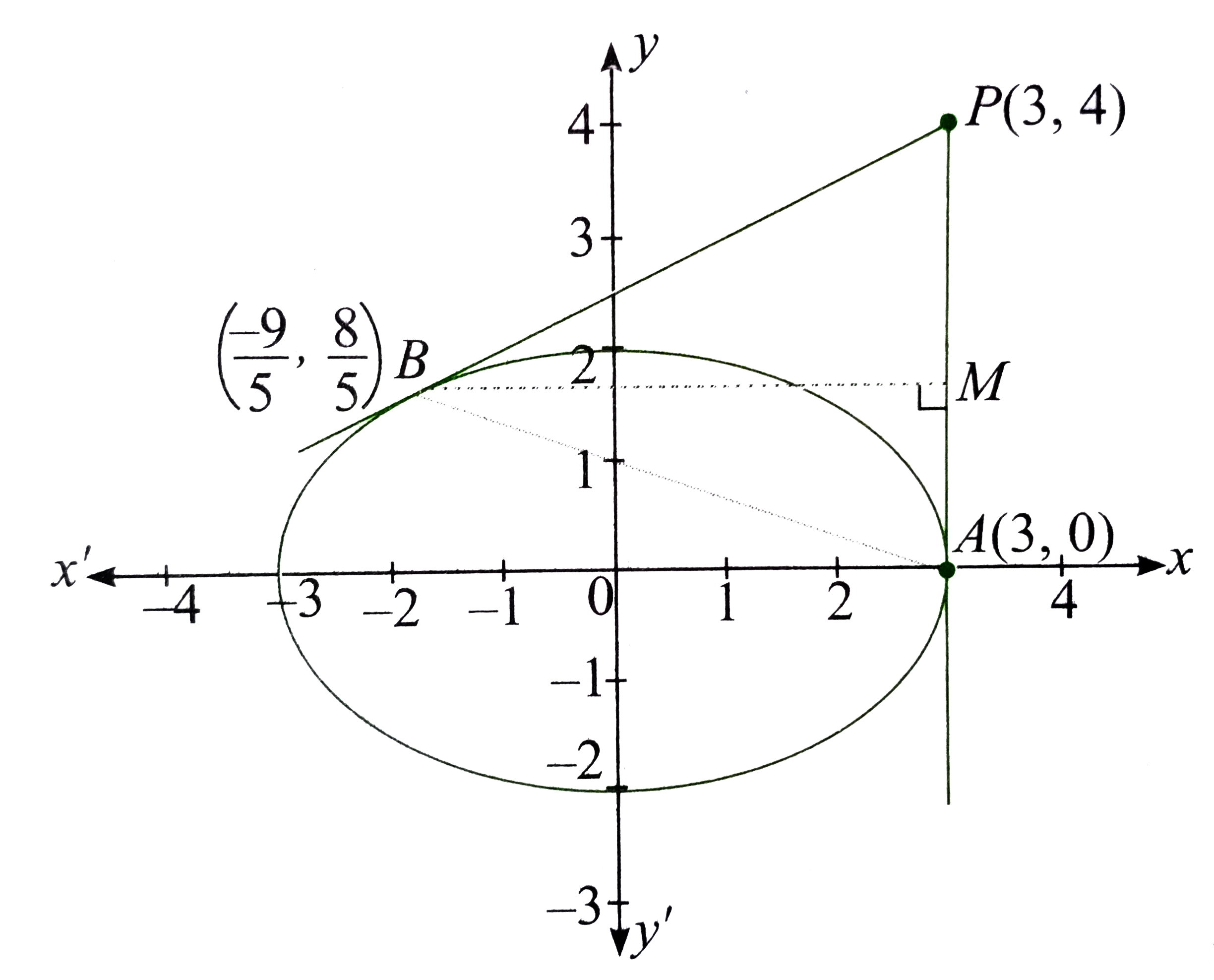
Given ellipse `(x^(2))/(9)+(y^(2))/(4)=1`
The equation of tangent having slope m is
`y=mx+sqrt(9m^(2)+4)`
Sqaring , we have
`16+9m^(2)-24m=9m^(2)+4`
or `m=(12)/(24)=(1)/(2)`
Threrefpre, the equation of tangent is `y-4=-(x-3)pr x-2y+5=0 " "(1)`
Let the point of contact on the curve be `B(alpha,beta)`
Equation of tangent at this point is `(xalpha)/(9)+(ybeta)/(4)-1=0" "(2)`
Comparing equations (1) and (2)
`(alpha//9)/(1)=(beta//4)/(-2)=-(1)/(5)`
or `alpha=-(9)/(5),beta=(8)/(5)" " :. B-=(-(9)/(5),(8)/(5))`
Another slope of tangent is `oo` then the equation of tanents is `x=3` and the coresponding point of cocntact is A(3,0)
Promotional Banner

Similar Questions

Explore conceptually related problems

Let a, b and c be positive real numbers. Then prove that tan^(-1) sqrt((a(a + b + c))/(bc)) + tan^(-1) sqrt((b (a + b + c))/(ca)) + tan^(-1) sqrt((c(a + b+ c))/(ab)) =' pi'

If sqrt(3)+i=(a+i b)(c+i d) , then find the value of tan^(-1)(b//a)+tan^(-1)(d//c)

If sqrt(3)+i=(a+i b)(c+i d) , then find the value of tan^(-1)(b//a) + tan^(-1)(d//c)dot

If sqrt(3)+i=(a+i b)(c+i d) , then find the value of tan^(-1)(b//a)tan^(-1)(d//c)dot

If A +B+C= pi and /_C is obtuse then tan A. tan B is

Prove that : tan^(-1)( (a^3 -b^3)/(1+a^3 b^3)) + tan^(-1)( (b^3 - c^3)/(1+b^3 c^3)) + tan^(-1)( (c^3 - a^3)/(1+c^3 a^3)) = 0

The angle between the curves y^2=x and x^2=y at (1,\ 1) is tan^(-1)4/3 (b) tan^(-1)3/4 (c) 90 (d) 45

Prove that tan^(-1)((a-b)/(1+ab))+ tan^(-1)((b-c)/(1+bc))+tan^(-1)((c-a)/(1+ca))=0 , ab>(-1), bc>(-1), ca>(-1)

In a triangle tan A+ tan B + tan C=6 and tan A tan B= 2, then the values of tan A, tan B and tan C are

Which of the following is greatest? tan1 (b) tan4 (c) tan7 (d) tan10