

Home
Class 12
MATHS
A point chanrge of magnitude q=4.5nC is ...

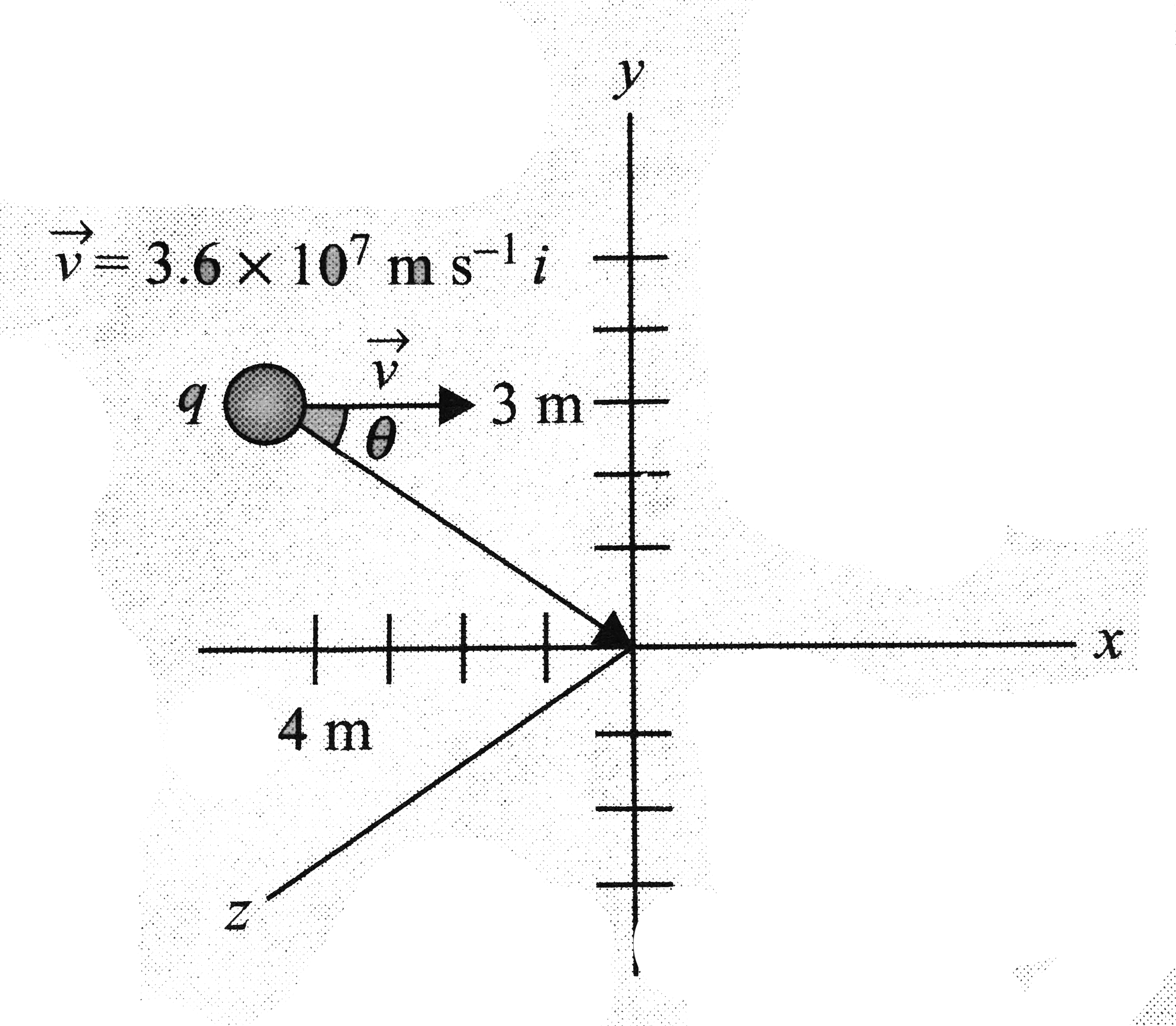
A point chanrge of magnitude `q=4.5nC` is moving with speed `v=3.6xx10^7ms^-1` parallel to the x-axis along the line `y=3m`. Find the magnetic field at the origin produced by this charge when the charge is at the point `x=-4 m`, `y=3m`, as shown in Fig.

Promotional Banner

Topper's Solved these Questions

  • ALGEBRA OF VECTORS

    RD SHARMA ENGLISH|Exercise All Questions|325 Videos
  • BINARY OPERATIONS

    RD SHARMA ENGLISH|Exercise All Questions|226 Videos

Similar Questions

Explore conceptually related problems

A particle of mass m=5 units is moving with a uniform speed v = 3 sqrt(2) units in the XY-plane along the y=x+4 . The magnitude of the angular momentum about origin is

A point charge q = - 8.0 nC is located at the origin. Find the electric field vector at the point x = 1.2 m, y = -1.6 m.

Find the magnitude of the electric field at a point 4 cm away from a line charge of density 2 xx 10^(-6) C m^(-1) .

As charge q=1muC is placed at point (1m,2m,4m) . Find the electric field at point P(0,-4m,3m)

Ratio of electric and magnetic field due to moving point charge if its speed is 4.5xx10^(5)m//s

A charge q = -2.0 muC is placed at origin. Find the electric field at (3 m, 4 m, 0) .

An elevator carrying a charge of 0.5C is moving down with a velocity of 5xx10^3ms^-1 . The elevator is 4m from the bottom and 3m horizontally from P as shown in Fig. What magnetic field ( muT ) does it produce at point P

An infinite number of charges, each of coulomb, are placed along x-axis at x = 1m, 3m, 9m and so on. Calculate the electric field at the point x = 0 due to these charges if all the charges are of the same sign.

Find the points on the curve y=4x^3-3x+5 at which the equation of the tangent is parallel to the X-axis.

A particle of charge -16xx10^(-18) coulomb moving with velocity 10 ms^(-1) along the x- axis , and an electric field of magnitude (10^(4))//(m) is along the negative z- ais . If the charged particle continues moving along the x - axis , the magnitude of B is

RD SHARMA ENGLISH-APPLICATION OF INTEGRALS-All Questions
  1. Using integration, find the area of the triangle ABC whose vertices ar...

    Text Solution

    |

  2. Using integration find the area of the triangular region whose side...

    Text Solution

    |

  3. A point chanrge of magnitude q=4.5nC is moving with speed v=3.6xx10^7m...

    Text Solution

    |

  4. Find dy/dx if y= logx+sinx

    Text Solution

    |

  5. Find dy/dx if x^2+y^2=16

    Text Solution

    |

  6. Find the area of the region included between the parabola y^2=x and...

    Text Solution

    |

  7. Draw a rough sketch of the region {(x,y): y^2 le 3x,3x^2 + 3y^2 le16 }...

    Text Solution

    |

  8. Draw a rough sketch of the region {(x , y): y^2lt=5x ,\ 5x^2+5y^2lt=36...

    Text Solution

    |

  9. Draw a rough sketch and find the area of the region bounded by the par...

    Text Solution

    |

  10. Find the area included between the parabolas y^2=4a x\ a n d\ x^2=4b y...

    Text Solution

    |

  11. Find the area of the region in the first quadrant enclosed by x-axis,...

    Text Solution

    |

  12. Find the area of the region bounded by y=sqrtx ,\ x=2y+3 in the first ...

    Text Solution

    |

  13. Find the area common to the circle x^2+y^2=16a^2 and the parabola y^2=...

    Text Solution

    |

  14. Find the area, lying above the x=axis and included between the circle ...

    Text Solution

    |

  15. Find the area enclosed by the parabolas y=5x^2a n d\ y=2x^2+9.

    Text Solution

    |

  16. The area common to the parabolas y=2x^2 and y=x^2+4 (in square units) ...

    Text Solution

    |

  17. Using integration, find the area of the region bounded by the triangle...

    Text Solution

    |

  18. Find the area of the region in the first quadrant enclosed by x-axis, ...

    Text Solution

    |

  19. Find the area of the region bounded by parabola y^2=2x+1\ and the lin...

    Text Solution

    |

  20. Find the area of the region bounded by the curves y=x-1 & (y-1)^2=4(x+...

    Text Solution

    |