

Home
Class 11
PHYSICS
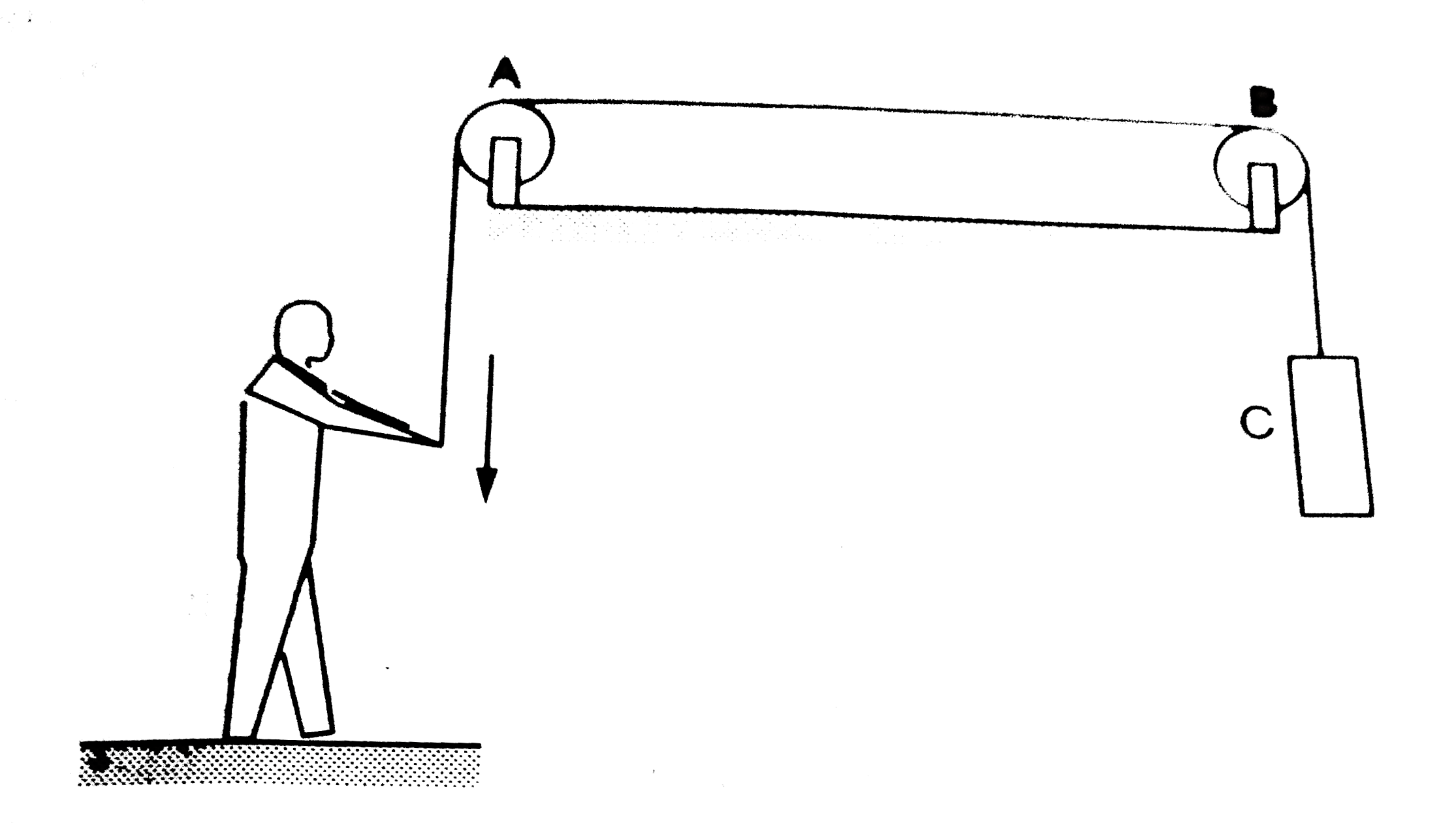
List all the forces acting on a. the pul...

List all the forces acting on a. the pulley A, b. the boy and c. the block C in figure

Promotional Banner

Topper's Solved these Questions

  • THE FORCES

    HC VERMA ENGLISH|Exercise Exercises|12 Videos
  • SPECIFIC HEAT CAPACITIES OF GASES

    HC VERMA ENGLISH|Exercise All Questions|75 Videos
  • WAVE MOTION AND WAVES ON A STRING

    HC VERMA ENGLISH|Exercise Question for short Answer|7 Videos

Similar Questions

Explore conceptually related problems

List all the forces acting on the block B in figure.

Consider a pulley fixed at its centre of mass by a clamp. A light rope is wound over it and the free end is tied to block. The tension in the rope is T. a. Write the forces acting on the pulley. How are they related? B. Locate the axis of rotation. c. Find the torque of the forces abut the axis of rotation.

Find the force of friction acting between both the blocks shown in the figure.

Figure shows a heavy block kept on a frictionless surfaces and being mass m. At t=0 , the force on the left rop is withdrawn but the force on the right end continues to act. Let F_(1) and F_(2) be the magnitudes of the forces acting on the block by the right rope and the left rope on the block respectively, then :

In the arrangement shown in figure, pulley is smooth and massless and all the strings are light. Let F_(1) be the force exerted on the pulley in case (i) and F_(2) the force in case (ii). Then :

Assuming all the surfaces to be frictionless accelration of the block c shown in the figure is

A block of mass m is kept over another block of mass M nd the system rests on a horizontal force F acting on the lower block produces an accelertion F/(2(m+M)) in the system the two blocks always move together. A. Find the coefficient of kinetic frictioin between the bigger block and th horizontal surface. b. find the frictional force acting on the smaller block. c. Find the work done by the force of friction on the smaller block by the bigger block during a displacement d of the system.

Consider the situation shown in figure. All the surfaces are frictions and the string and the pulley are light. Find the magnitude of the acceleration of the two blocks.

A block B is pulled by a force of 18 N applied to a light pulley as shown in the figure. If the coefficient of friction is 0.4 and the acceleration of the block is 0.5 ms^(-2) , the mass of the block is (g = 10 m//s^2)