Home
Class 11
PHYSICS
A small block B is placed on another blo...

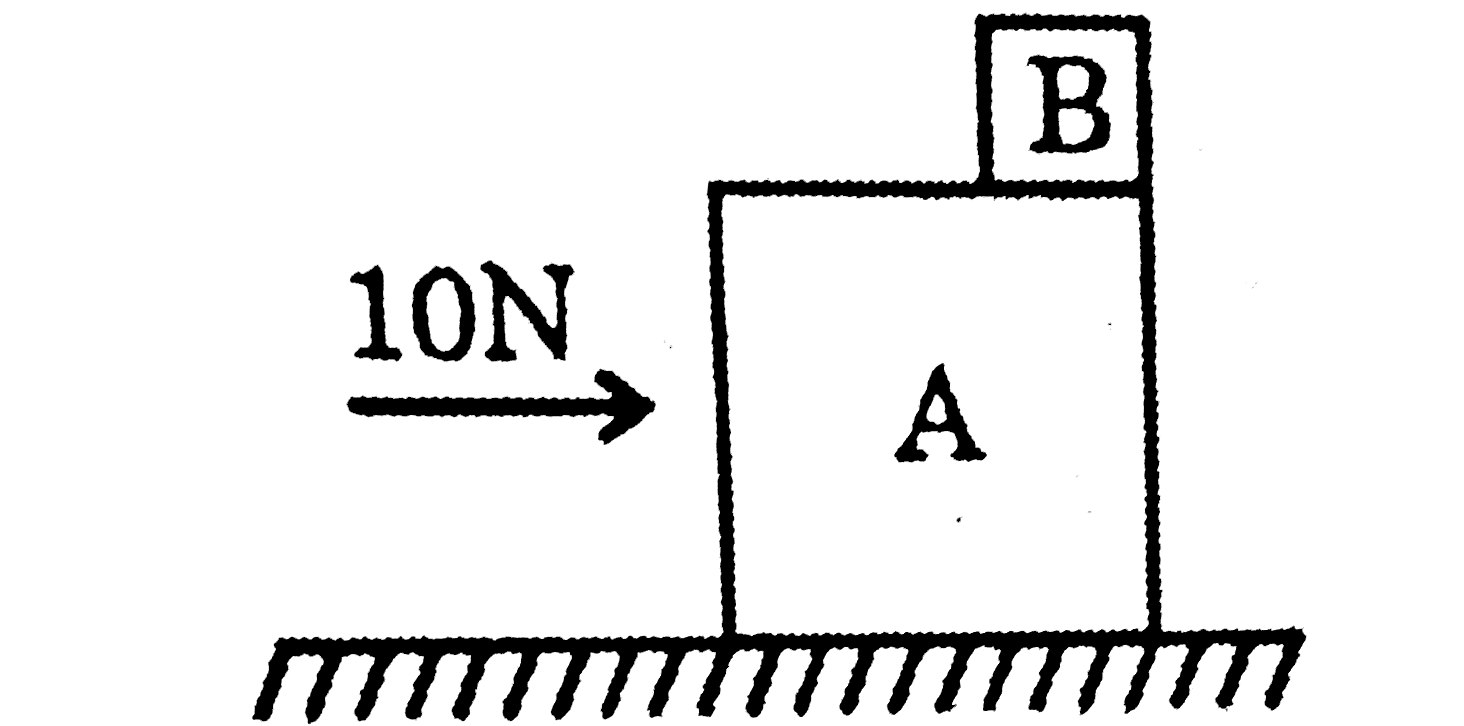
A small block B is placed on another block A of mass 5 kg and length 20 cm. Initially, the block B is near the right end of block A. A constant horizontal force of 10 N is applied to the block A. All the surfaces are assumed frictionless. Find the time elapsed before the block B separates from A.

Text Solution

Verified by Experts

Let the block m, towrds left through displacement x
` :. F_1 = k.x (compressed)`
` F_2 = k_2 x(expanded)`
Since they are in same directiion
`:. Resultant F= F_1+F_2=k_1x+k_2x`
`=x(k_1 +k_2)`
So, acceleration
`a=F/m (x(k_1+k_2))/m`.
Promotional Banner

Topper's Solved these Questions

  • NEWTON'S LAWS OF MOTION

    HC VERMA ENGLISH|Exercise Questions for short Answer|17 Videos
  • NEWTON'S LAWS OF MOTION

    HC VERMA ENGLISH|Exercise Objective -2|9 Videos
  • LAWS OF THERMODYNAMICS

    HC VERMA ENGLISH|Exercise All Questions|64 Videos
  • PHYSICS AND MATHEMATICS

    HC VERMA ENGLISH|Exercise Question for short Answer|14 Videos

Similar Questions

Explore conceptually related problems

A small block B of mass m_2 is placed on another block A of mass m_1 A constant horizontal force F is applied to the block A. All the surfaces are assumed to be frictionless. Find the acceleration of center of mass of the system

A block A of mass 4 kg is placed on another block B of mass 5 kg , and the block B rests on a smooth horizontal table . For sliding block A on B , a horizontal force of 12 N is required to be applied on A How much maximum force can be applied on B so that both A and B move togrther ? Also find out acceleration produced by this force .

A block A of mass 4 kg is placed on another block B of mass 5 kg , and the block B rests on a smooth horizontal table . For sliding block A on B , a horizontal force of 12 N is required to be applied on A How much maximum force can be applied on B so that both A and B move togrther ? Also find out acceleration produced by this force .

A block A of mass 4 kg is placed on another block B of mass 5 kg and the block rests on a smooth horizontal table. For sliding the block A on B, a horizontal force of 12 N is required to be applied on it. The maximum horizontal force that can be applied on B so that both A and B move together and the acceleration produced by this force is

Two blocks of masses 1 kg and 2 kg are placed in contact on a smooth horizontal surface as shown in fig. A horizontal force of 6N is applied d(a) on a 1-kg block. Find the force of interaction of the blocks. .

A block A of mass 2 kg is placed over another block B of mass 8 kg and supported by a ledge L fixed on block B on its smooth surface as its extended part. If a force F=100 N is applied on block B , it starts moving on a smooth horizontal surface. Find the force exerted by block B on is 25 N . (Take g=10m//s^(2) )

A block A of mass 2 kg rests on another block B of mass 8 kg which rests on a horizontal floor. The coefficient of friction between A and B is 0.2 while that between B and floor is 0.5 .When a horizontal floor F of 25 N is applied on the block B the force of friction between A and B is

In a figure shown mass of A and B is equal to M each. Friction between B and lowermost surface is negligible. Initially both the blocks are at rest. The dimensions of the block A are very small. A constant horizontal force F is applied on the blocks B and both the blocks start moving together without any relative motion. Suddenly, the block B encounters a fixed obstacle and comes to rest. The block A continues to slide on the block B . The block A just manages to reach the opposite end of the bolck B . What is the coefficient of friction between the two blocks? (Required length are shown in figure)

Two block of masses m_(1) and m_(2) are placed side by side on a smooth horizontal surface as shown in fig. A horizontal force F is applied on the block . (a) Find the acceleration of each block. (b) Find the normal reaction between the two blocks.

Two blocks of masses 4kg and 2kg are placed side on a smooth horizontal surface as shown in the figure. A horizontal force of 20N is applied on 4kg block. Find (a) the acceleration of each block. (b) the normal reaction between two blocks.

HC VERMA ENGLISH-NEWTON'S LAWS OF MOTION-Exercises
  1. Raindrops of raidus 1mm and mass 4 mg are falling with a speed of 30 ...

    Text Solution

    |

  2. Both the springs shown in figure are untretched. If the block is displ...

    Text Solution

    |

  3. A small block B is placed on another block A of mass 5 kg and length ...

    Text Solution

    |

  4. A man has fallen into a ditch of width d and two of his friends are sl...

    Text Solution

    |

  5. The elevator shown in figure is descending with an acceleration of 2m/...

    Text Solution

    |

  6. A pendulum bobof masss 50 g is suspended from the ceiling of an elevat...

    Text Solution

    |

  7. A perso is standing on a weighing machine placed on the floor of an el...

    Text Solution

    |

  8. Find the reading of th spring balance shown in figure. The elevator is...

    Text Solution

    |

  9. A block of 2 kg is suspended from the ceiling through a massless sprin...

    Text Solution

    |

  10. Suppose the ceiling in the previous problem is that the elevator which...

    Text Solution

    |

  11. The force of buoyancy exerted by the atmosphere on a balloon is B in t...

    Text Solution

    |

  12. An empty plastic box of mass m is found to accelerate up at the rate o...

    Text Solution

    |

  13. A force vecF=vecvxxvecA is exerted on a particle in addition to the fo...

    Text Solution

    |

  14. In a simple Atwood machine, two unequal masses m1 and m2 are connected...

    Text Solution

    |

  15. In a simple Atwood machine, two unequal masses m1 and m2 are connected...

    Text Solution

    |

  16. Figure shows a uniform rod of length 30 cm having a mass of 3.0 kg. Th...

    Text Solution

    |

  17. Three blocks of masses m1, m2 and m3 are connected as shown in the fig...

    Text Solution

    |

  18. A constant force F=m2g/s is applied on the block of mass m1 as shown i...

    Text Solution

    |

  19. In figure m1=5 kg, m2=2kg and F=1N. Find the acceleration of either bl...

    Text Solution

    |

  20. Let m1=1 kg, m2=2kg and m3=3kg is figure. Find the acceleration of m1,...

    Text Solution

    |
