Home
Class 11
PHYSICS
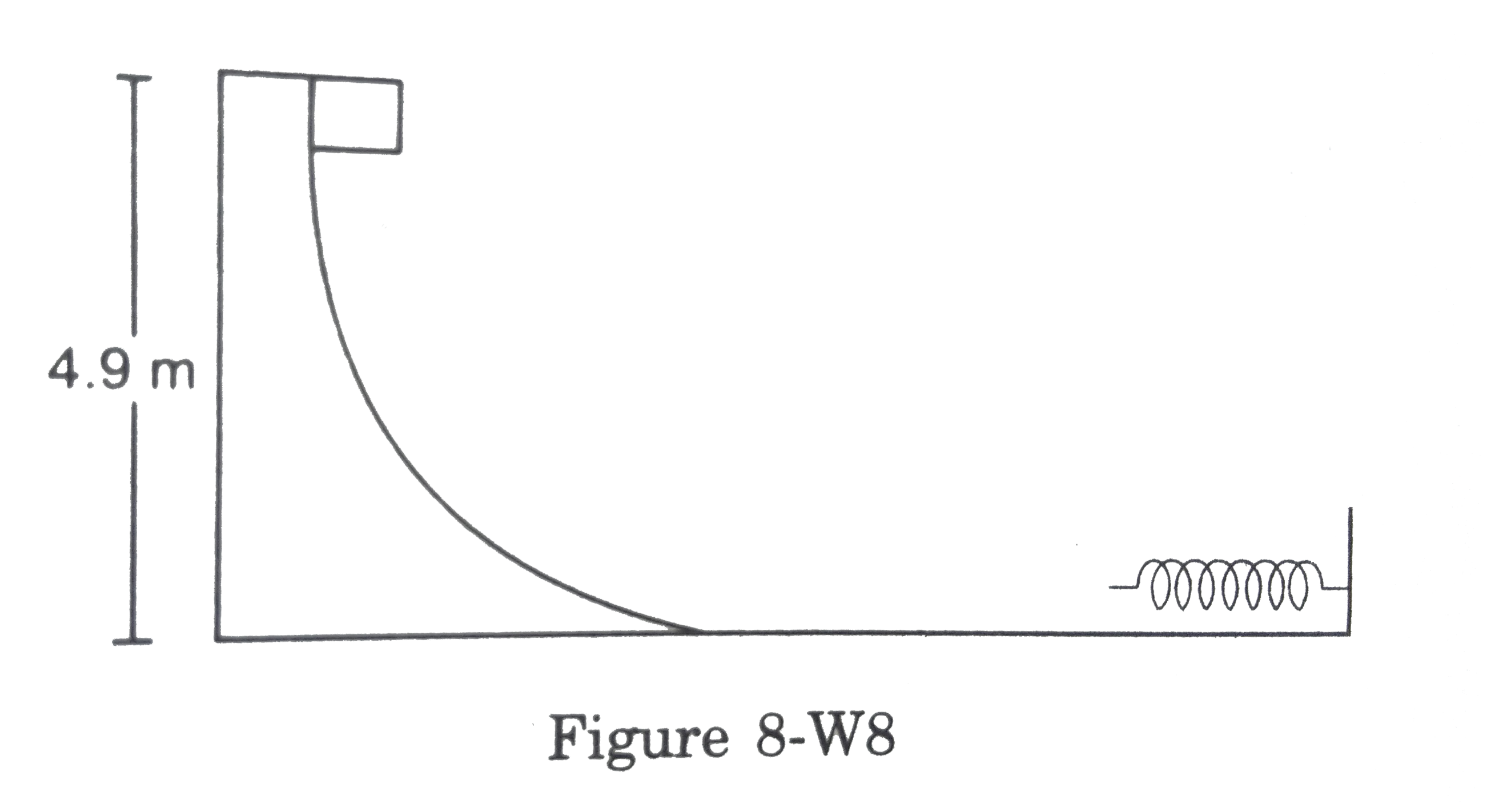
Figure shows a smooth curved track termi...

Figure shows a smooth curved track terminating in a smooth horizontal part. A spring of sprng constant 400 N/m is asttached at one end ot a wedge fixed rigidly with the horizontal part. A 40 g mas is released from rest at a height of 4.9 m n the curved track. Find the maximumcompression of the spring.

Text Solution

Verified by Experts

At the instant of maximum compressin the speed of the 40 g mass reduces to zero. Taking the gravitatioN/Al potential energy to be zero at the horizontal part the conservation of energy shows,
`mgh=1/2kx^2`
where m=0.04 k, h=4.9 m, k=400 N/m and x is the maximum compression.
Thus, `x=(sqrt(2mgh))/k`
`=(sqrt(2xx(0.04kg)xx(9.8m/s^2)xx(4.9m)/((400N/m)))`
`9.8cm`
Promotional Banner

Topper's Solved these Questions

  • WORK AND ENERGY

    HC VERMA ENGLISH|Exercise Objective -1|10 Videos
  • WORK AND ENERGY

    HC VERMA ENGLISH|Exercise Objective -2|8 Videos
  • WORK AND ENERGY

    HC VERMA ENGLISH|Exercise Question for Short Answer|16 Videos
  • WAVE MOTION AND WAVES ON A STRING

    HC VERMA ENGLISH|Exercise Question for short Answer|7 Videos

Similar Questions

Explore conceptually related problems

The figure shows a smooth curved track terminating in a smooth horizontal part. A spring of spring constant 400(N)//(m) is attached at one end to a wedge fixed rigidly with the horizontal part . A 40 g mass is released from rest at a height of 5 m on the curved track. The maximum compression of the spring will be

A smooth curved surface of height 10 m is ended horizontally. A spring of force constant 200 Nm^(-1) is fixed at the horizontal end as shown in figure when an object of mass 10g is released from the top, it travels along the curved path and collides with the spring. Then, the maximum compression in the spring is (Take, g = 10ms^(-2) )

Two blocks A and B of equal mass m=1.0kg are lying on a smooth horizontal surface as shown in figure. A spring of force constant k=200N//m is fixed at one end of block A. Block B collides with block A with velocity v_0=2.0m//s . Find the maximum compression of the spring.

A block of mass m is released from a height h from the top of a smooth surface. There is an ideal spring of spring constant k at the bottom of the track. Find the maximum compression in the spring (Wedge is fixed)

A block of mass M=1 kg resting on a smooth horizontal surface is connected to a horizontal light spring of spring constant k=6N/m whose other end is fixed to a verticall wall. Another block of mass m=0.5 kg is placed over the block M. If the coefficient of friction between the two blocks mu =0.4, find the maximum kinetic energy (in J) that the system can have for simple hormonic oscillation under the action of the spring.

Figure shown a block P of mass m resting on a smooth horizontal surface, attached to a spring of force constant k which is rigidly fixed on the wall on left side, shown in the figure . At a distance l to the right of the block there is a rigid wall. If block is pushed towards left so that spring is compressed by a distance 5l//3 and when released, if will starts its oscillations. If collision of block with the wall is considered to be perfectly elastic. Find the time period of oscillation of the block.

Figure shows a smooth track, a part of which is a circle of radius r . A block of mass m is pushed against a spring of spring constant k fixed at the left end and is then released. Find the initial compression of the spring so that the block presses the track with a force mg when it reaches the point P, where the radius of the track is horizontal.

A block of 10 g slides on smooth horizontal surface with 20 m/s towards a spring of spring constant 100 N/m placed horizontally (as shown in figure). The maximum compression in spring is

The pulley shown in figure has a radius of 20 cm and moment of inertial 0.2 kg-m^2. The string going over it is attached at one end to a vertical sprign of spring constant 50 N/m fixed from below and supports a 1 kg mas at other end. The system is released from rest with the spring at its natural length. Find the speed of the block when it has desceds through 10 cm. Take g=10 m/s^2 .

In the figure shown one end of a light spring of natural length l_(0)=sqrt(5/8)m(~~0.8m) is fixed at point D and other end is attached to the centre B of a uniform rod AF of length l_(0)//sqrt(3) and mass 10kg. The rod is free to rotate in a vertical plane about a fixed horizontal axis passing through the end A of the rod. The rod is held at rest in horizontal position and the spring is in relaxed state. It is found that, when the rod is released to move it makes an angle of 60^(@) with the horizontal when it comes to rest for the first time. Find the (a) the maximum elogation in the spring . (Approximately) (b) the spring constant. (Approximately)
