Home
Class 12
PHYSICS
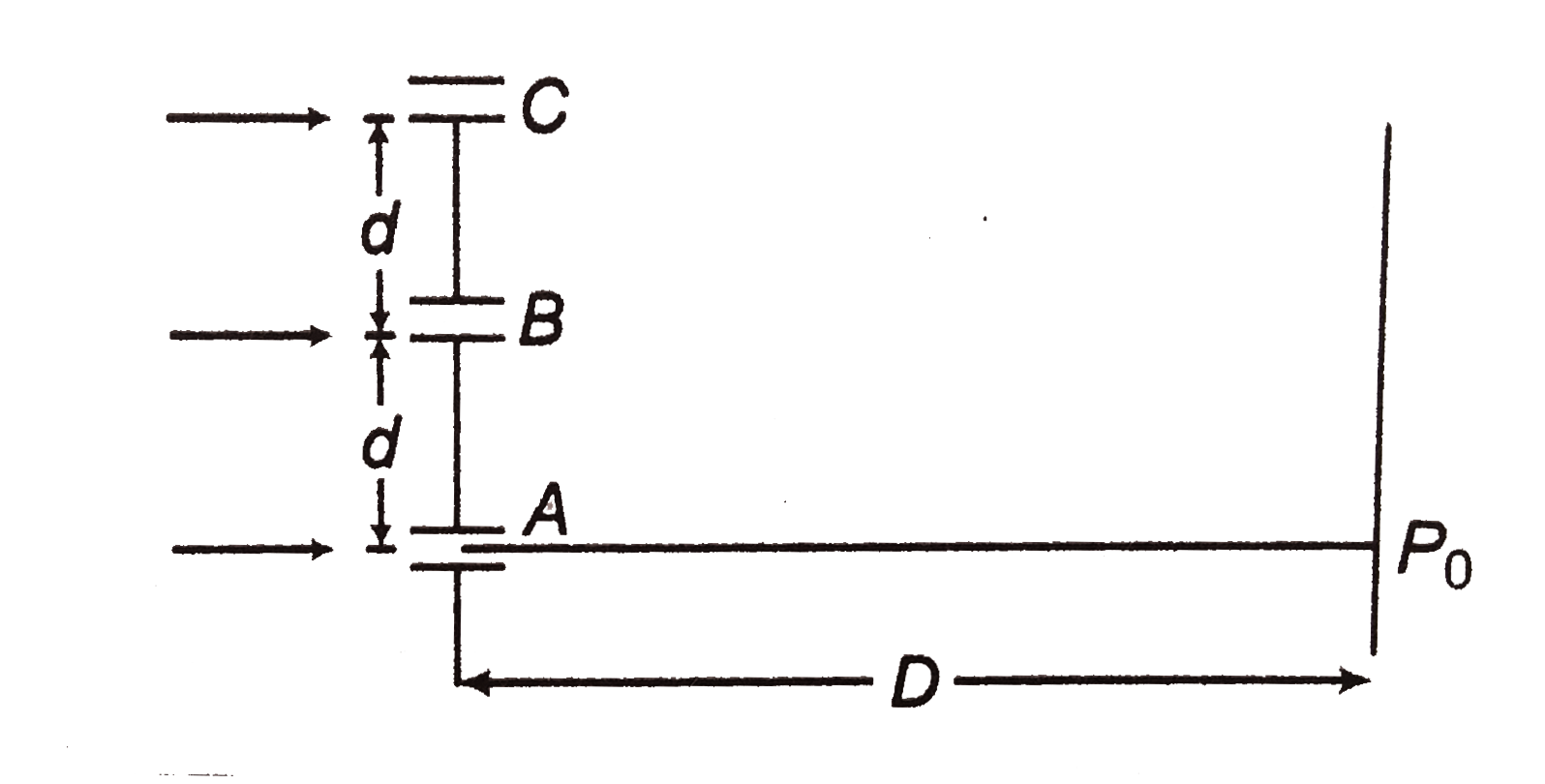
figure shows three equidistant slits ill...

figure shows three equidistant slits illuminated by a monochromatic parallel beam of light. Let `BP_0 -AP_0 = lambda/3` and `Dgtgtlambda`.

(a) Show that d = `sqrt ((2lambdaD)//3)`
(b) Show that the intensity at `P_0` is three times the intensity due to any of the three slits
individually.

Text Solution

Verified by Experts

The correct Answer is:

A

a. `BP-AB=1/3`
`rarr sqrt(D^2+d^2)-D=lamda/3`
`rarr D^2+d^2=D^2+(lamda^2/9)+(2lamdaD)/3`
`rarr d=theta(2lamdD)/3`
(neglecting the term `lamda^2/9` as it is very small)
b. To fing the inensity at P we have to consider the inteference of light waves coming from all the three slits.
`Here CP-AP-sqrt(D^2+4d^2)-D`
`=sqrt(D^2+8lamdaD)-D`
`=D{1+(8lamda)/(3lamda)}^(1/2)-D`
`=D{1+(8lamda)/(3D)xx2+..}-D`
`=41/3`
`[using binomial expansion]
`So, the corresponding phase difference between waves from C and A is
`phi_c=(2pix)/lamda=(2pix4lamda)/(3lamda)`
`=(8pi)/3=(2pi+(2pi)/3)`
`=(2pi)/3` ..............i
`Again theta_B=(2pilamda)/(3lamda)=(2pi)/3`.......i
so it can be said that light from B and C are i same phase as they have same phase difference with respect to A.
So, `R=sqrt((2)^2)+r^2+2xx2rxxrcos((2pi)/3)`
[using vector method]
`=sqrt(4r^2)+r^2+2r^2.sqrt3r`
`:. l_(p0)=K (sqrt3r^2)=3Kr^2=3l`
As the resulting amplitude is m3 times the intensity due to individual slits.
Promotional Banner

Topper's Solved these Questions

  • LIGHT WAVES

    HC VERMA ENGLISH|Exercise Question for short Answer|11 Videos
  • LIGHT WAVES

    HC VERMA ENGLISH|Exercise Objective -2|10 Videos
  • GEOMETRICAL OPTICS

    HC VERMA ENGLISH|Exercise Question For short Answer|18 Videos
  • MAGNETIC FIELD

    HC VERMA ENGLISH|Exercise objective2|9 Videos

Similar Questions

Explore conceptually related problems

Figure shows a narrow slit S illuminated b a monochromatic light of wavelength lambda in a double-slit experiment. In the path of the rays reaching the upper slit S_(1) , a tube to length L is interposed in which the index of reflection of the medium varies linearly as shown in figure . The position of the central maximum in the interference pattern on the screen was displaceed by N fringes. Find the value of N in terms of mu_(0) , L and lambda .

A monochromatic light source of wavelength lamda is placed at S. three slits S_(1),S_(2) and S_(3) are equidistant from the source S and the point P on the screen S_(1)P-S_(2)P=lamda//6 and S_(1)P-S_(3)P=2lamda//3 . if I be the intensity at P when only one slit is open the intensity at P when all the three slits are open is-

A Young's double slit experiment uses a monochromatic light of wavelength lambda . The intensity of each slit is same and is equal to I_(0) . What will be the resultant intensity at a point where waves interfere at a path difference of (lambda)/2 ?

In a Young's double slit set up using monochromatic light of wavelength lambda the intensity of light at a point, where path difference is 2lambda is found to be I_(0) What will be the intensity at a point when path different is lambda//3 ?

In the figure shown three slits s_(1),s_(2) and s_(3) are illuminated with of wavelength lambda.lambda ltltd and D gtgt d. Each slit prouduces same intensity I on the screen. If intensity at the point on screen directly infront of s_(2) is 3I then the maximum value of lambda is (nd^(2))/(2D) Find value of n.

Consider the situation shown in figure. The two slits S_1 and S_2 placed symmetrically around the central line are illuminated by a monochromatic light of wavelength lamda . The separation between the slits is d. The light transmitted by the slits falls on a screen Sigma_1 placed at a distance D from the slits. The slit S_3 is at the placed central line and the slit S_4 , is at a distance z from S_3 . Another screen Sigma_2 is placed a further distance D away from 1,1. Find the ratio of the maximum to minimum intensity observed on Sigma_2 if z is equal to a. z=(lamdaD)/(2d) b. (lamdaD)/d c. (lamdaD)/(4d)

Consider the situation shown in figure. The two slite S_1 and S_2 placed symmetrically around the centre line are illuminated by a monochromatic light of wavelength lambda. The separation between the slits is d. The light transmitted by the slits falls on a screen M_1 placed at a distance D from the slits. The slit S_3 is at the centre line and the slit S_4 is at a distance y form S_3 . Another screen M_2 is placed at a further distance D away from M_1 . Find the ration of the maximum to minimum intensity observed on M_2 if y is equal to (dltltD) .

Two coherent narrow slits emitting light of wavelength lambda in the same phase are placed parallel to each other at a small separation of 2lambda . The light is collected on a screen S which is placed at a distance D(gtgt lambda ) from the slit S_1 as shown in figure. Find the finite distance x such that the intensity at P is equal to intensity O. .

Show that the three straight lines 2x-3y + 5 = 0 , 3x + 4y - 7 = 0 and 9x- 5y + 8 = 0 meet in a point

Show that the points A(2, 1), B(0,3), C(-2, 1) and D(0, -1) are the vertices of a square.

HC VERMA ENGLISH-LIGHT WAVES-Exercises
  1. A long narrow horizontal slit is placed 1 mm above a horizontal plane ...

    Text Solution

    |

  2. Consider the situation of the previous problem, if the mirror reflects...

    Text Solution

    |

  3. A double slit S1-S2 is illuminated by a coherent light of wavelength l...

    Text Solution

    |

  4. White coherent light (400 nm-700 nm) is sent through the slits of a YD...

    Text Solution

    |

  5. Consider the arrangement shown in figure. The distance D is large comp...

    Text Solution

    |

  6. Two coherent point sources S1 and S2 emit light of wavelength lambda. ...

    Text Solution

    |

  7. figure shows three equidistant slits illuminated by a monochromatic pa...

    Text Solution

    |

  8. In a Young's double slit experiment, the separation between the slits ...

    Text Solution

    |

  9. In a Young's double slit interference experiment the fringe pattern is...

    Text Solution

    |

  10. In a Young's double slit experiment lamda= 500nm, d=1.0 mm andD=1.0m. ...

    Text Solution

    |

  11. The line-width of a bright fringe is sometimes defined as the separati...

    Text Solution

    |

  12. Consider the situation shown in figure. The two slits S1 and S2 placed...

    Text Solution

    |

  13. Consider the arrangement shownin figure. By some mechanism,the separat...

    Text Solution

    |

  14. A soap film of thickness 0.0011 mm appears dark when seen by the refle...

    Text Solution

    |

  15. A parallel beam of light of wavelength 560 nm falls on a thin film of ...

    Text Solution

    |

  16. A parallel beam of white light is incident normally on a water film 1....

    Text Solution

    |

  17. A glass surface is coated by an oil film of uniform thickness 1.00xx10...

    Text Solution

    |

  18. Plane microwaves are incident on a long slit having a width of 5.0 cm....

    Text Solution

    |

  19. Light of wavelength 560 nm goes through a pinhole of diameter 0.20 mm ...

    Text Solution

    |

  20. A convex lens of diameter 8.0 cm is used to focus a parallel beam of l...

    Text Solution

    |
