Home
Class 12
PHYSICS
A converging lens of focal length 15 cm ...

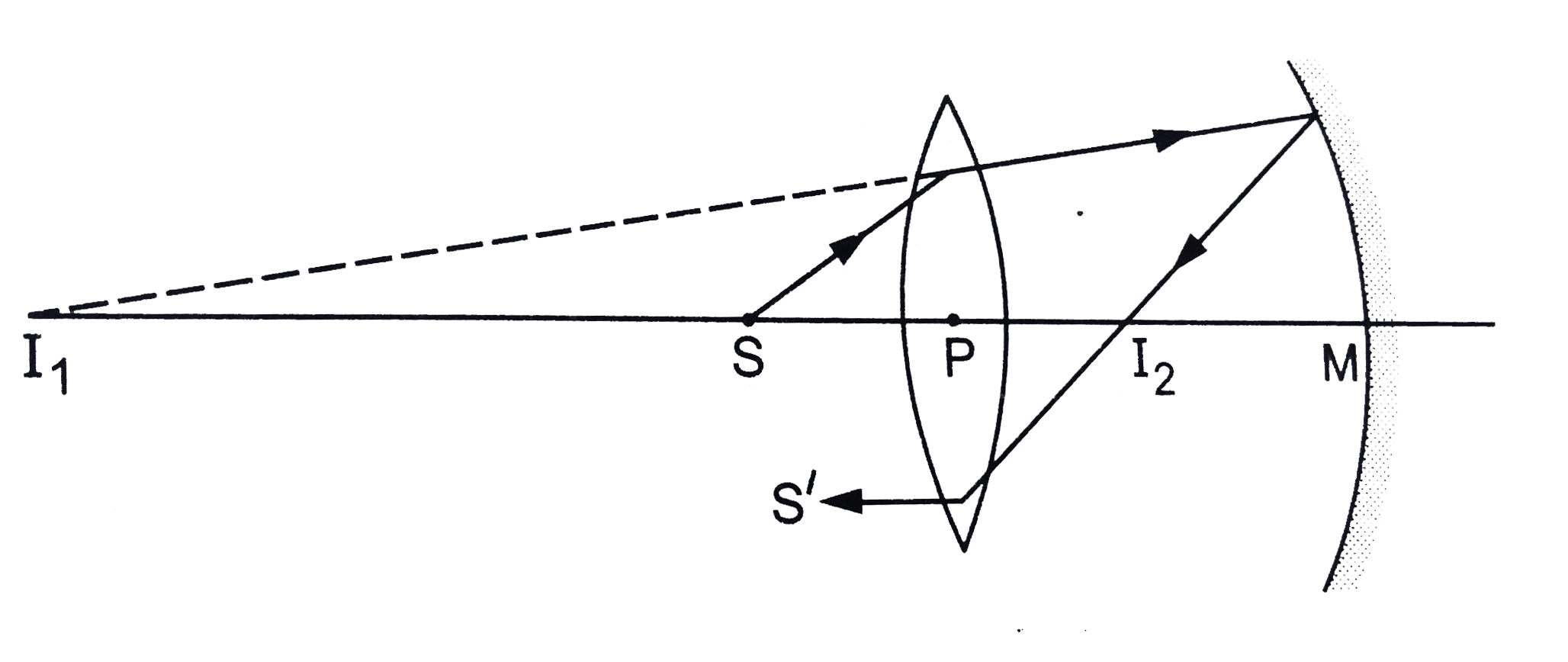
A converging lens of focal length 15 cm and a converging mirror of focal length 20 cm are placed with their principal axes coinciding. A point source S is placed on the principal axis at a distance of 12 cm from the lens as shown in figure. It is found that the final beam comes out parallel to the principal axis. Find the separation between the mirror and the lens.

Text Solution

Verified by Experts

Let us first locate the image of S formed byi the lens L. Here `u=-12cm and f=15 cm`. We have
`1/v-1/u=1/f`
`or 1/v=1/f+1/u`
`=1/(15cm)-1/(12cm)`
`or v=-60cm`
The negative sign shows that the image is formed to the left of the lens as suggeted in the ure. The image `I_1` acts as the source for the mirror. The mirror forms and image `I_2` of the source `I_1`. This image I_2 then acts as the source for the lens and the fiN/Al beam comes out parallel to the principal axis. Clearly `I_2` must be at the focus of the lens. We have
`I_1I_2=I_1L+L_2=60cm15cm=75cm`.
Suppose the distance of the mirror from `I_2` is x cm. For the reflection from the mirror.
`u=MI_1(=-(75+x)cm, v=-xcm =75cm`
Suppose the distance of the mirror from `I_2` is cm. For the reflection from the mirror.
`u=MI_1=-(75+x)cm,v=-xcm and f=-20cm`
Using `1/v+1/u=1/f`
`1/x+1/(75+x)=1/20`
`or (75+2x)/((75+x)x)=1/20`
`or x^2+35-1500=0`
or `x=(-35+-sqrt(35xx35+4x1500))/2`
This gives x=25 or -60.
As the negatives sign has no physical meaning only positive sigh should be taken. Taking `x=25` the separatioin between the lens and the mirror is `(15+25)cm=40cm.`
Promotional Banner

Topper's Solved these Questions

  • GEOMETRICAL OPTICS

    HC VERMA ENGLISH|Exercise Objective -1|15 Videos
  • GEOMETRICAL OPTICS

    HC VERMA ENGLISH|Exercise Objective -2|7 Videos
  • GAUSS LAW

    HC VERMA ENGLISH|Exercise Short Question|7 Videos
  • LIGHT WAVES

    HC VERMA ENGLISH|Exercise Question for short Answer|11 Videos

Similar Questions

Explore conceptually related problems

A converging lens and a converging mirror are placed with their principal axis coinciding. Their separation equals 40cm. A point source S is placed on the principal axis at a distance of 12 cm from the lens as shown in Fig. It is found that the final beam comes out parallel to the principal axis. Focal length of the lens equals 15 cm. Find the focal length of the mirror.

A converging lens of focal length 15 cm and a converging mirror of focal length 10 cm are placed 50 cm apart with common principal axis. A point source is placed in between the lens and the mirror at a distance of 40 cm from the lens. Find the locations of the two images formed.

A diverging lens of focal length 20 cm and a converging lens of focal length 30 cm are placed 15 cm apart with their principal axes coinciding. Where should an object be placed on the principal axis so that its image formed at infinity ?

A converging lens of focal length 12 cm and a diverging mirror of focal length 7.5 cm are placed 5.0 cm apart with their principal axes coinciding. Where should an object be placed so that its image falls on itself ?

A converging lens of focal length 20 cm and a converging mirror of focal length 10 cm are placed 60 cm apart with common principal axis. A point source is placed in between the lens and the mirror at a distance of 50 cm from the lens. Find the locations of the images formed.

A convex lens of focal length 20 cm is placed in front of a convex mirror of focal length 15 cm at a distance of 5 cm. An object of length 2 cm is placed perpendicular to the common axis at a distance of 20 cm from the lens

A convex lens of focal length 20 cm and a concave lens of focal length 10 cm are placed 10 cm apart with their principal axes coinciding. A beam of light travelling parallel to the principal axis and having a beam diameter 5.0 mm, is incident on the combination. Show that the emergent beam is parallel to the incident one. Find the beam diameter of the emergent beam.

A diverging lens of focal length 20 cm and a converging mirror of focal length 10 cm are placed coaxially at a separation of 5 cm. Where should an object be placed so that a real image is formed at the object itself ?

A converging lens of focal length 15 cm and a converging mirror of focal length 10 cm are placed 50 cm apart. If a pin of length 2.0 cm is placed 30 cm from the lens farther away from the mirror, where will the final image form and what will be the size of the final image ?

A convex lens has a focal length of 10 cm. Find the location and nature of the image if a point object is placed on the principal axis at a distance of (a) 9.8 cm, (b) 10.2 cm from the lens.

HC VERMA ENGLISH-GEOMETRICAL OPTICS-Question For short Answer
  1. A converging lens of focal length 15 cm and a converging mirror of foc...

    Text Solution

    |

  2. Is the formula "Real depth/Apparent depth = mu." valid if viewed from ...

    Text Solution

    |

  3. Can you ever have a situation in which a light ray goes undeviated thr...

    Text Solution

    |

  4. Why does a diamond shine more than a glass piece cut to the same shape...

    Text Solution

    |

  5. A narrow beam of light passes through a slab obliquely and is then rec...

    Text Solution

    |

  6. Can a plane mirror ever form a real image ?

    Text Solution

    |

  7. If a piece of paper is placed at the position of a virtual image of a ...

    Text Solution

    |

  8. Can a virtual image be photographed by a camera ?

    Text Solution

    |

  9. In motor vehicles, a convex mirror is attached near the driver's seat ...

    Text Solution

    |

  10. If an object far away from a convex mirror moves towards the mirror, t...

    Text Solution

    |

  11. Suppose you are inside the water in a swimming pool near an edge. A fr...

    Text Solution

    |

  12. A thin converging lens is formed with one surface convex and the other...

    Text Solution

    |

  13. A single lens is mounted in a tube. A parallel beam enters the tube an...

    Text Solution

    |

  14. An air bubble is formed inside water. Does it act as a converging lens...

    Text Solution

    |

  15. Two converging lenses of unequal focal lengths can be used to reduce t...

    Text Solution

    |

  16. If a spherical mirror is dipped in water, does its focal length change...

    Text Solution

    |

  17. If a thin lens is dipped in water, does its focal length change ?

    Text Solution

    |

  18. Can mirrors give rise to chromatic aberration ?

    Text Solution

    |

  19. A laser light is focussed by a converging lens. Will there be a signif...

    Text Solution

    |
