Home
Class 11
PHYSICS
A sample of an ideal gas is taken throug...

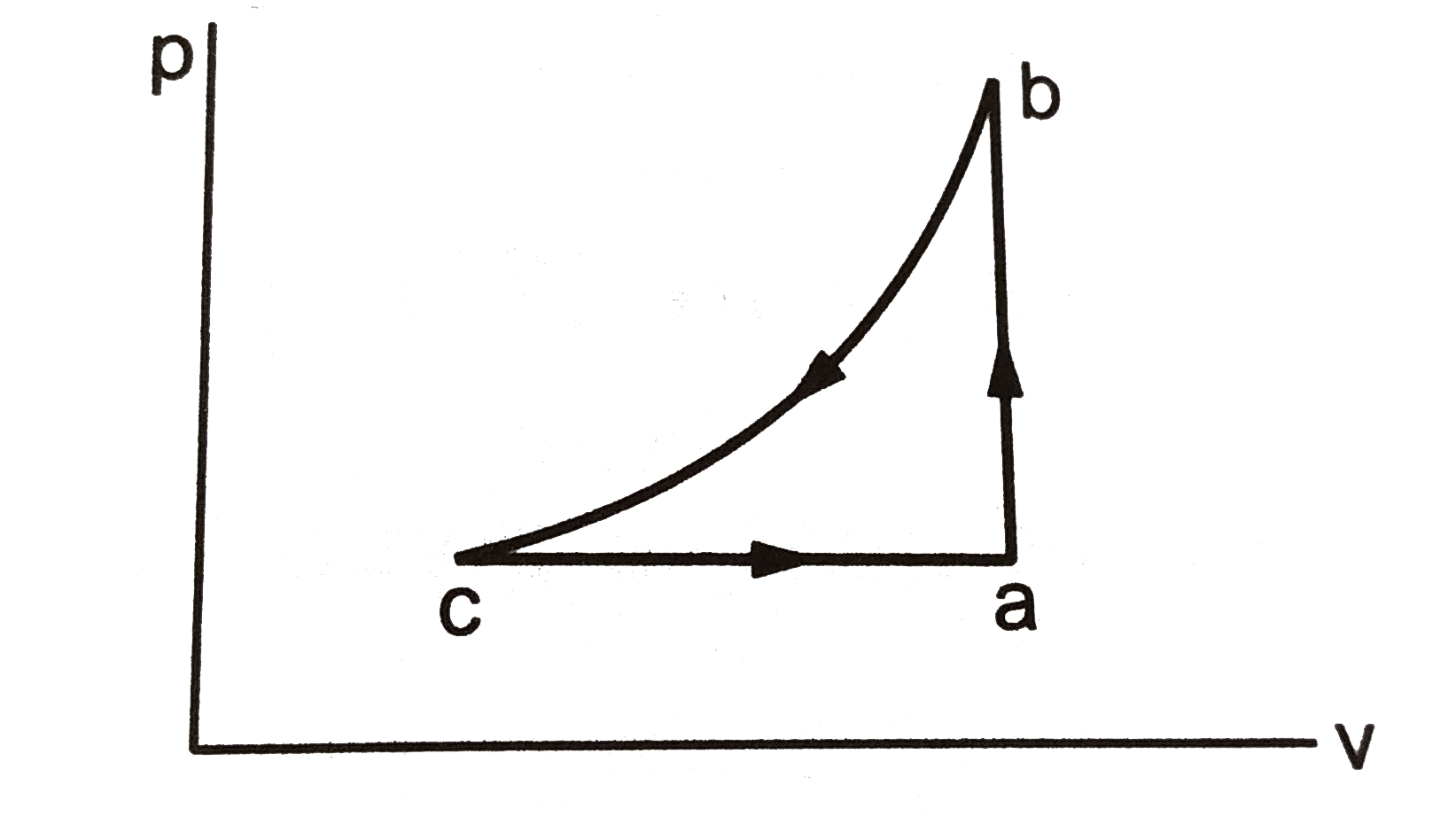
A sample of an ideal gas is taken through the cyclic process abca . It absorbs 50 J of heat during the part ab, no heat during bc and rejects 70 J of heat during ca. 40 J of work is done on the gas during the part bc.(a) find the internal energy of the gas at b and c if it is 1500 J at a. (b) calculate the work done by the gas during the part ca.

Text Solution

Verified by Experts

(a) In the part ab the volume remains constant. Thus, the work done by the gas is zero. The heat absorbed by the gas is 50 J. the increase in internal energy from a to b is `DeltaU=DeltaQ=50 J`.
As the internal energy is 1500 J at a, it will be 1550 J at b. in the part bc, the work done by the gas is `DeltaW=-40J` and no heat is given to the system. the increse in internal energy from b to c is
`DeltaU=-DeltaW=40 J`. ,brgt As the internal energy is 1550 J at b, it will be 1590 J at c.
(b) The change in internal energy from c to a is
`DeltaU=1500 J-1590 J=-90J`.
The heat given to the system is `DeltaQ=70 J`.
Using `DeltaQ=DeltaU+DeltaW`,
`DeltaW=DeltaQ-DeltaU`
`=-70 J+90J=20 J`.
Promotional Banner

Topper's Solved these Questions

  • KINETIC THEORY OF GASES

    HC VERMA ENGLISH|Exercise All Questions|106 Videos
  • NEWTON'S LAWS OF MOTION

    HC VERMA ENGLISH|Exercise Questions for short Answer|17 Videos

Similar Questions

Explore conceptually related problems

In figure, a sample of an ideal gas is taken through the cyclic process abca. 800J of work is done by the gas during process ab. If gas absorb no heat in process ab, rejects 100J of heat during bc and absord 500J of heat during process ca . Then (a) find the internal energy of the gas at b and c if its is 1000J at a (b). Also calculate the work by the gas during the part bc ,

A sample of an ideal gas is taken through the cyclic-process ABCA shown in Fig. It rejects 50 J of heat during the part AB , doens not absorb or reject the heat during BC , and accepts 70 J of heat during CA . Forty joules of works is done on the gas during the part BC . The internla energies at B and C , respectively, will be

A sample of an ideal gas is taken through the cyclic-process ABCA shown in Fig. It rejects 50 J of heat during the part AB , doens not absorb or reject the heat during BC , and accepts 70 J of heat during CA . Forty joules of works is done on the gas during the part BC . The internla energies at B and C , respectively, will be (Internal Energy at A=1500Joules)

A sample of an ideal gas is taken through the cyclic process abca and shown in the figure. The change in the internal energy of the gas along the path ca is -180J . The gas absorbs 250J of heat along the path ab and 60 J along the path bc. the work done by the gas along the path abc is:

During a process, a system absorbs 710 kJ of heat and does 250 J of work. Calculate the change in the internal energy of the system.

In a process, 701 J of heat is absorbed by a system and 394 J of work is done by the system. What is the change in internal energy of the process?

In a process, 701 J of heat is absorbed by a system and 394 J of work is done by the system. What is the change in internal energy for the process?

A system works in a cyclic process. It absorbs 20 calories of heat and rejects 60 J of heat during the process. The magnitude of work done (J) is [ 1 "calorie"=4.2 J] :

A gas is taken through a cyclic process ABCA as shown in, if 2.4 cal of heat is given in the process, what is the value of J ?

A gas is taken through a cyclic process ABCA as shown in, if 2.4 cal of heat is given in the process, what is the value of J ?

HC VERMA ENGLISH-LAWS OF THERMODYNAMICS-All Questions
  1. A gas is contained in a vessel fitted with a movable piston. The conta...

    Text Solution

    |

  2. calculate the work done by a gas as it is taken from the state a to b,...

    Text Solution

    |

  3. A sample of an ideal gas is taken through the cyclic process abca . It...

    Text Solution

    |

  4. A thermodynamic system is taken through the cycle abcda. (a) calculate...

    Text Solution

    |

  5. calculate the increase in internal energy of 1 kg of water at 100^(o)C...

    Text Solution

    |

  6. The internal energy of a monatomic ideal gas is 1.5 nRT. One mole of h...

    Text Solution

    |

  7. A steam engin intakes 100g of steam at 100^(o)C per minute and cools i...

    Text Solution

    |

  8. Figure Shows a process ABCA performed on an ideal gas. Find the net he...

    Text Solution

    |

  9. consider the cyclic process ABCA on a sample of 2.0 mol of an ideal ga...

    Text Solution

    |

  10. 2.00 mole of a monatomic ideal gas (U=1.5nRT) is enclosed in an adiaba...

    Text Solution

    |

  11. A sample of an ideal gas has pressure p(0), volume V(0) and tempreture...

    Text Solution

    |

  12. A sample of 100 g water is slowly heated from 27^(o)C to 87^(o)C. Calc...

    Text Solution

    |

  13. A heat engine operates between a cold reservoir at tempreture T(2)=300...

    Text Solution

    |

  14. The first law of theromodynamics is a statement of

    Text Solution

    |

  15. If heat is supplied to an ideal gas in an isothermal process.

    Text Solution

    |

  16. Figure shows two processes A and B on a system.Let DeltaQ(1) and Delt...

    Text Solution

    |

  17. Refer to figure. Let DeltaU(1) and DeltaU(2) be the changes in interna...

    Text Solution

    |

  18. Consider the process on a system as shown in the figure. During the pr...

    Text Solution

    |

  19. consider the following two statements. (A) If heat is added to a syst...

    Text Solution

    |

  20. An ideal gas goes from the state i to the state int as shown in .the w...

    Text Solution

    |
