

Home
Class 11
PHYSICS
Shows a peddle wheel couple to a mass of...

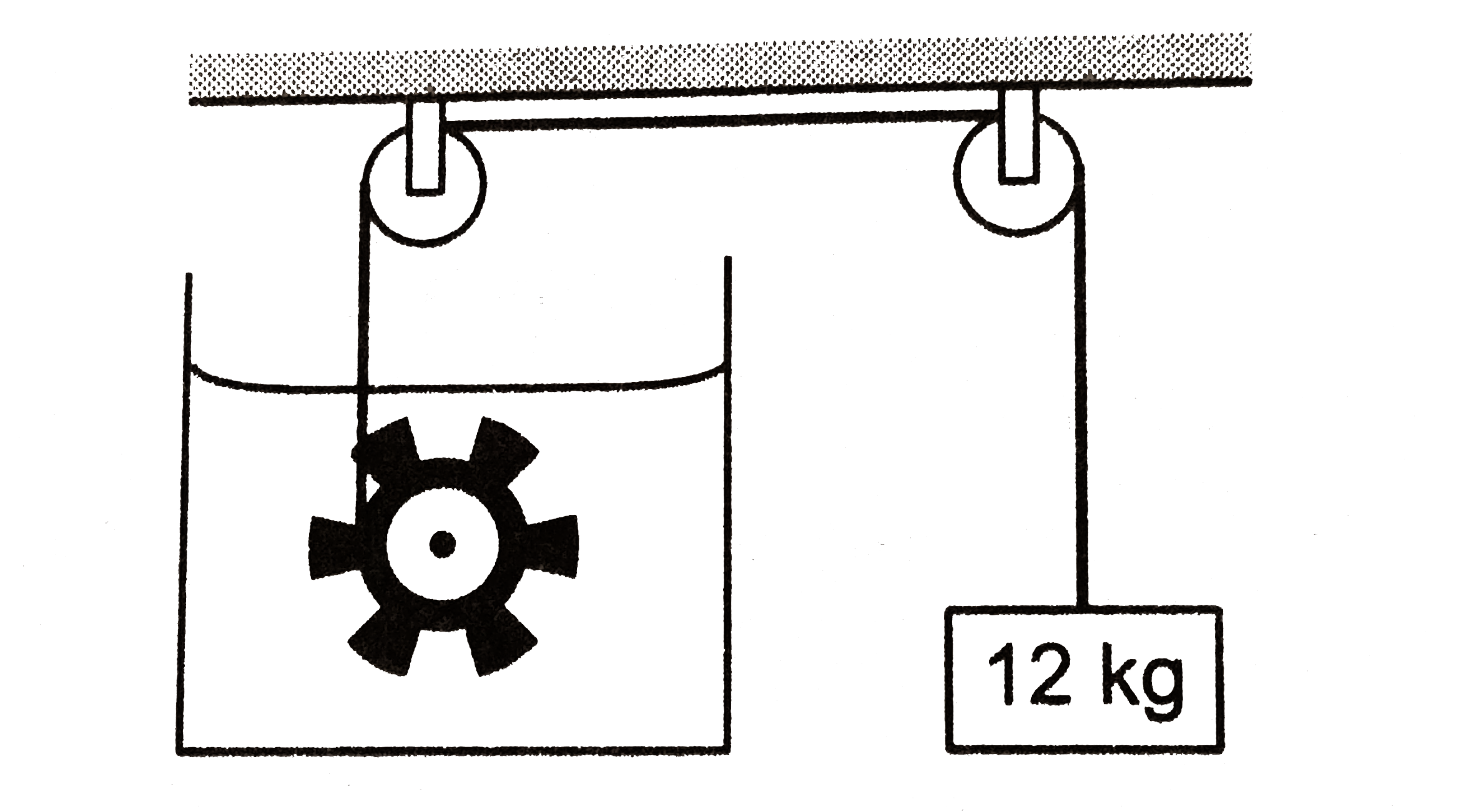
Shows a peddle wheel couple to a mass of 12 kg through fixed frictionless pulley. The paddle is immersed in a liquid of heat capacity `4200 J K^(-1)` kept in an adiabatic container. Consider a time interval in which the 12 kg block falls slowly through 70cm. (a) how much heat is given to the liquid ? (b) how much work is done on the liquid? (c ) calculate the rise in the temperature of the liquid neglecting the heat capacity of the container and the paddle.

Text Solution

Verified by Experts

The correct Answer is:
A, B, C, D

(a) heat is not given to the liqiud Instead, the mechanical workdone is converted to heat.
So, heat given to liquid is zero
(b) Work done on the liquid is the PE lost by the 12 kg mass =mgh`
`=12x10x0*70ltbrge84 J
(c ) Let rise in temperature be Deltat We know, 84=`msDeltat,`
`rArr 84=1xx4200xxDeltat(for m =1 kg)`
` rArr Deltat=(84)/(4200)=(1)/(50)=0*02 k.
Promotional Banner

Topper's Solved these Questions

  • KINETIC THEORY OF GASES

    HC VERMA ENGLISH|Exercise All Questions|106 Videos
  • NEWTON'S LAWS OF MOTION

    HC VERMA ENGLISH|Exercise Questions for short Answer|17 Videos

Similar Questions

Explore conceptually related problems

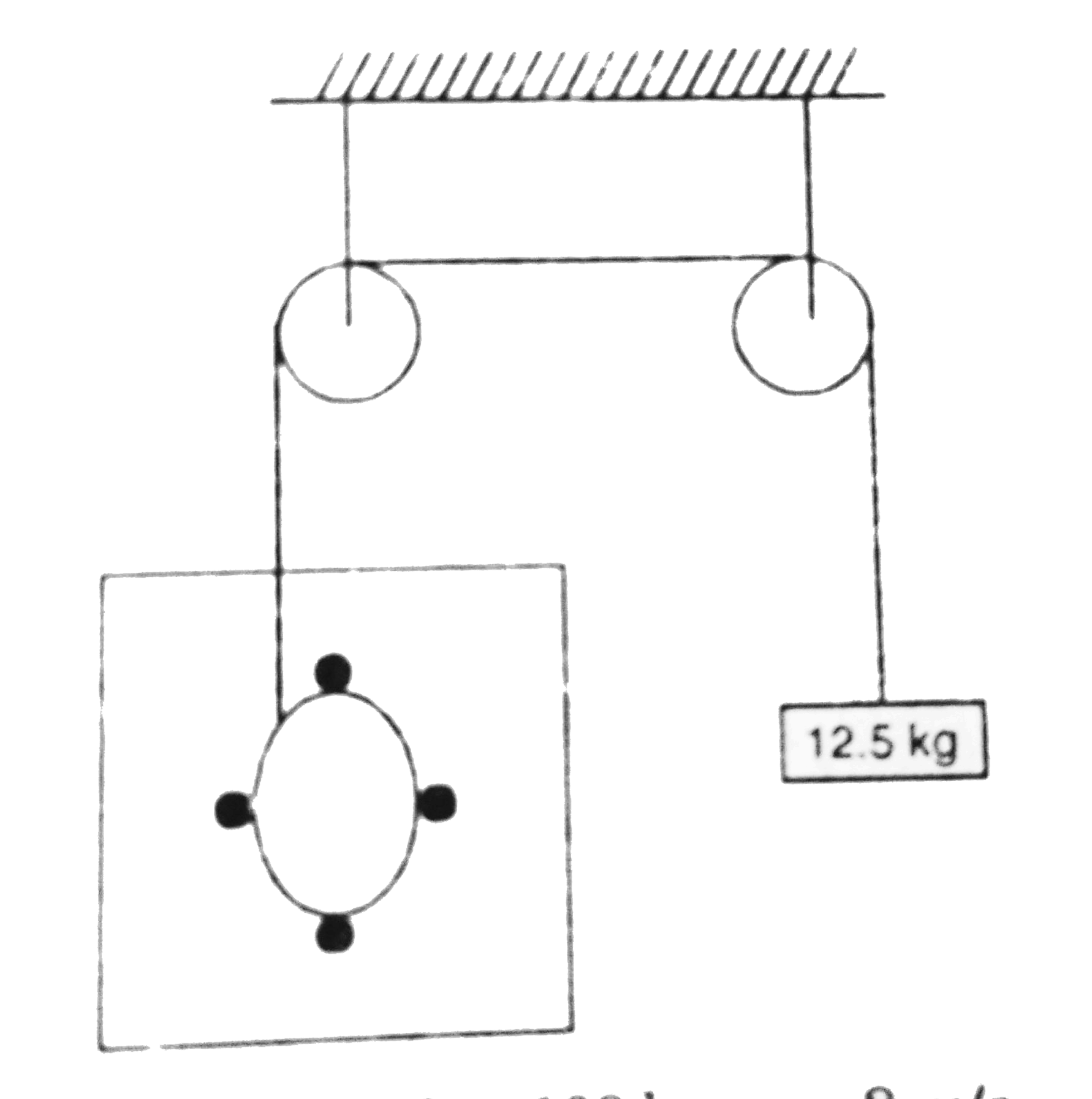
A paddle wheel is connected with a block of mass 10kg as shown in figure. The wheel is completely immersed in liquid of heat capacity 400 J//K . The container is adiabatic. For the time interval in which block goes down 1m slowly calculate (a) Work done on the liquid (b) Heat supplied to the liquid (c ) Rise in the temperature of the liquid Neglect the heat capacity of the container and the paddle. (g = 10 m//s^(2))

Name the liquid which has the highest specific heat capacity.

A sample of 100 g water is slowly heated from 27^(o)C to 87^(o)C . Calculate the change in the entropy of the water. specific heat capacity of water =4200 j/kg k .

A cube of side 4 cm is just completely immersed in a liquid A. When it is put in a liquid B, it floats with 2 cm outside the liquid. Calculate the ratio of densities of the two liquids.

A solid floats in a liquid at 20^@ C with 75 % of it immersed. When the liquid is heated to 100^@ C, the same solid floats with 80% of it immersed in the liquid. Calculate the coefficient of expansion of the liquid. Assume the volume of the solid to be constant.

Liquids expand much more than gases on heating.

A liquid of mass m and specific heat c is heated to a temperature 2T. Another liquid of mass m/2 and specific heat 2 c is heated to a temperature T. If these two liquids are mixed, the resulting temperature of the mixture is

A girl having mass of 35 kg sits on a trolley of mass 5 kg. The trolley is given an initial velocity of 4m//s by applying a force. The trolley comes to rest after travelling a distance of 16m. (a) How much work is done on the trolley ? (b) How much work is done by the girl ?

When a system is taken from A to C through path ABC, 10 J of heat flows to the system and 4 J of work is done by the system. How much heat flows into the system in path ADC, if the work done by the system is 3 J ?

An electric heater of power 600 W raises the temperature of 4.0 kg of a liquid from 10.0^@ C to 15.0^@ C in 100 s. Calculate : (i) the heat capacity of 4.0 kg of liquid, and (ii) the specific heat capacity of liquid.

HC VERMA ENGLISH-LAWS OF THERMODYNAMICS-All Questions
  1. The internal enegy of an ideal gas decreases by the same amount as the...

    Text Solution

    |

  2. A thermally insulated, closed copper vessel contains water at 15^(0)C....

    Text Solution

    |

  3. Shows a peddle wheel couple to a mass of 12 kg through fixed frictionl...

    Text Solution

    |

  4. A 100 kg block is started with a speed of 2.0 m s^(-1) on a long, roug...

    Text Solution

    |

  5. calculate the change in internal energy of a gas kept in a rigid conta...

    Text Solution

    |

  6. the pressure of a gas change linearly with volume from 10kPa, 200 cc t...

    Text Solution

    |

  7. An ideal gas is taken from an initial state i to a final state f in s...

    Text Solution

    |

  8. shows three paths through which a gas can be taken from the state A to...

    Text Solution

    |

  9. when a system is taken through the process abc shown in the fig. 80 J ...

    Text Solution

    |

  10. 50 cal of heat should be supplied to take a system from the state A t...

    Text Solution

    |

  11. calculate the heat absorbed by a system in going through the cyclic pr...

    Text Solution

    |

  12. A gas is taken through a cyclic process ABCA as shown in, if 2.4 cal o...

    Text Solution

    |

  13. A substance is taken through the process abc as shown in fig, if the ...

    Text Solution

    |

  14. A gas is taken along the path AB as shown in fig, if 70 cal of heat is...

    Text Solution

    |

  15. The internal energy of a gas is given by U=1.5pV. It expands from 100...

    Text Solution

    |

  16. A gas is enclosed in a cylindrical vessel fitted with a frictionless p...

    Text Solution

    |

  17. A gas is initially at a pressure of 100 kPa and its volume is 2.0 m^(3...

    Text Solution

    |

  18. Consider the cyclic process ABCA, shown in fig, performed on a sample ...

    Text Solution

    |

  19. Fig shows the variation in the internal energy U with the volume V of ...

    Text Solution

    |

  20. Find the change in the internal energy of 2 kg of water as it heated f...

    Text Solution

    |