Home
Class 11
PHYSICS
50 cal of heat should be supplied to tak...

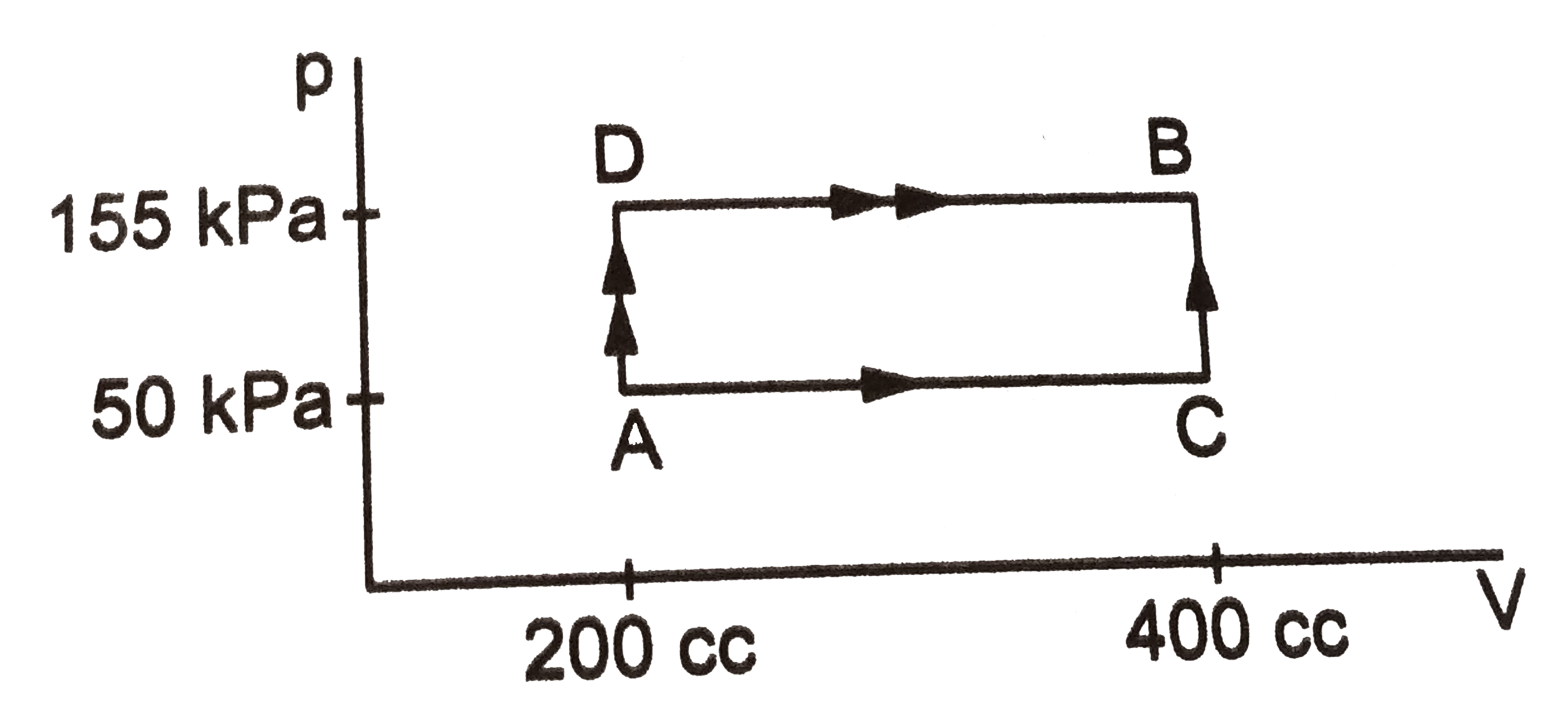
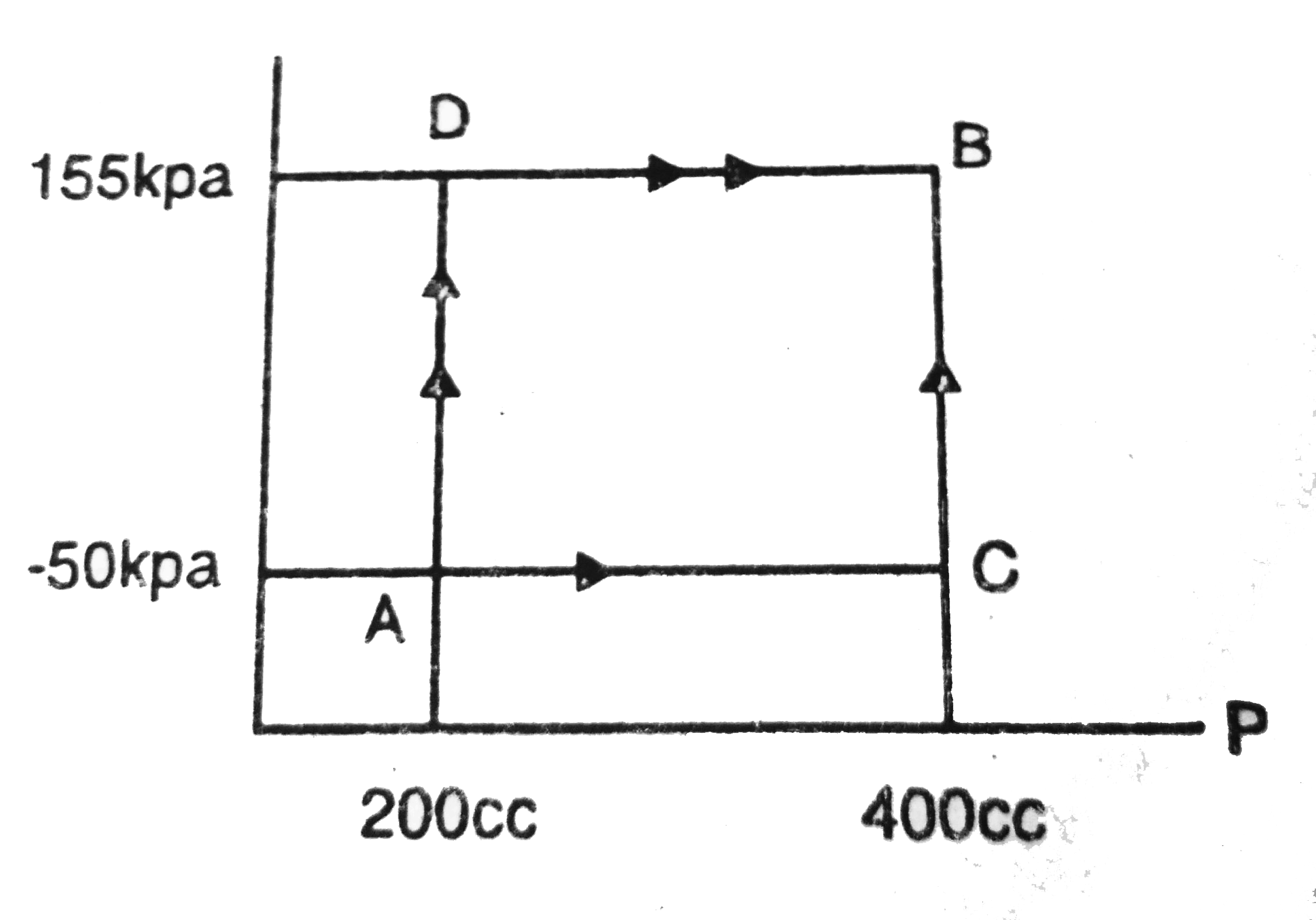
50 cal of heat should be supplied to take a system from the state A to the state B through the path ABC as shown in fig, Find the quantity of heat to be supplied to take it from A to B via ADB.

Text Solution

Verified by Experts

The correct Answer is:
A, C

In path ACB,`DeltaQ =50cal.=(50xx4*2)J`
`=`210J`,
`DeltaW=W_(AC)+W_(CB`
`=`50xx10^-3xx200xx10^-6`
`=`10Jltbrge10J`
`DeltaQ=DeltaU+DeltaW`
``rArrDeltaU=DeltaQ-DeltaQ-Delta-DeltaW=(210-10)J
200J
Inpath ADB,DeltaQ=?
DeltaU=200J
(Internal energy change between two point is always same)`
`DeltaW=W(AD)+W(DB)=DeltaWltbrge0 + 155xx10^3xx200xx10^(-6)`
` = 31J`
`Delta Q = Delta U+deltaW`
` = (200+31)J = 231J`
` = 55cal.
Promotional Banner

Topper's Solved these Questions

  • KINETIC THEORY OF GASES

    HC VERMA ENGLISH|Exercise All Questions|106 Videos
  • NEWTON'S LAWS OF MOTION

    HC VERMA ENGLISH|Exercise Questions for short Answer|17 Videos

Similar Questions

Explore conceptually related problems

The given figure shows a change of state A to state C by two paths ABC and AC for an ideal gas. Calculate. a. The path along which work done is least. b. The internal energy at C if the internal energy of gas at A is 10J and amount of heat supplied to change its state to C through the path AC is 200J . c. The amount of heat supplied to the gas to go from A to B , if internal energy of gas at state B is 10J .

The given figure shown a change of state A to state C by two paths ABC and AC for an ideal gas. Calculate the : (a) Path along which work done is least. (b) Internal energy at C if the internal energy of gas at A is 10 J and amount of heat supplied to change its state to C through the path AC is 200 J . (c) Amount of heat supplied ot the gas to go from A to B, if internal energy of gas at state B is 10 J .

In the given graph, an ideal gas changes its state from A to C by two paths ABC and AC. (a) Find the path along which work done is less. (b) The internal energy of gas at A is 10J and the amount of heat supplied in path AC is 200J. Calculate the internal energy of gas at C. (c) The internal energy of gas at state B is 20J. Find the amount of heat supplied to the gas to go from A to B.

In the given figure, an ideal gas changes its state from state state C by two paths ABC and AC. The internal energy of gas at A is 10 J and the amount of heat supplied to change its state to C through path AC is 200 J.Calculate the internal energy of gas at C

shows three paths through which a gas can be taken from the state A to the state B. calculate the work done by the gas in each of the three paths.

The circuit shown in fig. Is in steady state. i. Find the energy stored in the capacitors shown in fig. ii. Find the rate at which battery supplies energy.

In the given figure, an ideal gas changes it state from A to state C by two paths ABC and AC . (i) Find the path along which work done is the least. (ii) The internal energy of the gas at A to 10J and the amount of heat supplied to change its state to C through the path AC is 200J . Calculate the internal energy at C . (iii) The internal energy of the gas at state B is 30J . Find the amount of heat supplied to the gas to go from A to B .

Figure shows an ideal gas changing its state A to state C by two different path ABC and AC . The internal energy of the gas at A is 10 J and the amount of heat supplied to change its state to C through the path AC is 200 J . Find the internal energy at C .

An ideal gas is taken from state 1 to state 2 through optional path A, B, C and D as shown in the PV diagram. Let Q, W and U represent the heat supplied, work done and change in internal energy of the gas respectively. Then,

One mole of an ideal monoatomic gas is taken through the thermodynamic process shown in the P-V diagram. The heat supplied to the system is

HC VERMA ENGLISH-LAWS OF THERMODYNAMICS-All Questions
  1. shows three paths through which a gas can be taken from the state A to...

    Text Solution

    |

  2. when a system is taken through the process abc shown in the fig. 80 J ...

    Text Solution

    |

  3. 50 cal of heat should be supplied to take a system from the state A t...

    Text Solution

    |

  4. calculate the heat absorbed by a system in going through the cyclic pr...

    Text Solution

    |

  5. A gas is taken through a cyclic process ABCA as shown in, if 2.4 cal o...

    Text Solution

    |

  6. A substance is taken through the process abc as shown in fig, if the ...

    Text Solution

    |

  7. A gas is taken along the path AB as shown in fig, if 70 cal of heat is...

    Text Solution

    |

  8. The internal energy of a gas is given by U=1.5pV. It expands from 100...

    Text Solution

    |

  9. A gas is enclosed in a cylindrical vessel fitted with a frictionless p...

    Text Solution

    |

  10. A gas is initially at a pressure of 100 kPa and its volume is 2.0 m^(3...

    Text Solution

    |

  11. Consider the cyclic process ABCA, shown in fig, performed on a sample ...

    Text Solution

    |

  12. Fig shows the variation in the internal energy U with the volume V of ...

    Text Solution

    |

  13. Find the change in the internal energy of 2 kg of water as it heated f...

    Text Solution

    |

  14. Calculate the increase in the internal energy of 10 g of water when it...

    Text Solution

    |

  15. Fig shows a cylindrical tube of volume V with adiabatic walls containi...

    Text Solution

    |

  16. An adiabatic vessel of total volume V is divided into two equal parts ...

    Text Solution

    |

  17. Should the internal energy of a system necessarily increase if heat is...

    Text Solution

    |

  18. Should the internal energy of a system necessarily increase if its tem...

    Text Solution

    |

  19. A cylinder containing a gas is lifted from the first floor to the seco...

    Text Solution

    |

  20. A force F is applied on a block of mass M. The block is displaced thro...

    Text Solution

    |

