
Home
Class 11
PHYSICS
Fig shows the variation in the internal ...

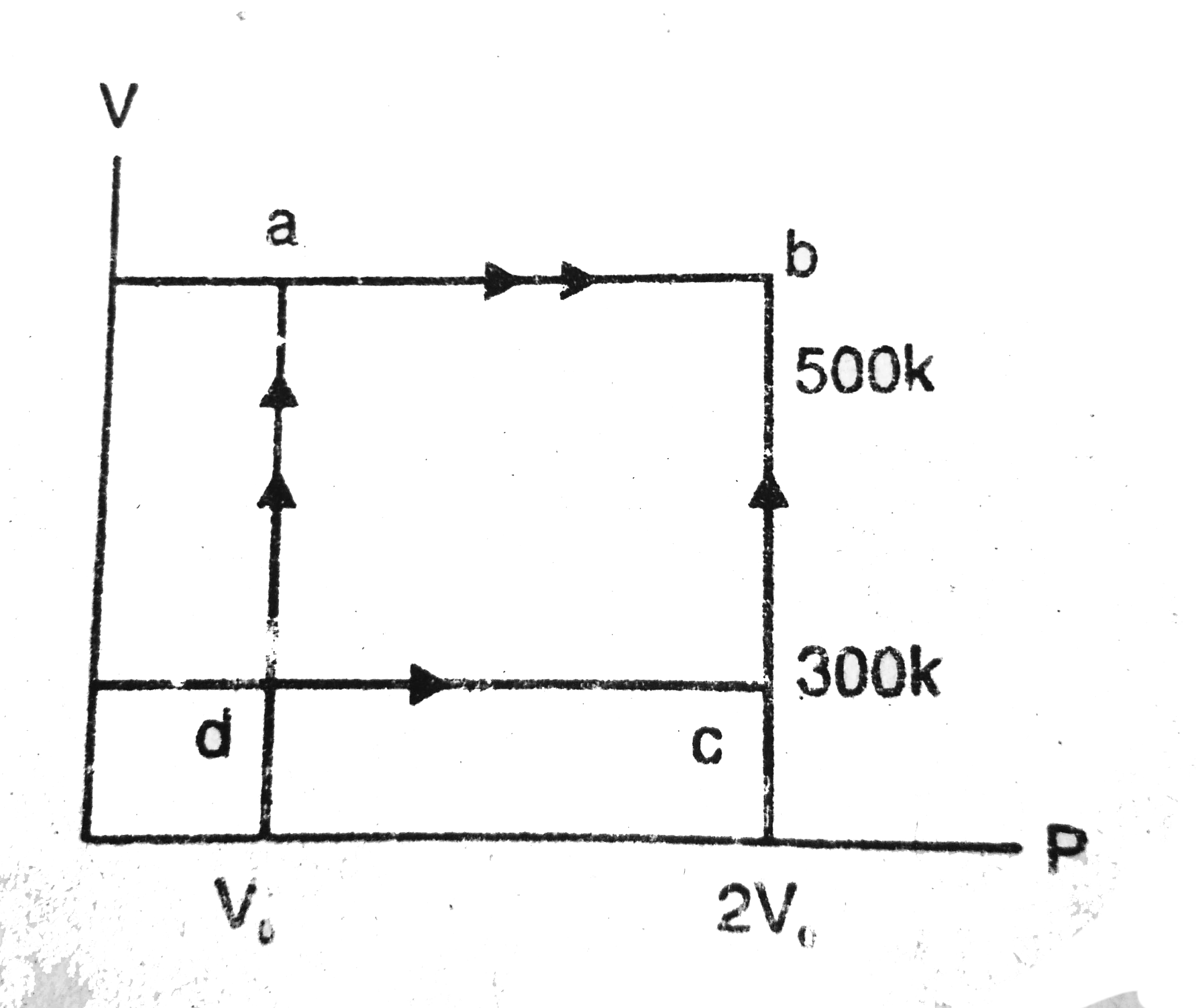
Fig shows the variation in the internal energy U with the volume V of 2.0 mol of an ideal gas in a cyclic process abcda. The temperatures of the gas at b and c are 500 K and 300 K respectively. Calculate the heat absorbed by the gas during the process.

Text Solution

Verified by Experts

The correct Answer is:
B, C

Given ,`n = 2moles`.`
`DeltaV = 0`
`In ab and bc`
`Hence DeltaW = DeltaQ`
`DeltaW =DeltaW_AB+DeltaW_CD`
` = nRT_1 In((2V_0)/(V_0)+nRT_2 In((V_0)/(2V_0))`
`nRxx2.303xxlog 2xx(500-300)`
`= 2xx8.314xx2.303xx0.301xx200`
` = 2305.31J
Promotional Banner

Topper's Solved these Questions

  • KINETIC THEORY OF GASES

    HC VERMA ENGLISH|Exercise All Questions|106 Videos
  • NEWTON'S LAWS OF MOTION

    HC VERMA ENGLISH|Exercise Questions for short Answer|17 Videos

Similar Questions

Explore conceptually related problems

Figure shows the variation of internal energy (U) with the pressure (P) of 2.0 mole gas in cyclic process abcda.The temperature of gas at c and d are 300 and 500 K respectively. The heat absorbed by the gas during the process is Xxx 10 R ln 2 . Find the value of x.

consider the cyclic process ABCA on a sample of 2.0 mol of an ideal gas as shown in the fig. temperature of the gas at A and B are 300 K and 500 k respectively. A total of 1200 J heat is withdrawn from the sample in the process. Find the work done by the gas in part BC. take R=8.3 JK^(-1) mol^(-1)

One mole of an ideal monoatomic gas undergoes a cyclic process, as shown in the figure. If the temperature of the gas at state 1 is 300 K and at state 4 is 500 K, then heat exchanged during process 2rarr3 , is

One mole of an ideal gas is taken through a cyclic process. The minimum temperature during the cycle is 300K. Then, net exchange of heat for complete cycle is

In figure, a cyclic process ABCA of 3 moles of an ideal gas is given. The temperature of the gas at B and C are 500k and 1000K respectively. If work done on the gas in process CA is 2500J then find the net heat absorbed or released by an idela gas. Take R = 25//3J//mol-K .

Figure, shows the variation of potential energy (U) of 2 mol of Argon gas with its density in a cyclic process ABCA . The gas was initiallly in the state A whose pressure and temperature are P_(A)=2 atm, T_(A)=300K , respectively. It is also stated the path AB is a rectangular hyperbola and the internal energy of the gas at state C is 3000r . Based on the above information answer the following question : The heat supplied to the gas in the process AB is

Figure, shows the variation of potential energy (U) of 2 mol of Argon gas with its density in a cyclic process ABCA . The gas was initiallly in the state A whose pressure and temperature are P_(A)=2 atm, T_(A)=300K , respectively. It is also stated the path AB is a rectangular hyperbola and the internal energy of the gas at state C is 3000r . Based on the above information answer the following question : Heat supplied in the process CA is

A sample of ideal gas is taken through the cyclic process shown in the figure. The temerauture of the gas in state A is T_(A) =200 K. In states B and C the temperature of the gas is the same. Net work done by the gas in the process is

Figure shows the variation of the internal energy U with the density rho of an ideal monoatomic gas for a therodynamic process AB. Process AB is a part of arectangular hyperbola. Find the work done (in joule) by gas in process AB.

One mole of a diatomic ideal gas undergoes a cyclic process ABC as shown in figure. The process BC is adiabatic. The temperature at A,B and C are 400K, 800K and 600K respectively. Choose the correct statement:

HC VERMA ENGLISH-LAWS OF THERMODYNAMICS-All Questions
  1. A gas is initially at a pressure of 100 kPa and its volume is 2.0 m^(3...

    Text Solution

    |

  2. Consider the cyclic process ABCA, shown in fig, performed on a sample ...

    Text Solution

    |

  3. Fig shows the variation in the internal energy U with the volume V of ...

    Text Solution

    |

  4. Find the change in the internal energy of 2 kg of water as it heated f...

    Text Solution

    |

  5. Calculate the increase in the internal energy of 10 g of water when it...

    Text Solution

    |

  6. Fig shows a cylindrical tube of volume V with adiabatic walls containi...

    Text Solution

    |

  7. An adiabatic vessel of total volume V is divided into two equal parts ...

    Text Solution

    |

  8. Should the internal energy of a system necessarily increase if heat is...

    Text Solution

    |

  9. Should the internal energy of a system necessarily increase if its tem...

    Text Solution

    |

  10. A cylinder containing a gas is lifted from the first floor to the seco...

    Text Solution

    |

  11. A force F is applied on a block of mass M. The block is displaced thro...

    Text Solution

    |

  12. The outer surface of a cylinder containing a gas is rubbed vigorously ...

    Text Solution

    |

  13. When we rub our hands they become warm. Have we supplied heat to the h...

    Text Solution

    |

  14. A closed bottle contains some liquid. The bottle is shaken vigorously ...

    Text Solution

    |

  15. The final volume of a system is equal to the initial volume in a certa...

    Text Solution

    |

  16. Can work be done by a system without changing its volume?

    Text Solution

    |

  17. An ideal gas is pumped into a rigid container having diathermic walls ...

    Text Solution

    |

  18. When a tyre bursts, the air coming out is cooler than the surrounding ...

    Text Solution

    |

  19. When we heat an object, it expands. Is work done by the object in this...

    Text Solution

    |

  20. When we stir a liquid vigorously, it becomes warm. Is it a reversible ...

    Text Solution

    |

