Home
Class 11
PHYSICS
Figure shows a cylindrical container con...

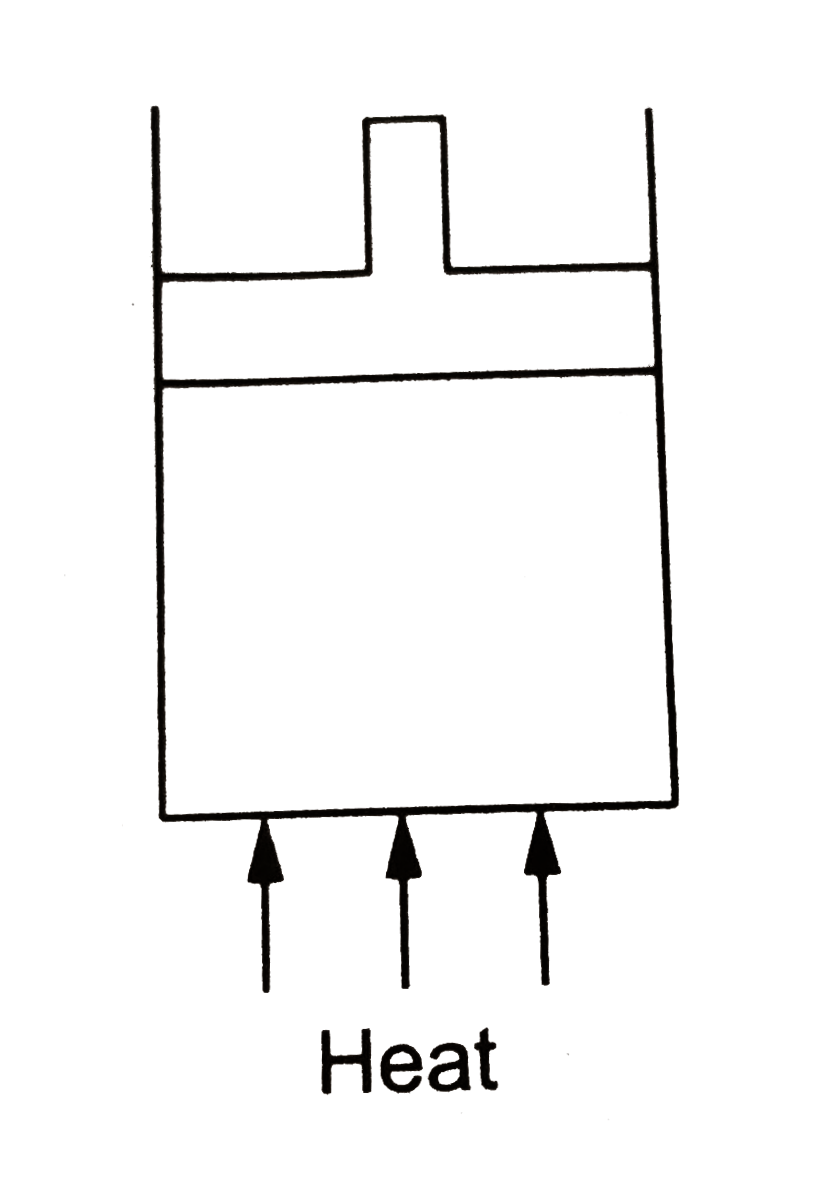
Figure shows a cylindrical container containing oxyegn `(gamma = 1.4)` and closed by a 50 kg frictionless piston. The area of cross section is `100cm(2)` , atmospheric pressure is `100 kPa`+E2 and g is 10 m s^(-2)`. The cylinder is slowly heated for some time. Find the amount of heat supplied to gas if the piston moves out through a distsnce of 20 cm.
.

Text Solution

Verified by Experts

`gamma =1.4`, Weight of piston (w) `= 50 kg`, Area of cross section of piston(A)
`=100 cm^2`
Atmospheric pressure `(P_0) = 100 kPa`,
`g=10 m//s^2, x=20 cm`,
`dW = Pdv= ((mg)/A+P_0).Adx`
`= ((50xx10)/(100xx10^(-4)) + 10^(5))`
`(100 xx 10 ^(-4) xx 20 xx 10^(-2))`
`= (5xx10^(4) xx10^(5) ) xx 20 xx 10^(-4)`
`= 1.5 xx 10^(5) xx 20 xx 10^(-4)`
`=300 J`.
Hence `nRdT = 300`ltbgt `dT= 300/nR` ltbgt So, `dQ=nCpdT=nc_p xx((300)/(nR))`
`=(ngammaR300)/((gamma-1)nR`
`= ((300xx1.4)/0.4)`
`=1050J`
Promotional Banner

Topper's Solved these Questions

  • SOUND WAVES

    HC VERMA ENGLISH|Exercise All Questions|133 Videos
  • THE FORCES

    HC VERMA ENGLISH|Exercise Questions for short Answer|9 Videos

Similar Questions

Explore conceptually related problems

2 moles of a diatomic gas are enclosed in a cylinder piston arrangment. The area of cross section and mass of the piston are 1 cm^(2) and 1 kg respectively. A heater is supplying heat to the gas very slowly. Find heat supplied (in joule) by the heater is the piston moves through a distance of 10 cm. .

A cylindrical vessel containing a liquid is closed by a smooth piston of mass m as shown in the figure. The area of cross section of the piston is A. If the atmospheric pressure is P_0 , find the pressure of the liquid just below the piston. ,

Figure shows a liquid being pushed out of a tube by pressing a piston. The area of cross section of the piston is 1.0 cm^2 and that of the tube at the outlet is 20 mm^2 . If the piston is pushed at a speed of 2cms^-1 . What is the speed of the outgoing liquid?

A vertical hollow cylinder contains an ideal gas. The gas is enclosed by a 5kg movable piston with an area of cross-section 5 xx 10^(-3)m^(2) . Now, the gas is heated slowly from 300K to 350K and the piston rises by 0.1m . The piston is now clamped at this position and the gas is cooled back to 300K . Fid the difference between the heat energy added during heating process and energy lost during the cooling process. ("1atm pressire" = 10^(5)Nm^(-2)]

A piston of cross-sectional area 100 cm^(2) is used in a hydraulic pressure to exert a force of 10^(7) dyne on the water. The cross-sectional area of the other piston which support a truck of mass 2000 kg is

An ideal monoatomic gas is confined in a cylinder by a spring-loaded piston of cross-section 8.0xx10^-3m^2 . Initially the gas is at 300K and occupies a volume of 2.4xx10^-3m^3 and the spring is in its relaxed (unstretched, unompressed) state, fig. The gas is heated by a small electric heater until the piston moves out slowly by 0.1m. Calculate the final temperature of the gas and the heat supplied (in joules) by the heater. The force constant of the spring is 8000 N//m , atmospheric pressure is 1.0xx10^5 Nm^-2 . The cylinder and the piston are thermally insulated. The piston is massless and there is no friction between the piston and the cylinder. Neglect heat loss through lead wires of the heater. The heat capacity of the heater coil is negligible. Assume the spring to be massless.

An ideal monoatomic gas is confined in a cylinder by a spring-loaded piston of cross-section 8.0xx10^-3m^2 . Initially the gas is at 300K and occupies a volume of 2.4xx10^-3m^3 and the spring is in its relaxed (unstretched, unompressed) state, fig. The gas is heated by a small electric heater until the piston moves out slowly by 0.1m. Calculate the final temperature of the gas and the heat supplied (in joules) by the heater. The force constant of the spring is 8000 N//m , atmospheric pressure is 1.0xx10^5 Nm^-2 . The cylinder and the piston are thermally insulated. The piston is massless and there is no friction between the piston and the cylinder. Neglect heat loss through lead wires of the heater. The heat capacity of the heater coil is negligible. Assume the spring to be massless.

Figure shows initial state of an ideal gas trapped in a container with conducting walls and a piston (mass m ) which can move without any friction. The container is placed on point supports and its wall are conducting. Assuming that atmospheric pressure is P_(0) and the mass of the ideal gas is negligible as compared to the mass of the piston and the mass of container. Take the cross section area of piston to be A. The piston is slowly lifted by an external agent and held in its position. Let M be the maximum mass of container so that it may "lift off" while pulling the piston upwards and P_(i) be the pressure of ideal gas in initial state. Pick the correct choice:

2.00 mole of a monatomic ideal gas (U=1.5nRT) is enclosed in an adiabatic, fixed , vertical cylinder fitted with a smooth, light adiabatic piston. The piston is connected to a vertical spring of spring constant 200 N m^(-1) as shown in .the area of cross section of the cylinder is 20.0 cm^(2) . initially, the spring is at its natural length and the temperature of the gas is 300K at its natural length. the atmosphere pressure is 100 kPa. the gas is heated slowly for some time by means of an electric heater so as to move the position up through 10 cm. find (a) the work done by the gas (b) the final temperature of the gas and (c ) the heat supplied by the heater.

Two moles of an ideal monoatomic gas are confined within a cylinder by a massless and frictionless spring loaded piston of cross-sectional area 4 xx 10^(-3)m^(2) . The spring is, initially in its relaxed state. Now the gas is heated by an electric heater, placed inside the cylinder, for some time. During this time, the gas expands and does 50J of work in moving the piston through a distance 0.10m . The temperature of the gas increases by 50K . Calculate the spring constant and the heat supplied by the heater. P_(atm) = 1 xx 10^(5)N//m^(2)R = 8.314 J//mol-K

HC VERMA ENGLISH-SPECIFIC HEAT CAPACITIES OF GASES-All Questions
  1. A vessel containing one of mole of a monatomic ideal gas (molecular we...

    Text Solution

    |

  2. 5g of a gas is contained in a rigid container and is heated from 15^@C...

    Text Solution

    |

  3. Figure shows a cylindrical container containing oxyegn (gamma = 1.4) a...

    Text Solution

    |

  4. The specific heat capacities of hydrogen at constant volume and at con...

    Text Solution

    |

  5. The ratio of the molar heat capacities of an ideal gas is (Cp / Cv = 7...

    Text Solution

    |

  6. A sample of air weighing 1.18 g occupies 1.0 xx 10^(3) cm^(3) when kep...

    Text Solution

    |

  7. An ideal gas expands from 100 cm^(3) to 200 cm^(3) at a constant press...

    Text Solution

    |

  8. An amount of heat is added to a monatomic ideal gas in a process in wh...

    Text Solution

    |

  9. An ideal gas is taken through a process in which the pressure and the ...

    Text Solution

    |

  10. An ideal gas (Cp // CV = (gamma) is taken through a process in which t...

    Text Solution

    |

  11. Two ideal gases have same value of (Cp / Cv = gamma). What will be the...

    Text Solution

    |

  12. A mixture contains 1 mole of helium (cp = 2.5 R, Cv 1.5 R. ) and 1mol...

    Text Solution

    |

  13. Half mole of an ideal gas (gamma = 5/3) is taken through the cycle abc...

    Text Solution

    |

  14. An ideal gas (gamma = 1.67 ) is taken through the process abc shown in...

    Text Solution

    |

  15. In Joly's differential steam calorimeter, 3g of an ideal gas is cconta...

    Text Solution

    |

  16. The volume of an ideal gas (gamma = 1.5 ) is changed adiabatically fro...

    Text Solution

    |

  17. An ideal gas at pressure 2.5 xx 10^(5) pa and temperature 300k occupie...

    Text Solution

    |

  18. Air (gamma = 1.4 ) is pumped at 2atm pressure in a motor tyre at 20^@C...

    Text Solution

    |

  19. A gas is enclosed in a cylindrical can fitted with a piston. The walls...

    Text Solution

    |

  20. The initial pressure and volume of a given mass of a gas (Cp / Cv = ga...

    Text Solution

    |

