

Home
Class 11
PHYSICS
Figure shows a cylindridcal tube with a ...

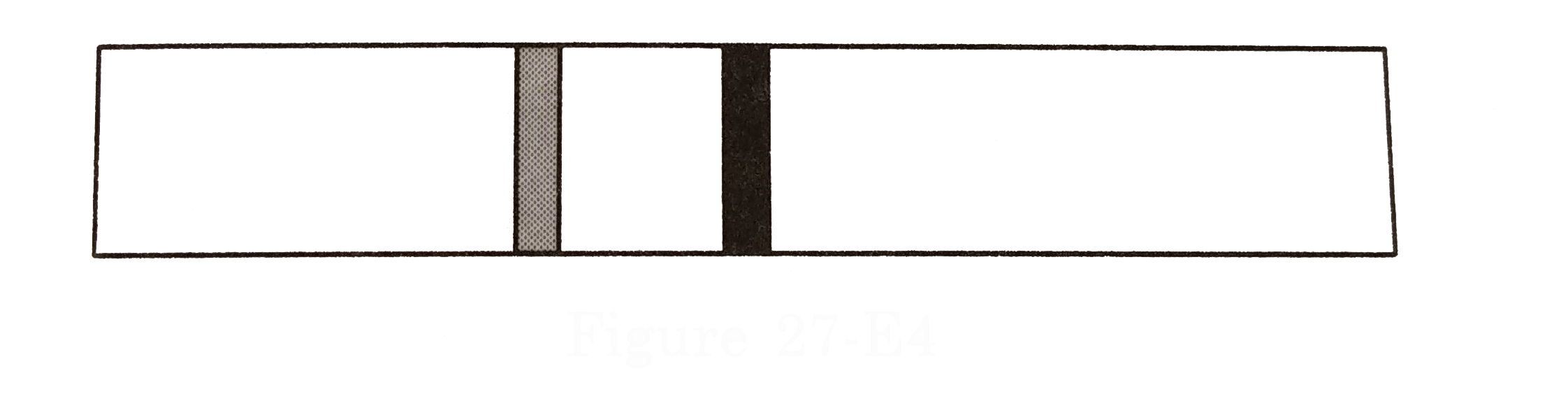
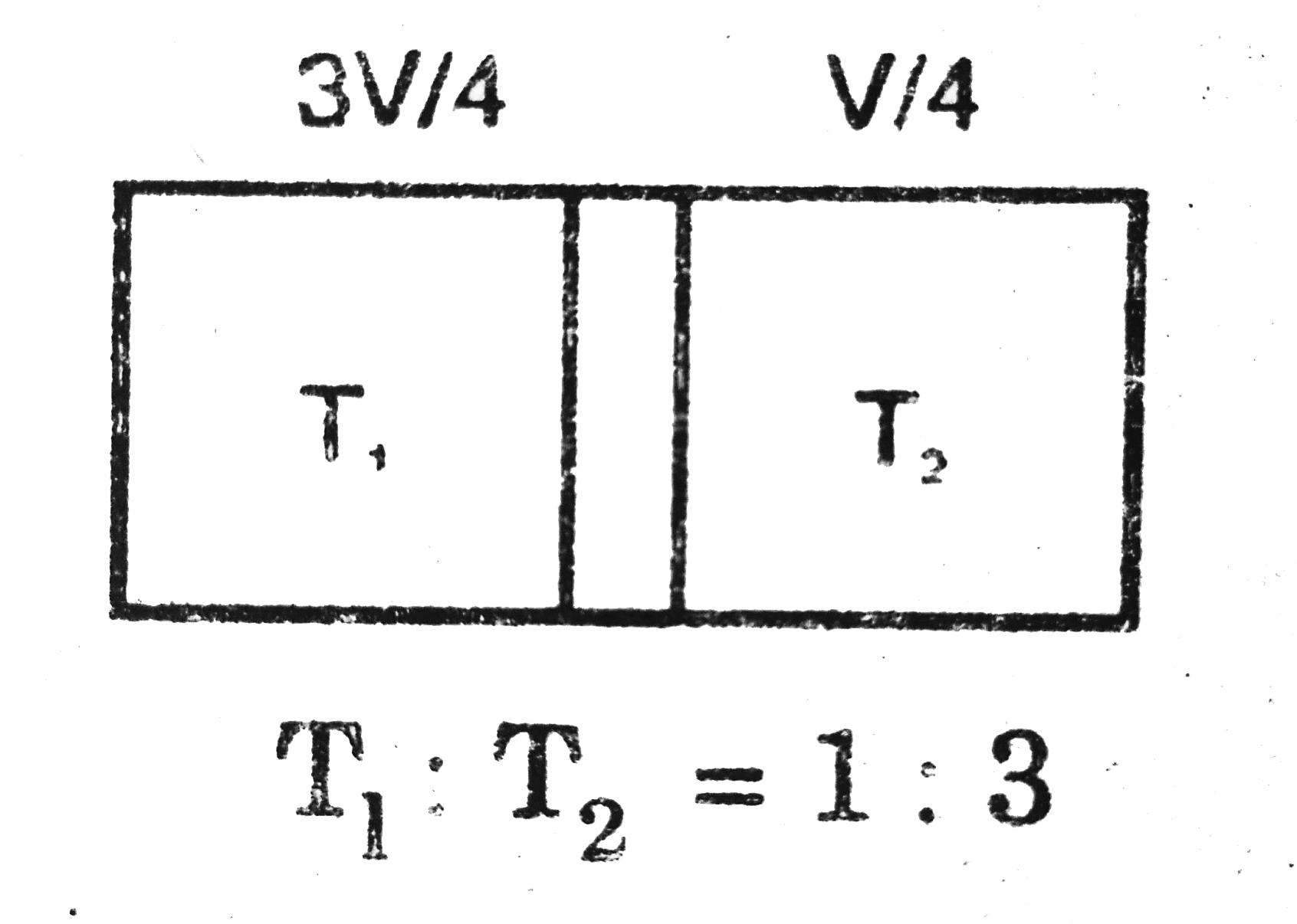
Figure shows a cylindridcal tube with a adibatic walls and fitted with an adiabatic separtor. The separator can be slid into the tube by an external mechanism. An ideal gas`(gamma=1.5)` is injected in the two sides at equal pressures and temperatures . The separator remains in equilibrium at the middel. It is now slid to a position where it divides the tube in the ratio 1:3 Find the ratio of the tempertures in the two parts of the vessel.

Text Solution

Verified by Experts

Given `gamma=1.5`
We know for adiabatic process `TV^(gamma-1)`
`=constant`
So, `T_1 V_1^(gamma-1) = T_2 V_2^(gamma-1)` …(equation)
As, it is an adiabatic process and all the other conditions are same, hence the above equation can be applied.
So, `T_1 xx ((3v)/(4)) = T_2 xx ((v)/(4))`
So, `T_1:T_2 = 1:3`
Promotional Banner

Topper's Solved these Questions

  • SOUND WAVES

    HC VERMA ENGLISH|Exercise All Questions|133 Videos
  • THE FORCES

    HC VERMA ENGLISH|Exercise Questions for short Answer|9 Videos

Similar Questions

Explore conceptually related problems

Shows a cylindrical tube with adiabatic walls and fittled with a diathermic separetor. The separetor can be slid in the tube by and external mechanism. An ideal gas is injected into the two sides at equal pressures and equal temperatures. The separetor remaons in equilibrium at the middle. It is now slid to pisition where it devides the tube in the ratio of 1:3. Find the ratio of the pressures in the two parts of the vessel.

An adiabatic cylindrical tube is fitted with an adiabatic separator as shown in figure. Initial separator is in equilibrium and divides a tube in two equal parts. The seperator can be slide into the tube by an extermal mechanism. An ideal gas (gamma = 1.5) is injected in the two slides at equal pressure and temperature. Now separator is slid to a piston where it divides the tube in the ratio 7 :3 The ratio of the temperature in the two parts of the vessel is sqrt(n) : sqrt(7) find n .

Water rises in a capillary tube to a height 4 cm. If the tube is inclined at an angle of 45^(@) with the vertical , find the position of the water in the tube.

Figure shows an adiabatic cylindrical tube of volume (V_0) divided in two parts by a frictionless adiabatic separator . Initially, the separator is kept in the middle, an ideal gas at pressure (P_1) and the temperatures (T_1) is injected into the left part and the another ideal gas at pressures (P_2) and temperature (T_2) is injected into the right part. (C_p / C_v = gamma) is the same for both the gases. The separator is slid slowly and is released at a position where it can stay in equilibrium. Find (a) the volumes of the parts, (b) the heat given to the gas in the left part and (c) the final common pressure of the gases.

In given figure, an adiabatic cylindrical tube of volume 2V_(0) is divided in two equal parts by a frictionless adiabatic separator. An ideal gas in left side of a tube having pressure P_(1) and temperature T_(1) where as in the right side having pressure P_(2) and temperature T_(2).C_(p)//C_(v) =gamma is the same for both the gases. The separator is slid slowly and is released at a position where it can stay in equilibrium. Find (a) the final volumes of the two parts (b) the heat given to the gas in the left part and (c) the final common pressure of the gases,

Following figure shows on adiabatic cylindrical container of volume V_(0) divided by an adiabatic smooth piston (area of cross-section = A ) in two equal parts. An ideal gas (C_(p)//C_(y)=lambda) is at pressure P_1 and temperature T_1 in left part and gas at pressure P_2 and temperature T_2 in right part. The piston is slowly displaced and released at a position where it can stay in equilibrium. The final pressure of the two parts will be (Suppose x = displacement of the piston)

Fig shows a cylindrical tube of volume V with adiabatic walls containing an ideal gas. The internal energy of this ideal gas is given by 1.5nRT. The tube is divided into two equal parts by a fixed diathermic wall. Initially, the pressure and the temperature are p_(1), T_(1) on the left and p_(2), T_(2) on the right. the system is left for sufficient time so that the temperature becomes equal on the two sides. (a) how much work has been done by the gas on the left part ? (b) find the final pressures on the two sides. (c ) find the final equilibrium temperature. (d) how much heat has flown from the gas on the right to the gas on the left ?

Functional part of pollen tube is separated from the rest by

A cylindrical tube with adiabatic walls having volume 2V_(0) contains an ideal monoatomic gas as shown in figure. The tube is divided into two equal parts by a fixed super conducting wall. Initially, the pressure and the temperature are P_(0), T_(0) on the left and 2P_(0), 2T_(0) on the rigid. When system is left for sufficient amount of time the temperature on both sides becomes equal

Figure shows a cylindrical tube of radius 5cm and length 20cm. It is closed by a tight-fitting cork. The friction coefficient between the cork and the tube is 0.20. The tube contains an ideal gas at a pressure of 1atm and a temperature of 300K. The tube is slowly heated and it is found that the cork pops out when the temperature reaches 600K. Let dN denote the magnitude of the normal contact force exerted by a small length dl of the cork along the periphery (see the figure). Assuming that the temperature pf the gas is uniform at any instant, calculate(dN)/(dl).

HC VERMA ENGLISH-SPECIFIC HEAT CAPACITIES OF GASES-All Questions
  1. A mixture contains 1 mole of helium (cp = 2.5 R, Cv 1.5 R. ) and 1mol...

    Text Solution

    |

  2. Half mole of an ideal gas (gamma = 5/3) is taken through the cycle abc...

    Text Solution

    |

  3. An ideal gas (gamma = 1.67 ) is taken through the process abc shown in...

    Text Solution

    |

  4. In Joly's differential steam calorimeter, 3g of an ideal gas is cconta...

    Text Solution

    |

  5. The volume of an ideal gas (gamma = 1.5 ) is changed adiabatically fro...

    Text Solution

    |

  6. An ideal gas at pressure 2.5 xx 10^(5) pa and temperature 300k occupie...

    Text Solution

    |

  7. Air (gamma = 1.4 ) is pumped at 2atm pressure in a motor tyre at 20^@C...

    Text Solution

    |

  8. A gas is enclosed in a cylindrical can fitted with a piston. The walls...

    Text Solution

    |

  9. The initial pressure and volume of a given mass of a gas (Cp / Cv = ga...

    Text Solution

    |

  10. Conider a given sample of an ideal gas (Cp / Cv = gamma ) having initi...

    Text Solution

    |

  11. A given sample of an ideal gas (gamma = 1.5 ) is compressed adiabatica...

    Text Solution

    |

  12. Three samples A, B and C of the same gas (gamma = 1.5) have equal volu...

    Text Solution

    |

  13. Three samples A, B and C of the same gas (gamma = 1.5) have equal volu...

    Text Solution

    |

  14. Figure shows a cylindridcal tube with a adibatic walls and fitted with...

    Text Solution

    |

  15. In given figure, an adiabatic cylindrical tube of volume 2V(0) is divi...

    Text Solution

    |

  16. An adiabatic cylindrical tube of cross-sectional area 1 cm^(2) is clos...

    Text Solution

    |

  17. The speed of sound in hydrogen at 0^@C is 1280 m s^(-1). The density o...

    Text Solution

    |

  18. 4.0 g of helium occupies 22400 cm^(3) at STP. The specific heat capaci...

    Text Solution

    |

  19. An ideal gas having density 1.7 xx 10^(-3) g cm ^(-3) at a pressure 1....

    Text Solution

    |

  20. Standing waves of frequency 5.0 kHz are produced in a tube filled with...

    Text Solution

    |