Home
Class 12
PHYSICS
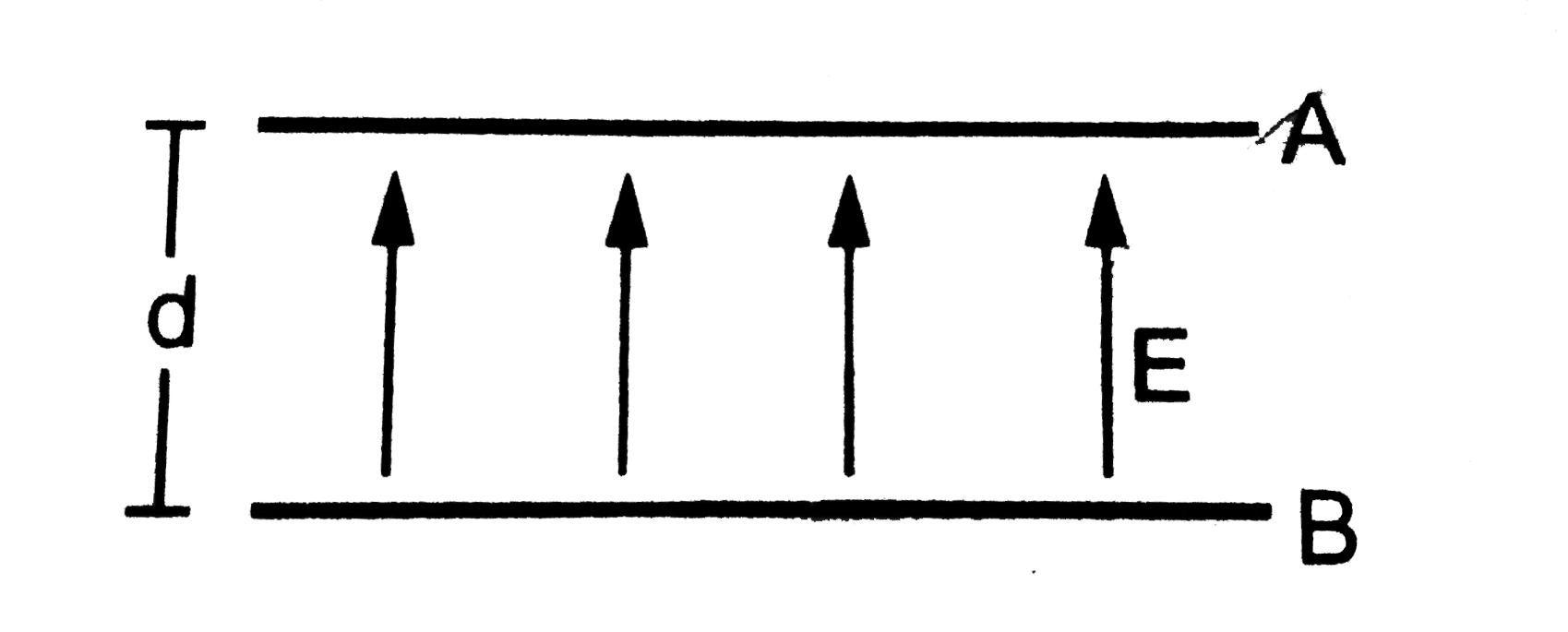
Figure shows two metallic plates A and B...

Figure shows two metallic plates A and B placed parallel to each other at a seperation d. A uniform electric field E exists between the plates in the direction from plate B to plate A. Find the potential difference between the plates.

Text Solution

Verified by Experts

Let us take the origin at plate a and x-axis
along the direction from plate A to plate B. We have
`V_B - V_A =-int_(r_A)^(r_B) vecE dvecr = -int_0^d - E dx = Ed.
if we work in Cartesian coordinate system
`E = E_x veci +E_y vec j +E_z veck`
and `dvecr = dx veci +dy vecj +dz veck.`
Thus from
`dV = E_x dx- E_y dy-Ez dz. (i)`
If we change x to x + dx keeping y and z constant,
dy = dz = 0 and from (i),
`|(E_x=-(delV)/(delx)),(E_y=-(delV)/(dely)),(E_z = -(delV)/(delz))|`
The symbols `(del)/(delx), (del)/(dely)` ect. are used to indicate that
while differentiating with respect to one coordinate, the other are kept constant.
if we know the electric field in a region, we can
find the electric using equation and
if we know the electrinc potential in a retgion, we can find the electric field using
Equation may also be written as
`dV = -E dr cos theta`
Where `theta` is the angle between the field `vecE` and the small
displacement `dvecr.` Thus.
`-(dV)/(dr) = E cos theta`
We see that, `-(dV)/(dr)` gives the compnent of the electric

field in the direction of displacement `dvecr.` In we show a small displacement PP' = dr. The electric field
is E making an angle `theta` with PP.' we have
`dV = V(P,) - V(P)`
so that `(V(P) - V(P))/(dr) = E cos theta.`
This gives us a method to get the component fo
the electric field in any given direction if we know the
potential. MOve a small distance dr in the given
direction and see the change dV in the potential. The
component of electric field along that direction is
`(dV)/(dr).`
If we move a distance dr in the direction of the
field, `theta` is zero and ` -(dV)/(dr) = E` is maximum. Thus the
electric field is along the direction in which the potential decrease at the maximum rate.
If a mall displacement `dvecr` perpendicular to the
electric field is considered, `theta = 90^@` and
`dV = -vecE.dvecr = -0.` The potential does not vary in a
direction perpendicular to the electric field.
Promotional Banner

Topper's Solved these Questions

  • ELECTRIC FIELD AND POTENTIAL

    HC VERMA ENGLISH|Exercise worked out Examples|19 Videos
  • ELECTRIC FIELD AND POTENTIAL

    HC VERMA ENGLISH|Exercise Exercises|75 Videos
  • ELECTRIC CURRENT THROUGH GASES

    HC VERMA ENGLISH|Exercise Short answer|6 Videos
  • ELECTROMAGNETIC INDUCTION

    HC VERMA ENGLISH|Exercise Questions for short answer|9 Videos

Similar Questions

Explore conceptually related problems

A parallel plate capacitor has a uniform electric field E in the space between the the plates. If the distance between the plates is d and area of each plate is A, the energy stored in the capacitor is

Charges 2q and -3q are given to two identical metal plates of area of cross section A . the distance between the plates is d . Find the capacitance and potential difference between the plates.

The force between the plates of a parallel plate capacitor of capacitance C and distance of separation of the plates d with a potential difference V between the plates, is.

The diagram shows an arrangement of identical metal plates placed parallel to each other and the variation of potential between the paltes by dotted lilne. Using the details given in diagram, the equivalent capacitance connected across the plate No. 2 and plate No. 4 is (Separation between the consecutive plates =L , area of each plate =A )

A charge of 1 muC is given to one plate of a parallel - plate capacitor of capacitance 0.1muF and a charge of 2 muC is given to the other plate . Find the potential difference developed between the plate .

In a parallel plate capacitor of capacitor 1muF two plates are given charges 2muC and 4muC the potential difference between the plates of the capacitor is

Two plates are 2cm apart, a potential difference of 10 volt is applied between them, the electric field between the plates is

Two large conducting plates of a parallel plate capacitor are given charges Q and 3Q respectively. If the electric field in the region between the plates is E_0 , then the force of interaction between the plates is

Five identical plates each of area a are joined as shown in the figure. The distance between the plates is d. the plates are connected to a potential difference of V volt. The charge on plates 1 and 4 will be

Four parallel large plates separated by equal distance d are arranged as shown in. The area of the plates is S Find the potential differnce between plats B and C if plate B is given a charge Q. .
