Home
Class 12
PHYSICS
A block of mass m having a charge q is p...

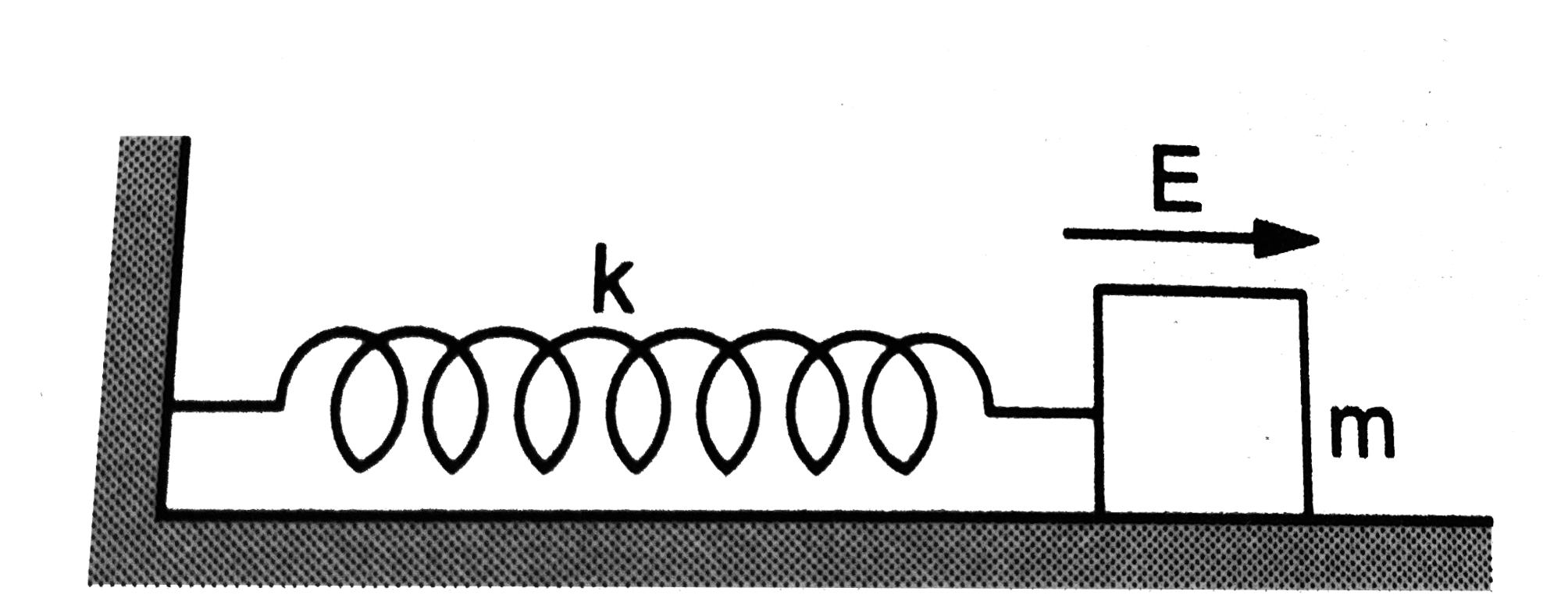
A block of mass m having a charge q is placed on a smooth horizontal table and is connected to a wall through an unstressed spring of spring constant k as shown in figure(29.E1) . A horizontal electric field E parallel to the spring is switched on. Find the amplitude of the resulting SHM of the block.

Text Solution

Verified by Experts

` F=qE,F-kx[where x amplitude] `
` qE=-kx `
` or x=(qE)/k`
Promotional Banner

Topper's Solved these Questions

  • ELECTRIC FIELD AND POTENTIAL

    HC VERMA ENGLISH|Exercise question for short answer|14 Videos
  • ELECTRIC FIELD AND POTENTIAL

    HC VERMA ENGLISH|Exercise Objective 1|9 Videos
  • ELECTRIC FIELD AND POTENTIAL

    HC VERMA ENGLISH|Exercise worked out Examples|19 Videos
  • ELECTRIC CURRENT THROUGH GASES

    HC VERMA ENGLISH|Exercise Short answer|6 Videos
  • ELECTROMAGNETIC INDUCTION

    HC VERMA ENGLISH|Exercise Questions for short answer|9 Videos

Similar Questions

Explore conceptually related problems

A block of mass m containing a net negative chage -q is placed on a froctionless horizontal tabe and is connected to a wall through an unstreached spring of spring constant k. If the horizontal electric field E parallel to spring is switched on , then the maximum compression of the spring is

A small cork block of mass m=1kg having charge q=-1C placed on a rough horizontal surface and is connected to a vertical wall through an unstretched non conducting light spring of spring consant k=9N//m as shown in the figure. If a horizontal constant electric field E=10N//C is switched on then the maximum compression in the spring is xm . Find the value of x . (Take g=10m//s^(2),mu=0.1 )

A block of mass m containing a net positive charge q is placed on a smooth horizontal table which terminates in a vertical wall as shown in figure(29-E2). The distance of the block from the wall is d. A horizontal electric field E to towards right is switched on. Assuming elastic collisions find the time period of the resulting oscillatory motion. Is it a simple harmonic motion?

A block of mass m is suspended by different springs of force constant shown in figure.

A block of mass m moving with velocity v_(0) on a smooth horizontal surface hits the spring of constant k as shown. The maximum compression in spring is

Two blocks of masses 3kg and 6kg respectivley are placed on a smooth horizontal surface. They are connected by a light spring of force constant k=200N//m . Initially the spring is unstretched. The indicated velocities are imparted to the blocks. Find the maximum extension of the spring.

Two blocks of masses 3kg and 6kg respectivley are placed on a smooth horizontal surface. They are connected by a light spring of force constant k=200N//m . Initially the spring is unstretched. The indicated velocities are imparted to the blocks. Find the maximum extension of the spring.

A block of mass M=1 kg resting on a smooth horizontal surface is connected to a horizontal light spring of spring constant k=6N/m whose other end is fixed to a verticall wall. Another block of mass m=0.5 kg is placed over the block M. If the coefficient of friction between the two blocks mu =0.4, find the maximum kinetic energy (in J) that the system can have for simple hormonic oscillation under the action of the spring.

A block of mass m held touching the upper end of a light spring of force constant K as shown in figure. Find the maximum potential energy stored in the spring if the block is released suddenly on the spring.

A spring of spring constant 'K' is fixed at one end has a small block of mass m and charge q is attached at the other end. The block rests over a smooth horizontal surface. A uniform and constant magnetic field B exists normal to the plane of paper as shown in figure. An electric field vec(E) = E_(0) hat (i)(E_(0) is a positive constant) is switched on at t =0 sec. The block moves on horizontal surface without ever lifting off the surface. Then the normal reaction acting on the block is :

HC VERMA ENGLISH-ELECTRIC FIELD AND POTENTIAL-Exercises
  1. A ball of mass 100g and having a charge of 4.9xx 10^(-5) C is released...

    Text Solution

    |

  2. The bob of a simple pendulum has a mass of 40 g and a positive char...

    Text Solution

    |

  3. A block of mass m having a charge q is placed on a smooth horizontal t...

    Text Solution

    |

  4. A block of mass m containing a net positive charge q is placed on a sm...

    Text Solution

    |

  5. A Uniform electric field of 10NC ^(-1) exists in the vertically downwa...

    Text Solution

    |

  6. 12 j of work has to be done against an existion electric field to take...

    Text Solution

    |

  7. Two equal charges, 2.0xx10^(-7) C each, are held fixed at a separation...

    Text Solution

    |

  8. An electric field of 20 N//C exists along the x-axis in space. Calcula...

    Text Solution

    |

  9. Consider the situation of the previous problem. A charge of 2.0xx 10 ^...

    Text Solution

    |

  10. An electric field vecE = vec(i20 + vecj30 ) NC^(-1) exists in the spac...

    Text Solution

    |

  11. An electric field vecE = vec I Ax exists in the space, where A= 10 V ...

    Text Solution

    |

  12. The electric potential existing in space is V(x,y,z)= A (xy+ yz+zx).(a...

    Text Solution

    |

  13. Two charged particles, having equal charges of 2.0xx 10^(-5) C each, a...

    Text Solution

    |

  14. Some equipotential surfaces are shown in figure(29.E3) What can you sa...

    Text Solution

    |

  15. Consider a circular ring of radius r, uniformly charged with linear ch...

    Text Solution

    |

  16. An electric field of magnitude 1000 NC ^(-1) is produced between two p...

    Text Solution

    |

  17. A uniform field of 2.0 NC^(-1) exists in space in x direction (a) Taki...

    Text Solution

    |

  18. How much work has to be done in assembling three charged particles at ...

    Text Solution

    |

  19. The kinetc energy of a chargd particle decreased by 10 J as it moves f...

    Text Solution

    |

  20. Two identical particles, each having a charge of 2.0xx10^(-4) C and m...

    Text Solution

    |
