Home
Class 12
PHYSICS
How much work has to be done in assembli...

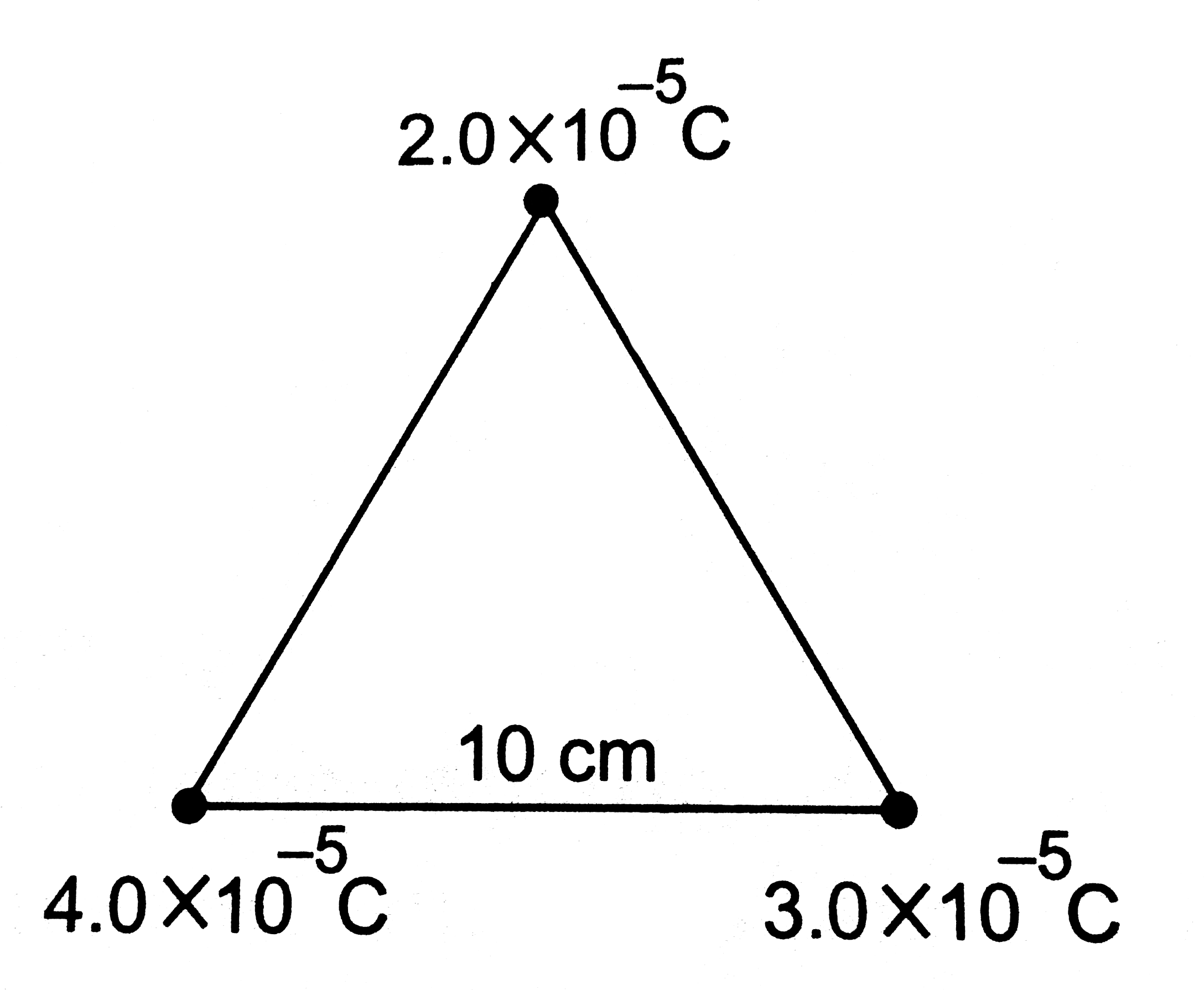
How much work has to be done in assembling three charged particles at the vertices of an equilateral triangle as shown in figure

Text Solution

Verified by Experts

Amount of workdone in assembling the charges is equal to the net potential energy
` So, P.E.=V_(12)+V_(13)+V_(23) `
` =(9xx10^3)/10^-1xx10^-10 `
` [4xx2+4xx3+3xx2] `
` 9xx(8+12+6) `
` 9xx26=234J `
Promotional Banner

Topper's Solved these Questions

  • ELECTRIC FIELD AND POTENTIAL

    HC VERMA ENGLISH|Exercise question for short answer|14 Videos
  • ELECTRIC FIELD AND POTENTIAL

    HC VERMA ENGLISH|Exercise Objective 1|9 Videos
  • ELECTRIC FIELD AND POTENTIAL

    HC VERMA ENGLISH|Exercise worked out Examples|19 Videos
  • ELECTRIC CURRENT THROUGH GASES

    HC VERMA ENGLISH|Exercise Short answer|6 Videos
  • ELECTROMAGNETIC INDUCTION

    HC VERMA ENGLISH|Exercise Questions for short answer|9 Videos

Similar Questions

Explore conceptually related problems

Find the coordinates of the vertices of an equilateral triangle of side 2a as shown in Figure.

Determine the electric dipole moment of the syatem of three charges , placed on the verices of an equilateral triangle , as shown in the fogure :

Three particles of massses 50 g, 100 g and 150 g are placed at the vertices of an equilateral triangle of side 1m ( as shown in the figure ) . The ( x, y) coordinates of the centre of mass will be :

Three masses each of mass m are palced at the vertices of an equilateral triangles ABC of side l as shown in figure. The force acting on a mass 2m placed at the centroid O of the triangle is

Three charges Q, (+q) and (+q) are placed at the vertices of an equilateral triangle of side l as shown in the figure. It the net electrostatic energy of the system is zero, then Q is equal to

Three charges Q, (+q) and (+q) are placed at the vertices of an equilateral triangle of side l as shown in the figure. It the net electrostatic energy of the system is zero, then Q is equal to

(a) Three point charges q,-4q and 2q are placed at the vertices of an equilateral triangle ABC of side 'l' as shown in the figure. Obtain the expression for the magnitude of the resultant electric force acting on the charge q. (b) Find out the amount of the work 4one to separate the charges at infinite distance.

Three particle each of mass m are placed at the corners of an equilateral at the corners of an equilateral triangle of side d as shown in figure. Calculate (a) the potential energy of the system, (b) work done on this system if the side of the traingle is changed from d to 2d.

Three particles, each of mass m are situated at the vertices of an equilateral triangle ABC of side l (as shown in the figure). The moment of inertia of the system about a line AX perpendicular to AB and in the plane of ABC, will be:

Calculate the work required to be done to make an arrangement of three particles each having a charge +q such that the particles lie at the vertices of an equilateral triagnle of side a. What work will be doen by electric field when the particles are shifted away so that the side of triangle becomes 2a ?

HC VERMA ENGLISH-ELECTRIC FIELD AND POTENTIAL-Exercises
  1. An electric field of 20 N//C exists along the x-axis in space. Calcula...

    Text Solution

    |

  2. Consider the situation of the previous problem. A charge of 2.0xx 10 ^...

    Text Solution

    |

  3. An electric field vecE = vec(i20 + vecj30 ) NC^(-1) exists in the spac...

    Text Solution

    |

  4. An electric field vecE = vec I Ax exists in the space, where A= 10 V ...

    Text Solution

    |

  5. The electric potential existing in space is V(x,y,z)= A (xy+ yz+zx).(a...

    Text Solution

    |

  6. Two charged particles, having equal charges of 2.0xx 10^(-5) C each, a...

    Text Solution

    |

  7. Some equipotential surfaces are shown in figure(29.E3) What can you sa...

    Text Solution

    |

  8. Consider a circular ring of radius r, uniformly charged with linear ch...

    Text Solution

    |

  9. An electric field of magnitude 1000 NC ^(-1) is produced between two p...

    Text Solution

    |

  10. A uniform field of 2.0 NC^(-1) exists in space in x direction (a) Taki...

    Text Solution

    |

  11. How much work has to be done in assembling three charged particles at ...

    Text Solution

    |

  12. The kinetc energy of a chargd particle decreased by 10 J as it moves f...

    Text Solution

    |

  13. Two identical particles, each having a charge of 2.0xx10^(-4) C and m...

    Text Solution

    |

  14. Two particles have equal masses of 5.0 g each and opposite charges of ...

    Text Solution

    |

  15. A smple of HCl gas is placed in an electric field of 2.5xx 10^4 NC^(-1...

    Text Solution

    |

  16. Two particles A and B, having opposite charges2.0xx 10^(-6) and -2.0 ...

    Text Solution

    |

  17. Three charges are arranged on the vertices of an equilateral triangle ...

    Text Solution

    |

  18. find the magnitude of the electric field at the point P in the configu...

    Text Solution

    |

  19. Two particles, carrying charges -q and +q and having equal masses m ea...

    Text Solution

    |

  20. Assume that each atom in a copper wire contributes one free electron. ...

    Text Solution

    |
