Home
Class 12
PHYSICS
Find the currents going through the thre...

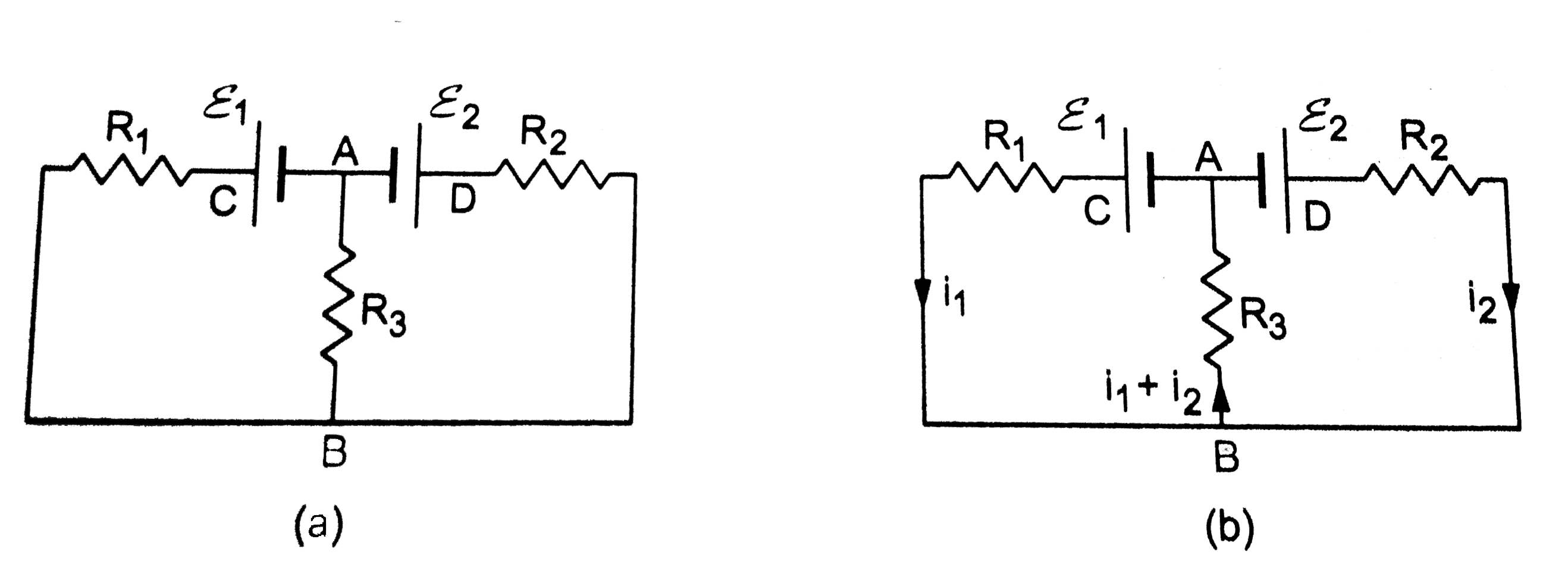
Find the currents going through the three resistors `R_(1),R_(2)` and `R_(3)` in the circuit of figure.

Text Solution

Verified by Experts

Lets us take the potential of the point A to be zero. The potential at C will be (epsilon)_(1)and that at D will be `(epsilon)_(2)`.Let the potential at B be V . The currents through the three resistors are `i_(1),i_(2)and i_(1)+i_(2)`as shown in figure. Note that the current directed towards B equals the current directed away from B.
Applying Ohm's law to the three resistors `R_(1),R_(2)and R_(3),`
we get,
`(epsilon)_(1)-V=R_(1)i_(1) ...(i)`
`(epsilon)_(2)-V=R_(2)i_(2) ...(ii)`
`and V-0=R_(3)(i_(1)+I_(2)). ...(iii)`
Adding (i) and (iii),
`(epsilon)_(1)=R_(1)i_(1)+R_(3)(i_(1)+i_(2))`
`=(R_(1)+R_(3))i_(1)+R_(3)i_(2) ...(iv)`
`and adding (ii)and (iii)`
`(epsilon)_(2)=R_(2)i_(2)+R_(3)(i_(1)+I_(2))`
`=(R_(2)+R_(3))i_(2)+R_(3)i_(1). ...(v)`
Equations (iv) and (v) may be directly written from Kirchhoff's loop applied to the left half and the right half of the circuit.
Multiply (iv)by `(R_(2)+R_(3)), (v) by R_(3) and subtract to eliminate i_(2)`.This gives
`i_(1)=((epsilon_(1)(R_(2)+R_(3))-(epsilon_(2)R_(3))/(R_(1)+R_(3))(R_(2)+R_(3))-R_(3)^(2)).`
`((epsilon_1)(R_(2)+R_(3))-(epsilon_2)R_(3))/(R_(1)R_(2)+R_(2)R_(3)+R_(3)R_(1)).`
Similarly, eliminating `i_(1)`from (iv) and (v) we obtain,
`i_(2)=((epsilon_2)(R_(1)+R_(3))-(epsilon_1)R_(3))/(R_(1)R_(2)+R_(2)R_(3)+R_(3)R_(1))`
`And so`
`i_(1)+i_(2)=((epsilon_(1))R_(2)+(epsilon_(2)R_(1))/(R_(1)R_(2)+R_(2)R_(3)+R_(3)R_(1)).`
Promotional Banner

Topper's Solved these Questions

  • ELECTRIC CURRENT IN CONDUCTORS

    HC VERMA ENGLISH|Exercise Objective 1|15 Videos
  • ELECTRIC CURRENT IN CONDUCTORS

    HC VERMA ENGLISH|Exercise objective 2|9 Videos
  • ELECTRIC CURRENT IN CONDUCTORS

    HC VERMA ENGLISH|Exercise questions for short answer|17 Videos
  • DISPERSION AND SPECTRA

    HC VERMA ENGLISH|Exercise Question for short Answer|6 Videos
  • ELECTRIC CURRENT THROUGH GASES

    HC VERMA ENGLISH|Exercise Short answer|6 Videos

Similar Questions

Explore conceptually related problems

In the circuit shown below, E_(1)=17V,E_(2)=21V,R_(1)=2Omega,R_(2)=3Omega and R_(3)=5Omega . Using Kirchhoff.s laws, find the currents flowing through the resistors R_(1),R_(2) and R_(3) . (Internal resistance of each of the batteries is negligible.)

Find the current through resistor R.

Find the currents through the three resistors shown in Figure

Find the current through resistor R

Find R_(AB) in the circuit shown in figure.

The circuit is shown in the following figure. The potential at points A, B, C, D and O are given. The currents in the resistance R_(1), R_(2) and R_(3) are in the ratio of 4:2:1 . What is the ratio of resistance R_(1),R_(2),R_(3) and R_(4) ?

The current in the resistor R_3 in the circuit as shown in the figure is

Find the current through 4Omega resistor in the circuit shown in figure.

In the circuit diagram given below, three resistors R_(1),R_(2) , and R_(3) of 5 Omega, 10 Omega and 30 Omega , respectively are connected as shown. Calculate: (a) current through each resistor. (b) total current in the circuit. (c) total resistance in the circuit.

Figure shows an L-R circuit. When the switch S is closed, the current through resistor R_(1), R_(2) and l_(3) are l_(1), l_(2) and l_(3) respectively. The value of l_(1), l_(2) and l_(3) at t=0 s is

HC VERMA ENGLISH-ELECTRIC CURRENT IN CONDUCTORS-worked out Example
  1. Find the effective resistance between the points A and B in figure.

    Text Solution

    |

  2. Find the equivalent resistance of the network shown in figure between ...

    Text Solution

    |

  3. Find the equivalent resistance between the point a and b .

    Text Solution

    |

  4. Find the equivalent resistances of the nerwork shown in figure between...

    Text Solution

    |

  5. In the circuit shown in figure E,F, G and H are cell of emf 2,1,3, and...

    Text Solution

    |

  6. Find the equivalent resistance between the point a and b of the circui...

    Text Solution

    |

  7. Find the currents going through the three resistors R(1),R(2) and R(3)...

    Text Solution

    |

  8. Find the equivalent resistances between the points a and c of the netw...

    Text Solution

    |

  9. Twelve wire, each having resistance r, are joined to form a cube as sh...

    Text Solution

    |

  10. Find the equivalent resistance of the circuit of the previous problen ...

    Text Solution

    |

  11. Find the equivalent resistance between thepoints a and b of the infini...

    Text Solution

    |

  12. Find the equivalent resistance of the network shown in figure between ...

    Text Solution

    |

  13. (a)Find the current I supplied by the battery in the network shown in ...

    Text Solution

    |

  14. A part of a circuit in steady state along with the currents flowing in...

    Text Solution

    |

  15. (a)find the potential drops across the two resistors shown in figure. ...

    Text Solution

    |

  16. A galvanometer has a xoil of resistance 100(Omega)showing a full-scale...

    Text Solution

    |

  17. The electric field between the plates of a parallel-plate capacitor of...

    Text Solution

    |

  18. A capacitor is connected to a 12 V battery through a resistance of (10...

    Text Solution

    |

  19. A capacitor charged to 50 V is discharged by connecting the two plates...

    Text Solution

    |

  20. A 5.0(mu)F capacitor having a charge of (20 (mu)C)is discharged throug...

    Text Solution

    |
