Home
Class 12
CHEMISTRY
Decomposition of NH(4)NO(2)(aq into N(2)...

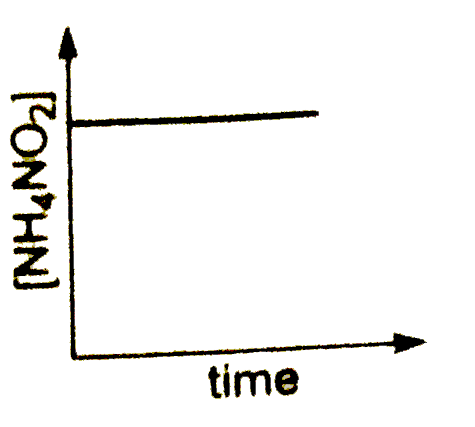
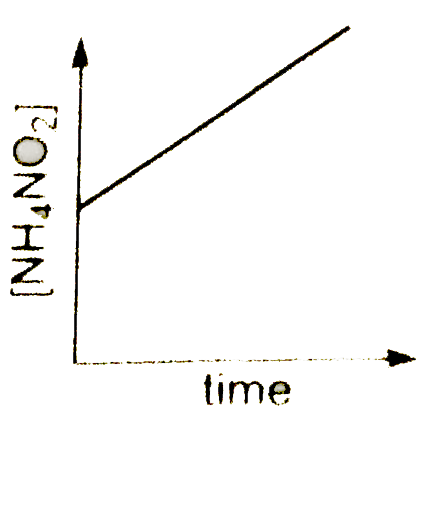
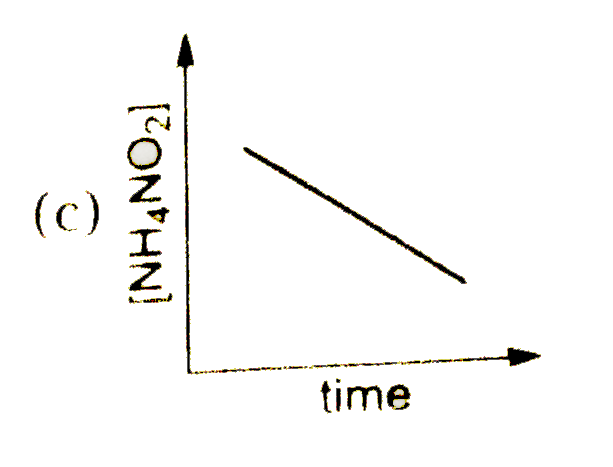
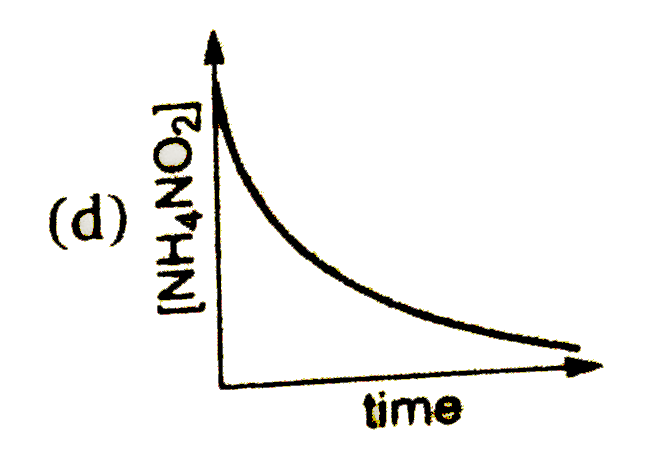
Decomposition of `NH_(4)NO_(2)(aq` into `N_(2)(g)` and `2H_(2)O(l)` is first order reaction.

A

B

C

D

Text Solution

AI Generated Solution

The correct Answer is:

To analyze the decomposition of NH₄NO₂ into N₂ and H₂O as a first-order reaction, we can follow these steps: ### Step 1: Write the Reaction The decomposition reaction can be written as: \[ \text{NH}_4\text{NO}_2 (aq) \rightarrow \text{N}_2 (g) + 2\text{H}_2\text{O} (l) \] ### Step 2: Identify the Order of the Reaction The problem states that this reaction is a first-order reaction. In first-order reactions, the rate of reaction is directly proportional to the concentration of one reactant. ### Step 3: Write the Integrated Rate Law for a First-Order Reaction For a first-order reaction, the integrated rate law is given by: \[ \ln[A] = \ln[A_0] - kt \] Where: - \([A]\) is the concentration of the reactant at time \(t\). - \([A_0]\) is the initial concentration of the reactant. - \(k\) is the rate constant. - \(t\) is the time. ### Step 4: Rearranging the Equation We can rearrange the equation to express it in the form of \(y = mx + b\): \[ \ln[A] = -kt + \ln[A_0] \] This indicates that if we plot \(\ln[A]\) (y-axis) against time \(t\) (x-axis), we will get a straight line with a slope of \(-k\) and a y-intercept of \(\ln[A_0]\). ### Step 5: Graphical Representation In a first-order reaction, the graph of \(\ln[A]\) versus time will be a straight line that slopes downwards, indicating that as time increases, the concentration of the reactant decreases exponentially. ### Step 6: Conclusion Based on the analysis, we can conclude that the correct graph representing the first-order decomposition of NH₄NO₂ is the one that shows a downward slope when plotting \(\ln[A]\) against time.
Promotional Banner

Similar Questions

Explore conceptually related problems

The gas phase reaction 2NO_(2)(g) rarr N_(2)O_(4)(g) is an exothermic reaction. The decomposition of N_(2)O_(4) in equilibrium mixture of NO_(2)(g) and N_(2)O_(4) can be increased by :

NH_(4)NO_(3) overset(Delta) to N_(2)O+H_(2)O

NH_(4)NO_(3) overset(Delta) to N_(2)O+H_(2)O

The molar heat of formation of NH_(4)NO_(3)(s) is -367.54kJ and those of N_(2)O(g) and H_(2)O(l) are +81.46kJ and -285.80kJ , respectively, at 25^(@)C and 1atm . Calculate DeltaH and DeltaU for the reaction. NH_(4)NO_(3)(s) rarr N_(2)O(g) +2H_(2)O(l)

The molar heat of formation of NH_(4)NO_(3)(s) is -367.5kJ and those of N_(2)O(g) and H_(2)O(l) are +81.46kJ and -285.78kJ respectively at 25^(@)C and 1 atmospheric pressure. Calculate the DeltaH and DeltaU for the reaction, NH_(4)NO_(3)(s)toN_(2)O(g)+2H_(2)O(l)

Decomposition of H_(2)O_(2) is retarded by : 2H_(2)O_(2)(l) rarr 2H_(2)O(l)+O_(2)(g)

The ratio of coefficient of HNO_(3), Fe(NO_(3))_(2) and NH_(4)NO_(3) in the following redox reaction Fe + HNO_(3) rarr Fe (NO_(3))_(2) + NH_(4)NO_(3) + H_(2)O are respectively

The half-life of first order decomposition of NH_(4)NO_(3) is 2.10 hr at 288 K temperature NH_(4)NO_(3)(aq)toN_(2)O(g)+2H_(2)O(l) . If 6.2 of NH_(4)NO_(3) is allowed to decompose, the required for NH_(4)NO_(3) to decompose 90 % is :

The reaction: NH_(2)CN(s) +(3)/(2)O_(2)(g)rarr N_(2)(g) +CO_(2)(g) +H_(2)O(l) Was carried out in a bomb caloriemeter. The heat released was 743 kJ mol^(-1) . The value of DeltaH_(300K) for this reaction would be

N_(2)+3H_(2)rarr2NH_(3) . 1 mol N_(2) and 4 mol H_(2) are taken in 15L flask at 27^(@)C After complete conversion of N_(2) into NH_(3),5L of H_(2)O is added. pressure set up in the flask is:
