Home
Class 12
CHEMISTRY
If decompositon reaction A(g)toB(g) foll...

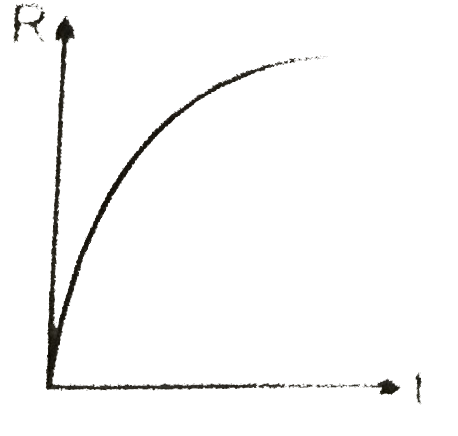
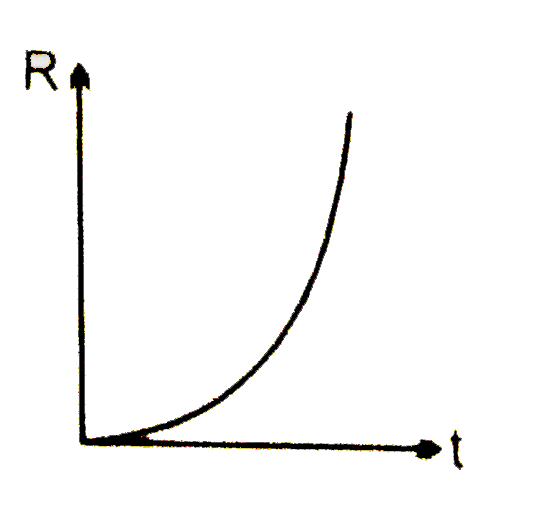
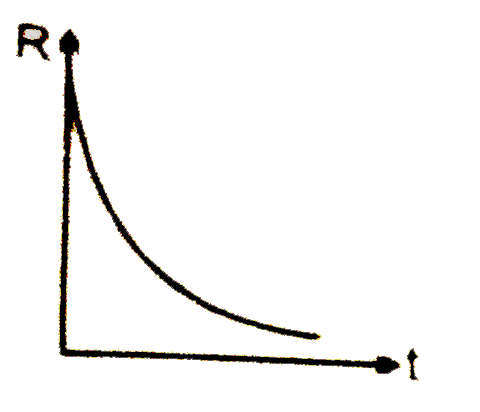
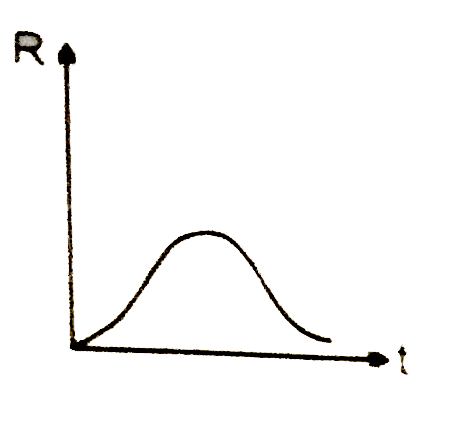
If decompositon reaction `A(g)toB(g) follows first order linetics then the graph of rate of formation (R ) of B against time t will be :

A

B

C

D

Text Solution

AI Generated Solution

The correct Answer is:

To solve the problem, we need to analyze the decomposition reaction \( A(g) \to B(g) \) that follows first-order kinetics. We want to determine the graph of the rate of formation of \( B \) against time \( t \). ### Step-by-Step Solution: 1. **Understanding First-Order Kinetics**: - For a first-order reaction, the rate of reaction is directly proportional to the concentration of the reactant. This can be expressed mathematically as: \[ -\frac{d[A]}{dt} = k[A] \] - Here, \( k \) is the rate constant, and \( [A] \) is the concentration of \( A \). 2. **Relating the Formation of B**: - The rate of formation of \( B \) is equal to the rate of consumption of \( A \): \[ \frac{d[B]}{dt} = -\frac{d[A]}{dt} \] - Therefore, we can write: \[ \frac{d[B]}{dt} = k[A] \] 3. **Expressing Concentration of A**: - For a first-order reaction, the concentration of \( A \) at any time \( t \) can be expressed as: \[ [A] = [A_0] e^{-kt} \] - Here, \( [A_0] \) is the initial concentration of \( A \). 4. **Substituting into the Rate Equation**: - Substituting the expression for \( [A] \) into the rate of formation of \( B \): \[ \frac{d[B]}{dt} = k[A_0] e^{-kt} \] - This shows that the rate of formation of \( B \) is also an exponential function of time. 5. **Graphing the Rate of Formation**: - The equation \( \frac{d[B]}{dt} = k[A_0] e^{-kt} \) indicates that the rate of formation of \( B \) decreases exponentially over time. - Therefore, if we plot the rate of formation of \( B \) (on the y-axis) against time \( t \) (on the x-axis), we will get a graph that starts at a maximum value (when \( t = 0 \)) and decreases towards zero as time progresses. ### Conclusion: The graph of the rate of formation of \( B \) against time \( t \) will be an exponential decay curve.
Promotional Banner

Similar Questions

Explore conceptually related problems

A radioactiev nuleus X deays to a stable nuleus Y . Then, time graph of rate of formation of Y against time t will be:

Reaction AtoB follows second order kinetics. Doubling the concentration of A wil increase the rate of formation of B by a factor of :

Consider a first order gas phase decomposition reaction given below: A (g) to B(g) +C(g) The initial pressure of the system before decomposition of A was pi. After lapse of time 'T', total pressure of the system increased by x units and became ' p_t '. The rate constant k for the reaction is given as

The rate of decomposition of NH_(3)(g) at 10 atm on platinum surface is zero order . What is rate of formation (in M min^(-1) ) of H_(2) (g) , if rate constant of reaction 2NH_(3(g)) to N_(2)(g) +3H_(2)(g) is 2.0 M min^(-1) ?

The decomposition of a gaseous substance A yields gaseous products as shown, A(g) to 2 B(g) + C(g) . This reaction follows first order kinetics. If the total pressure at the start of the experiment & 9 minutes after the start are 169 mm and 221 mm, what is the value of rate constant?

Consider a first order gas phase decompostion reaction gives below A(g) to B(g) to C(g) The initial pressure of the system before decomposition of A p_(i) . After lapse of time 't' total pressure of the system increased by x units and became p_(t) . The rate constant K for the reaction is given as....... .

Consider a first order gas phase decomposition reaction given below: A(g) to B_(g) + C_(g) The initial pressure of the system before decomposition of A was p_(i) . After lapse of time t' . Total pressure of the system increased by x units and became P_(t) . the rate constant k for the reaction is given as

A reaction in which reactants (R ) are converted into products (P) follows second order kinetics. If concentration of R is increased by four times, what will be the increase in the rate formation of p?
