Home
Class 12
CHEMISTRY
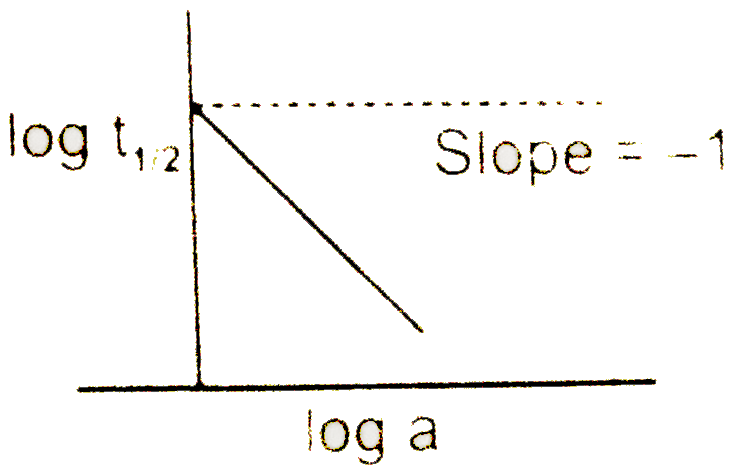
A graph between log t((1)/(2)) and log a...

A graph between `log t_((1)/(2))` and log a (abscissa), a being the initial concentration of A in the reaction For reaction `Ato`Product, the rate law is :

A

`-(d[A])/(dt)=K`

B

`-(d[A])/(dt)=K[A]`

C

`-(d[A])/(dt)=K[A]^(2)`

D

`-(d[A])/(dt)=K[A]^(3)`

Text Solution

Verified by Experts

The correct Answer is:

C
Promotional Banner

Similar Questions

Explore conceptually related problems

Following is the graph between log t_(1//2) and log a ( a initial concentration) for a given reaction at 300K Find the order of reaction.

Following is the graph between log T_(50) and log a ( a = initial concentration) for a given reaction at 27^(@)C . Hence order is

The graph between log t_(1//2) and log a at a given temperature is Rate of this reaction will …….with passage of time

A graph plotted between log t_((1)/(2)) vs log concentration is a straight line. What is your conclusion? [Given : n = order of reaction]

Plotting log_(10)t_(1//2) against log _(10)[A_0] (where A_0 is the initial concentration of a reactant) for a fist order reaction the slope will be

For zero order reaction , t_(1//2) will be ( A_0 is the initial concentration , K is rate constant)

In a reaction A + B to Products (i) If the initial concentration of A is doubled and B is kept constant, the rate of the reaction is doubled (ii) If the initial concentration both A and B are doubled the rate of reaction becomes eight times The rate law of the reaction is :

For the reaction A + B rarr C + D , doubling the concentration of both the reactants increases the reaction rate by 8 times and doubling the initial concentration of only B ismply doubles the reaction rate. What is the rate law for the reaction ?

The graph of t_(1//2) versus initial concentration 'a' is for

For the reaction A + B products, it is observed that: (1) on doubling the initial concentration of A only, the rate of reaction is also doubled and (2) on doubling te initial concentration of both A and B , there is a charge by a factor of 8 in the rate of the reaction. The rate of this reaction is given by
